
Your thoughts circle back to one person, again and again. Your mood soars with a simple message from them, only to plummet when they seem distant. If this intense, all-consuming focus feels more like an obsession than a simple crush, leaving you feeling out of control and exhausted, please know you are not alone. This powerful and often overwhelming emotional state has a name: limerence.
It can be a deeply isolating experience, making you question your own feelings and sanity. But you don’t have to navigate this journey by yourself. This compassionate guide is here to offer clarity and support. We will gently explore what limerence is, understand why it feels so powerful, and distinguish it from the foundations of a grounded, loving connection. Together, we’ll walk through supportive, actionable steps you can take to regain your emotional balance and find your way back to yourself.
Key Takeaways
- Understand the difference between intense love and the involuntary, obsessive state of limerence to gain clarity on your feelings.
- Recognise the common signs and stages of this experience, helping you map out where you are on your emotional journey.
- Gently explore the potential underlying reasons for these powerful feelings, which are often linked to unmet needs and personal history.
- Discover supportive, practical steps to manage obsessive thoughts and begin your path towards emotional balance and freedom.
Understanding Limerence: When a Crush Becomes an Obsession
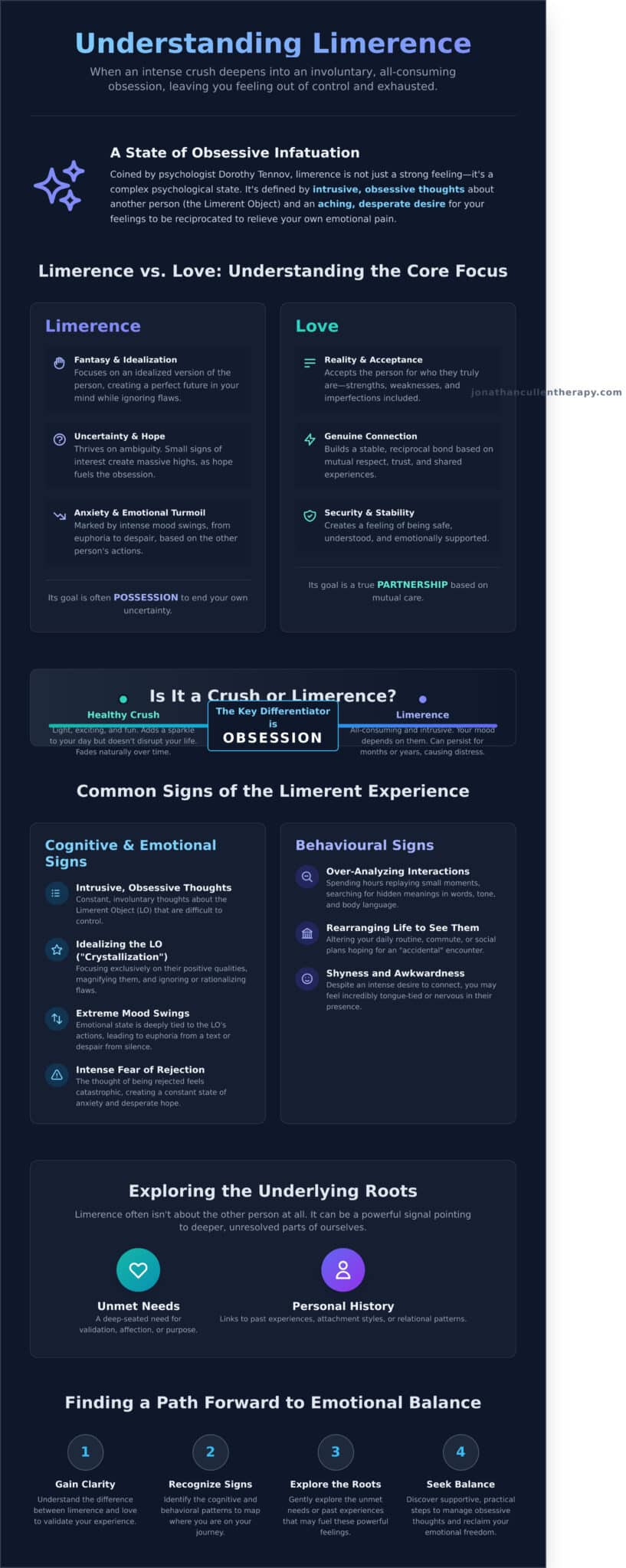
If you’ve found your way here, it’s likely because you’re experiencing feelings so intense they feel overwhelming and all-consuming. It’s important to know that you are not alone in this, and what you’re feeling has a name: limerence. Coined by psychologist Dorothy Tennov in the 1970s, limerence describes an involuntary state of profound, obsessive infatuation with another person. This isn’t a personal failing or a simple crush gone wild; it is a complex psychological state characterised by intrusive thoughts and an aching, desperate desire for your feelings to be reciprocated. The complete definition of limerence highlights this deep need for validation from the other person, often called the Limerent Object (LO).
Limerence vs. Love: Key Differences
While both feel powerful, the focus of limerence is fundamentally different from that of grounded, healthy love. Love is built on a genuine, mutual connection and a deep concern for the other person’s happiness and well-being. In contrast, limerence is primarily focused on winning the other person’s affection to end your own painful uncertainty and anxiety. Love is about partnership, whereas limerence is about possession.
In Limerence, the focus is on:
- Fantasy: Idealising the person and imagining a perfect future.
- Uncertainty: Thriving on hope and small signs of interest.
- Anxiety: Experiencing intense emotional highs and lows.
In Love, the focus is on:
- Reality: Accepting the person for who they are, flaws and all.
- Connection: Building a genuine, reciprocal bond.
- Security: Feeling safe, stable, and understood.
Is it Limerence or Just a Healthy Crush?
It’s natural to develop crushes, which are often light, exciting, and fun. They add a little sparkle to your day but don’t typically disrupt your life. Limerence, however, is far more consuming. A crush might make you daydream, but limerence can prevent you from focusing on work, hobbies, and other relationships. While a crush tends to fade naturally over time, a limerent episode can persist for months or even years, causing significant emotional distress. The key differentiator is obsession; if your thoughts are intrusive and your mood depends entirely on the other person’s actions, you may be experiencing something deeper than a simple crush.
The Common Signs and Symptoms of Limerence
If you’re feeling overwhelmed by an intense and all-consuming focus on someone, it can be a confusing and isolating experience. Understanding the common signs of limerence can offer a sense of clarity. Please remember, this is not a clinical diagnosis but a guide to help you reflect on your experience. The central figure in these feelings is often called the ‘Limerent Object’ or LO.
It’s not about ticking boxes; the key is the intensity of these feelings, how long they last, and the disruptive impact they have on your daily life.
Cognitive and Emotional Signs
The internal experience of limerence is often the most powerful and demanding part. It can feel like your thoughts and emotions are no longer entirely your own. You might recognise some of the following:
- Intrusive, obsessive thoughts about the LO. Your mind feels occupied by constant, involuntary thoughts about them. It can be difficult to focus on work, hobbies, or even simple conversations because your thoughts always drift back to the LO.
- Idealising the LO. You may find yourself focusing exclusively on the LO’s positive qualities, magnifying them while ignoring or rationalising their flaws. This process, sometimes called ‘crystallization’, places them on an impossibly high pedestal.
- Mood swings dependent on the LO’s actions. Your emotional state becomes deeply tied to their perceived feelings. A kind word or a text message can lead to euphoria, while perceived indifference or a delayed reply can cause deep despair.
- An intense fear of rejection. The thought of being rejected by the LO feels more than just disappointing-it feels catastrophic. This can create a constant state of anxiety and a desperate hope for reciprocation.
Behavioural Signs
These intense internal feelings often translate into specific actions and behaviours that are driven by the need for connection with, and validation from, the Limerent Object.
- Replaying and over-analysing interactions. You may spend hours replaying every small moment spent with the LO, searching for hidden meanings in their words, body language, or tone of voice.
- Rearranging your life to see the LO. You might change your daily routine, commute, or social plans in the hope of creating an ‘accidental’ encounter with them.
- Shyness and awkwardness around the LO. Despite the intense desire to be near them, you may feel incredibly shy, awkward, or tongue-tied in their presence due to overwhelming anxiety and the fear of saying the wrong thing.
- Losing interest in other activities. Your focus on the LO becomes so consuming that other important areas of your life, such as friendships, family, work, and personal hobbies, start to feel less important or are neglected.
Experiencing one or two of these signs might simply point to a strong crush. However, when these patterns combine to create a persistent and distressing cycle, it may be something more. Recognizing this is the first step toward understanding what you are going through. Exploring the full spectrum of the symptoms and treatment of limerence can provide further valuable insight. Remember, understanding is the beginning of finding a path forward.
The Three Stages of the Limerent Experience
If you’re in the grip of limerence, the experience can feel chaotic and all-consuming. However, it often follows a predictable, though not always linear, path. Thinking of these stages as a map can help you understand where you are in your journey. This structure isn’t meant to confine your experience, but to demystify it, making it feel more manageable. Understanding this pattern is a powerful first step toward navigating these intense emotions and finding your footing again.
Stage 1: Infatuation
This is where it all begins-the initial spark. You meet someone, and a simple attraction quickly deepens. Your Limerent Object (LO) starts to occupy your thoughts more frequently, and you find yourself replaying conversations or imagining future interactions. This stage is often filled with a hopeful, exhilarating energy, driven by the exciting possibility that your feelings might be returned.
Stage 2: Crystallization
Here, the infatuation intensifies into a powerful obsession. This is the peak of the limerent experience, where you begin to ‘crystallize’ your LO, magnifying their positive qualities while minimising or completely ignoring any flaws. Your emotional state becomes a rollercoaster, soaring with the smallest sign of hope and crashing with perceived rejection. The intense focus on the LO and the uncertainty of reciprocation are central to the psychological aspects of limerence during this phase.
Stage 3: Deterioration
This final stage begins when the fantasy can no longer be sustained. This might happen because the LO has clearly rejected you, entered a relationship with someone else, or a reality check shatters your idealised image of them. The emotional high of crystallization gives way to despair, anger, or profound sadness. While painful, this stage is also where the intrusive thoughts can begin to fade, leading toward resolution, acceptance, or sometimes, a feeling of numb apathy as the intensity finally subsides.
Why Does Limerence Happen? Exploring the Underlying Roots
Understanding the intense, all-consuming nature of limerence often leads to a crucial question: why is this happening to me? While there is no single answer, exploring the potential roots can be a powerful step toward self-compassion and healing. It’s important to remember these are not definitive causes but common contributing factors that can create a vulnerability to this experience. Unpacking them can help make sense of the emotional storm.
Often, the seeds of limerence are sown in our earliest experiences and personal wiring. Let’s gently explore some of the common underlying themes.
Attachment Styles and Unmet Needs
Our early attachment patterns-the way we learned to connect with caregivers-can create a blueprint for our adult relationships. Individuals with an anxious attachment style, who may fear abandonment and crave deep intimacy, can be more susceptible. Limerence can feel like the ultimate answer to a lifetime of unmet emotional needs, offering a fantasy of a perfect, all-encompassing connection that promises to finally make you feel secure and whole.
The Link to Neurodivergence (ADHD & Autism)
For some, neurodivergent traits can play a significant role. If you have ADHD, your brain’s tendency to hyperfocus can latch onto a person with the same intensity it might apply to a new project or hobby. Compounded by Rejection Sensitive Dysphoria (RSD)-an intense emotional pain in response to perceived rejection-the stakes can feel incredibly high, fuelling the obsessive cycle of seeking validation from your Limerent Object (LO).
Past Experiences and Self-Esteem
Difficult past relationships or unresolved trauma can leave us with a deep sense of unworthiness. When self-esteem is low, the validation of an LO can feel like a lifeline. The fantasy becomes a comforting escape from present-day pain or the echoes of past hurt. The intense hope for reciprocation is not just about the other person; it’s about a deep, human need to feel seen, valued, and finally, good enough.
Understanding these roots is a profound first step. If these themes resonate with you, know that you don’t have to navigate them alone. Exploring your unique story in a supportive, non-judgmental space can help you find a more grounded and fulfilling way to connect. You can learn more about working together at jonathancullentherapy.com.
Finding a Path Forward: Healthy Ways to Cope with Limerence
Navigating the powerful feelings that come with limerence can feel isolating and overwhelming. The journey toward emotional freedom isn’t about fighting or suppressing these intense emotions, but about understanding them with compassion. It’s a process of gently redirecting your focus back towards yourself and building a life that feels whole and fulfilling on its own terms.
Taking small, supportive steps can help you regain your sense of balance and personal power. Remember to be kind to yourself as you begin this journey.
Step 1: Acknowledge and Accept Without Judgment
The first and most courageous step is to simply name your experience: “This is limerence.” Acknowledging it without shame or self-blame removes its power. These feelings are not a reflection of your worth. Practice self-compassion by reminding yourself that you are human and deserving of kindness, especially from yourself. Mindfulness can be a valuable tool here, helping you observe the intrusive thoughts and intense emotions without getting swept away by them.
Step 2: Shift Focus from Fantasy to Reality
Limerence thrives on an idealised fantasy. Gently begin to challenge this image by acknowledging that your limerent object (LO) is a whole, complex person with flaws, just like anyone else. To break the cycle of hope and reinforcement, it is often necessary to limit or cut contact (often called ‘No Contact’). This isn’t a punishment, but a compassionate boundary you set for your own well-being. Use this new space to reinvest your energy back into your own life-reconnect with hobbies, nurture your friendships, and set meaningful personal goals.
Step 3: Seek Professional Support
Exploring these deep-seated feelings with a professional can be incredibly healing. A therapist provides a warm, confidential, and non-judgmental space to unpack what you are going through. Together, you can explore the possible roots of these patterns, which are often linked to attachment styles, past experiences, or low self-esteem. Therapy is a collaborative process where you can learn grounded coping strategies and build a stronger connection to yourself.
You don’t have to navigate this alone. Learn more about how individual therapy can support you on your journey.
Moving Forward with Clarity and Compassion
Understanding limerence is the first powerful step toward loosening its grip. By recognising that these intense, obsessive feelings are a distinct psychological experience-not just a powerful crush-you can begin to reclaim your focus. Knowing the signs and stages empowers you to navigate this challenging emotional state with greater awareness and self-compassion, paving the way for healthier coping strategies.
If these intense emotions feel overwhelming, please know you don’t have to face them alone. I provide a warm, non-judgmental, and confidential space to explore what you’re going through. My approach to therapy honours your unique story and is grounded in an ADHD-informed perspective, which can be particularly helpful for understanding intense emotional states.
If these feelings are impacting your life, support is available. Reach out to start your journey. Taking this step is a courageous move toward building more grounded and fulfilling connections.
Frequently Asked Questions About Limerence
Can limerence ever turn into a healthy, loving relationship?
It is possible, though it requires a significant shift. Limerence thrives on idealisation, whereas genuine love is built on accepting a person’s whole, authentic self. For the connection to evolve, the fantasy must give way to reality. This happens when genuine, mutual affection is established and both people commit to building a bond based on trust and understanding, rather than obsessive highs. The journey is one of moving from idealisation to true connection.
How long does limerence typically last?
The duration varies widely, but it often lasts from a few months to a few years. The psychologist who first defined the state, Dorothy Tennov, suggested an average of around three years. This timeframe can be extended by “breadcrumbs” or intermittent signs of hope from the object of affection. Conversely, establishing firm ‘no contact’ or receiving a clear and final rejection can help shorten the duration, although the emotional recovery still takes time and care.
Is limerence considered a mental health disorder?
Limerence is not officially classified as a mental health disorder in diagnostic manuals like the DSM-5. It is better understood as an intense psychological state involving obsessive thoughts and emotional dependency. However, its symptoms can feel overwhelming and often overlap with conditions like OCD or addiction. If your experience with limerence is causing you significant distress or disrupting your life, seeking compassionate support from a therapist can be an incredibly helpful step toward healing.
Why is the uncertainty in limerence so addictive?
The uncertainty creates a powerful psychological hook known as intermittent reinforcement-the same principle that makes gambling so compelling. Because you don’t know when a “reward” (like a text, a smile, or a kind word) will come, your brain stays on high alert. Each small sign of hope delivers a potent hit of dopamine, a pleasure chemical. This unpredictable cycle of hope and longing creates an addictive loop that can feel impossible to escape.
What should I do if my Limerent Object is a friend or coworker I can’t avoid?
This is a deeply challenging situation that calls for creating emotional distance, even if you can’t create physical distance. Focus on setting firm internal boundaries. Keep necessary interactions brief, professional, and focused on the task at hand. When you notice your thoughts drifting into fantasy, gently but firmly redirect them. Investing your time and energy into your own hobbies, other friendships, and personal goals will help you reclaim your focus and sense of self.
Can you experience limerence for more than one person at a time?
Typically, no. A defining feature of the experience is its singular, all-consuming focus on one person. The obsessive nature of the state makes it very difficult for the mind to divide that intense energy between multiple people. While it’s possible for the focus of the limerence to transfer from one person to another, experiencing a full-blown limerent episode for two or more people simultaneously is considered extremely rare. The state almost always demands a single focus.