
If you’re starting to explore therapy, the sheer number of different approaches can feel overwhelming. CBT, psychodynamic, person-centred… it’s easy to get lost in the terminology and worry about being forced into a rigid, one-size-fits-all box. What if you choose the ‘wrong’ kind of therapy? This is a common and understandable fear, but it’s one you don’t have to navigate alone.
This is where a more flexible, human-centred approach can offer reassurance. If you’ve been asking what is integrative psychotherapy, you’re asking about a way of working that puts you, and your individual experience, at the very heart of the process. It isn’t a single, rigid method; it’s a compassionate philosophy that thoughtfully combines different therapeutic tools to create a space that truly fits you.
In this gentle guide, we will explore how this down-to-earth approach works. You’ll come away with a clear understanding of how therapy can be a supportive, collaborative journey that honours your unique story, helping you feel more confident and grounded as you take the next step.
Key Takeaways
- Discover how integrative therapy moves beyond a one-size-fits-all model by blending different tools to honour your unique story.
- Understand what is integrative therapy in a real-world session, focusing on a warm, collaborative relationship rather than a rigid set of rules.
- Learn the core principles that guide this flexible approach, ensuring your therapy is both personalised and grounded in a solid, ethical framework.
- Identify the key signs that suggest an integrative approach could be the most supportive and effective path for your personal healing journey.
Decoding ‘Integrative’: More Than a Single Approach to Therapy
When you’re exploring your options for support, you might wonder, what is integrative psychotherapy? At its heart, it’s a compassionate and flexible way of working that combines effective, evidence-based elements from different therapeutic models. The core philosophy is simple but powerful: no single theory holds all the answers to the complexities of human experience.
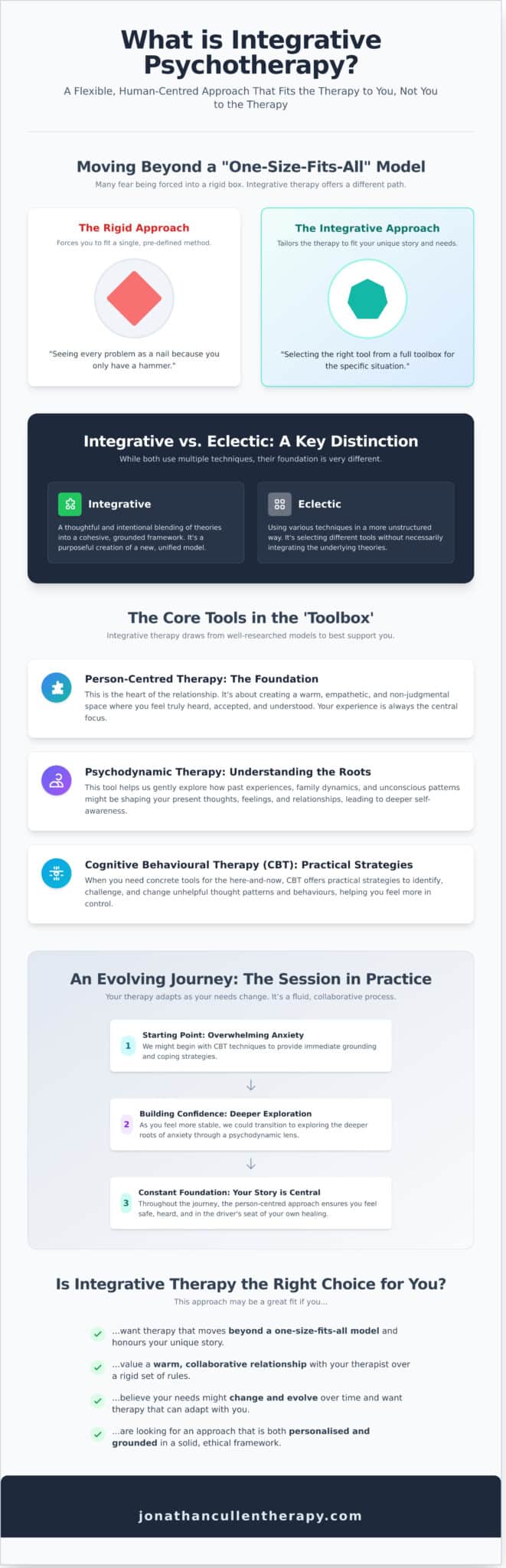
Think of it like a skilled craftsperson. While someone with only a hammer sees every problem as a nail, an integrative therapist has a full toolbox. They can select the right tool-whether it’s from humanistic, psychodynamic, or cognitive-behavioural traditions-that best suits the specific situation and, most importantly, you. This stands in contrast to single-modality therapies, which follow one specific framework. The goal here is to fit the therapy to you, not to ask you to fit into a pre-defined therapeutic box. This approach honours your unique story and acknowledges that your needs may change throughout our journey together.
The Problem with a ‘One-Size-Fits-All’ Approach
You are a unique individual with a complex inner world and a one-of-a-kind life story. A rigid, one-size-fits-all method may not fully address all the different aspects of what you’re going through. Different challenges often require different kinds of support, and a flexible approach ensures that we can find the most helpful way to explore your thoughts, feelings, and behaviours in a safe, non-judgmental space.
Integrative Psychotherapy vs. Eclectic Therapy
It’s important to understand that ‘integrative’ is not the same as ‘eclectic’. While eclectic therapy might involve using various techniques in a more unstructured way, Integrative psychotherapy involves a thoughtful and intentional blending of different psychological theories into a cohesive and grounded framework. This ensures the approach is not random but is built on a solid theoretical foundation, providing a coherent and deeply considered path to support your wellbeing.
What Does an Integrative Therapy Session Actually Look Like?
Stepping into a therapy room for the first time can feel daunting. You might be wondering what to expect, especially with an approach that sounds so broad. The simple answer to what is integrative therapy in practice is that it looks like whatever you need it to be. While every session is as unique as you are, they are all built on the same foundation: a warm, non-judgmental, and supportive relationship where you feel safe to explore what’s on your mind.
Think of it not as a rigid procedure, but as a collaborative conversation. We move at your pace, focusing on your goals and what feels most helpful to you in the moment.
The Therapist’s Flexible ‘Toolbox’
An integrative therapist draws from a ‘toolbox’ of different, well-researched therapeutic models. We don’t believe in a one-size-fits-all solution. Instead, we select and blend approaches to honour your unique story. Some core tools include:
- Person-Centred Therapy: This is the foundation. It’s all about creating a relationship built on empathy, warmth, and unconditional positive regard, ensuring you feel truly heard and accepted.
- Psychodynamic Therapy: We might gently use these ideas to explore how past experiences or family dynamics could be shaping your present thoughts and feelings, helping to uncover underlying patterns.
- Cognitive Behavioural Therapy (CBT): When you need practical strategies, we can draw on CBT to offer concrete tools for managing challenging thoughts, feelings, and behaviours right now.
A Journey That Adapts and Evolves With You
Your needs can change from week to week, and your therapy should change with you. For instance, you might come to therapy feeling overwhelmed by anxiety. In our initial sessions, we could focus on CBT-informed techniques to help you feel more grounded and in control. As you build confidence, we might transition to exploring the deeper roots of that anxiety, perhaps looking at past events through a psychodynamic lens. The journey is fluid and always guided by you.
Your Story is Always at the Centre
Ultimately, all the theories and techniques are secondary to your personal experience. My primary role is to listen deeply and understand your world from your perspective. This collaborative process is empowering; it puts you in the driver’s seat of your own healing. This person-first focus is central to why evidence suggests that Integrative Psychotherapy Works, because it honours you as the true expert on your own life. Together, we find the path forward that feels right for you.
The Core Principles of the Integrative Approach
At its heart, integrative psychotherapy is more than just a collection of techniques; it is a philosophy built upon a coherent and ethical framework. It moves away from a rigid, one-size-fits-all model and instead embraces a set of core values that place you, the client, at the centre of the therapeutic journey. The ultimate goal is not simply to treat symptoms, but to foster a deeper sense of wholeness and self-understanding.
Understanding what is integrative therapy means appreciating these guiding principles, which ensure the work is both compassionate and effective.
Honouring Your Unique Experience
Integrative therapy honours your unique story. It recognises that your life experiences, personality, cultural background, and personal values have shaped who you are today. Rather than trying to fit you into a predefined therapeutic box, the therapy is tailored specifically to your individual needs and goals. An integrative therapist works collaboratively with you to understand your personal worldview, respecting you as the foremost expert on your own life.
A Holistic View of Wellbeing
This approach takes a holistic view of you as a person, considering the intricate connections between your thoughts, feelings, behaviours, and even your physical sensations. It acknowledges that your mind, body, and emotions are not separate entities but are constantly influencing one another. This comprehensive perspective is a cornerstone of Integrative Therapy, as it focuses on the whole picture of your wellbeing rather than just isolated issues, leading to more profound and lasting change.
The Centrality of the Therapeutic Relationship
Perhaps the most crucial principle is the belief that the relationship between therapist and client is a primary agent of healing. A warm, non-judgmental, and trusting connection forms the bedrock of our work together. This collaborative alliance provides a secure and supportive base from which you can feel safe enough to explore difficult feelings, experiment with new ways of being, and heal past wounds. Finding the right fit is key. Learn more about my approach.
Is Integrative Therapy the Right Choice For You?
Choosing a therapeutic approach is a deeply personal decision. If you’re feeling overwhelmed by different therapy ‘brands’ and just want support that feels right for you, integrative therapy might be the answer. It’s built on the idea that you are the expert on your own life, and therapy should be flexible enough to honour your unique story.
This approach empowers you to be an active participant in your own healing journey. Together, we don’t just follow a manual; we create a supportive and collaborative space where we can find the right tools for you, at the right time.
When You’re Facing Complex Challenges
Life is rarely simple, and our struggles often overlap. Integrative therapy is particularly helpful for complex or long-standing issues because it doesn’t limit us to a single perspective. It offers a coherent way to work with:
- Persistent anxiety, depression, or the effects of trauma.
- Difficult relationship patterns that seem to repeat themselves.
- The experience of being neurodivergent (e.g., ADHD) in a world not always built for you, requiring a flexible and compassionate approach.
If You’ve Found Other Therapies Too Rigid
Have you ever felt ‘stuck’ in therapy, as if you were being asked to fit into a box that wasn’t quite right? The adaptability of this model is at the heart of what is integrative therapy. It’s a good fit if you want to combine practical, skill-based work (like CBT) with a deeper exploration of your past and emotions (like psychodynamic therapy). It provides a gentle balance between structure and open, heartfelt conversation.
For Those Seeking Deeper Self-Understanding
While reducing symptoms like anxiety is important, you may also be seeking something more. Integrative therapy supports a journey that goes beyond just feeling better-it helps you understand why you feel the way you do. By exploring the roots of your thoughts and behaviours in a non-judgmental space, you can foster genuine personal growth and move towards living a more connected and fulfilling life.
If this down-to-earth, person-centred approach resonates with you, I invite you to learn more. You can explore how we might work together at jonathancullentherapy.com.
Embracing a Therapy That Fits You
Ultimately, the answer to what is integrative therapy is that it’s a deeply personal and flexible path to healing. It moves beyond a one-size-fits-all model, instead drawing from various therapeutic tools to create a framework that honours your individual experiences and needs. The focus isn’t on fitting you into a specific box, but on building a supportive relationship where you can explore your inner world safely and authentically.
This philosophy is at the heart of my practice. I offer a down-to-earth approach in a warm, supportive, and non-judgmental space. As an ADHD-informed and neurodivergent-affirming therapist, I am committed to a process that truly honours your unique story and perspective.
If you feel an integrative approach could support you, I invite you to get in touch. Taking that first step can feel daunting, but it’s a powerful act of self-compassion. You don’t have to do it alone.
Frequently Asked Questions About Integrative Psychotherapy
How is integrative therapy different from ‘eclectic’ therapy?
That’s a great question, as the two can sound similar. An eclectic approach often involves a therapist drawing from a ‘toolbox’ of different techniques as needed, without a single guiding theory. Integrative therapy is more intentional. It thoughtfully combines elements from different psychological theories into one cohesive framework. This creates a seamless and deeply personalised approach that is more than just the sum of its parts, honouring your unique story within a consistent therapeutic model.
What’s the difference between integrative psychotherapy and integrative medicine?
While both share a holistic philosophy, their focus is different. Integrative medicine combines mainstream medical treatments with complementary therapies like acupuncture or nutrition for overall physical health. Integrative psychotherapy, on the other hand, is focused exclusively on your mental and emotional wellbeing. It blends different schools of psychological thought-like psychodynamic and person-centred therapies-to create a supportive and comprehensive approach to mental health, helping you feel more grounded and connected.
Do I need to know about all the different therapy types for it to work?
Absolutely not. It is your therapist’s role to understand the theories and models, not yours. Your only role in our sessions is to be yourself. The journey of therapy is a collaboration where I bring the professional framework, and you bring your unique life experience. Together, we create a safe, non-judgmental space to explore what’s on your mind. You don’t need any special knowledge to begin; you just have to show up.
How can I find a qualified integrative therapist?
Finding the right person is key. In the UK, a great place to start is by checking professional directories like the BACP (British Association for Counselling and Psychotherapy) or the UKCP (UK Council for Psychotherapy). You can filter your search for therapists who specify an ‘integrative’ approach. Most importantly, trust your gut. Take advantage of initial consultations to see if you feel a comfortable and supportive connection with the therapist and their down-to-earth approach.
Is integrative therapy effective for specific issues like anxiety or ADHD?
Yes, its flexibility is one of its greatest strengths. Because it isn’t a rigid, one-size-fits-all model, it can be compassionately tailored to your specific needs. For anxiety, we might blend practical CBT tools with deeper relational work to understand its roots. For neurodivergent clients, like those with ADHD, this adaptable approach allows us to create strategies that honour your unique brain wiring, rather than trying to force you into a box that doesn’t fit.
How long does integrative therapy usually take?
The duration of therapy is a personal journey and varies for everyone. There is no set timeline. Some people seek short-term support for a specific, immediate issue over a few months. Others engage in longer-term therapy to explore deeper patterns and facilitate lasting personal growth. We will work together at a pace that feels comfortable and right for you, regularly checking in on your goals and progress. You are always in control of your journey.