
Have you spent years feeling like you’re constantly swimming against the tide? Perhaps you’ve been called ‘lazy’ or ‘a daydreamer,’ all while silently fighting a battle just to stay focused. If you don’t see yourself as hyperactive, you might have dismissed the idea of ADHD entirely. But what if your struggle is a quieter, more internal one? This is a common experience for many adults with inattentive ADHD, a subtype that often goes unrecognised because it doesn’t fit the loud, disruptive stereotype we so often see.
Feeling like your challenges are invisible can be incredibly isolating, but you don’t have to face it alone. This article offers a compassionate, down-to-earth look at this ‘quiet’ type of ADHD. Together, we will explore the often-missed signs, help you understand why your brain works the way it does, and begin the journey toward clarity and self-acceptance. It’s time to find the validation you deserve and learn supportive strategies for navigating your life with more ease.
Key Takeaways
- Discover that ADHD isn’t always about hyperactivity; it can be a quiet, internal experience of feeling overwhelmed and distracted.
- Recognise the real-world signs of inattentive ADHD in adults, and understand why these persistent challenges are more than just ‘being a bit forgetful’.
- Uncover why these quiet symptoms are so often missed, especially in women, leading many to feel misunderstood well into adulthood.
- Learn how understanding your brain is the first step towards finding compassionate strategies for a more connected, fulfilling life.
Beyond the Stereotype: What Inattentive ADHD Really Means
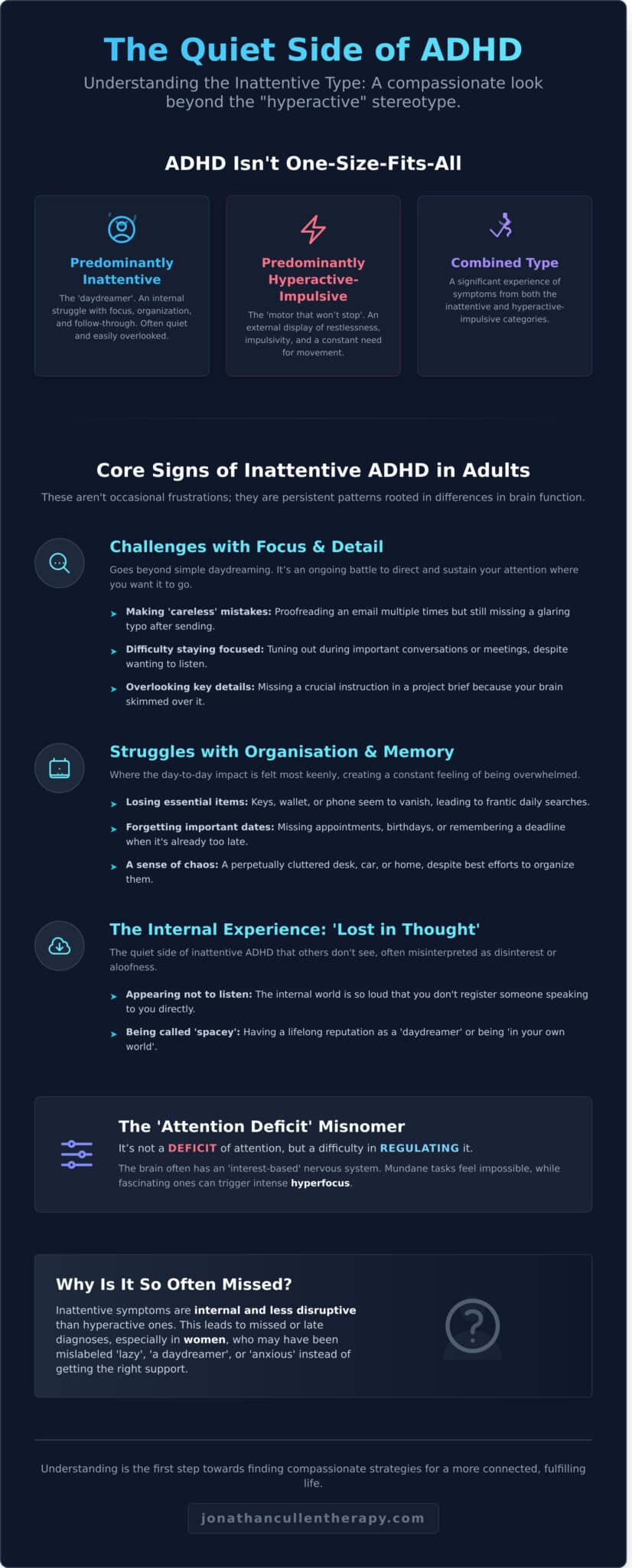
When you hear the term ‘ADHD’, the image that often comes to mind is of a child who can’t sit still—constantly moving, talking, and full of boundless energy. While that can be one experience of ADHD, it’s only part of the story. There is a quieter, more internalised presentation that often goes unnoticed, particularly in adults and women: inattentive ADHD.
This isn’t about being disruptive; it’s about feeling adrift in a sea of internal distraction and overwhelm. You might have been called a ‘daydreamer’ or told you just need to ‘try harder’. The reality is that this is a neurological difference in how your brain is wired, not a character flaw or a lack of effort. Over the years, the terminology has evolved. What was once commonly known as Attention Deficit Disorder (ADD) is now officially recognised by clinicians as ADHD, Predominantly Inattentive Presentation. You can read more about the specifics of inattentive ADHD (ADHD-PI), but the core truth is that it’s a valid and real experience deserving of understanding and support.
The ‘Attention Deficit’ Misnomer
One of the biggest misunderstandings is in the name itself. It’s not truly a ‘deficit’ of attention, but rather a difficulty in regulating it. People with inattentive ADHD often have what’s described as an ‘interest-based’ nervous system. If a task is novel, urgent, or genuinely fascinating, they can enter a state of intense concentration known as hyperfocus. It’s the mundane, everyday tasks that often feel impossible to start or finish.
Inattentive vs. Hyperactive vs. Combined Types
To put it simply, ADHD presents in three main ways. Think of the inattentive type as the ‘daydreamer’ whose mind wanders, struggling with focus and organisation. The hyperactive-impulsive type is more like a ‘motor that won’t stop’, driven by a need for movement and acting on impulse. The combined type experiences significant symptoms from both categories. It’s also important to know that how ADHD presents can change and evolve throughout a person’s life.
The Core Signs of Inattentive ADHD in Daily Adult Life
Many people occasionally misplace their keys or find their mind wandering during a long meeting. It’s a part of being human. However, for an adult with inattentive ADHD, these moments aren’t occasional frustrations; they are persistent patterns that can create significant challenges. It’s not a matter of willpower or not trying hard enough. Understanding how these traits manifest is a compassionate first step. The challenges of ADHD in daily adult life are rooted in differences in brain function, and recognising them can be incredibly validating.
Instead of a dry checklist, let’s explore what these signs of inattentive adhd truly feel like, grouped into common themes you might recognise in your own life.
Challenges with Focus and Detail
This goes far beyond simple daydreaming. It’s an ongoing struggle to direct and sustain your attention where you want it to go, often leading to feelings of frustration and inadequacy.
- Making ‘careless’ mistakes: You proofread an important work email three times, but only spot a glaring typo moments after you hit ‘send’.
- Difficulty staying focused: During conversations or meetings, you find yourself tuning out, even when the topic is important. You want to listen, but your mind has drifted elsewhere.
- Overlooking key details: You might miss a crucial instruction in a project brief or an important detail in a contract because your brain skimmed over it.
Struggles with Organisation and Memory
This is often where the practical, day-to-day impact of ADHD is felt most keenly. It can feel like you’re constantly trying to keep your head above water in a sea of forgotten tasks and misplaced items.
- Losing essential items: Your keys, wallet, or phone seem to have a life of their own, leading to a frantic search almost every day.
- Forgetting important dates: Missing appointments, forgetting birthdays, or suddenly remembering a deadline when it’s too late is a common and stressful experience.
- A sense of chaos: Your desk, car, or home may feel perpetually cluttered, despite your best efforts to organise it. Starting a multi-step task, like tidying a room, can feel completely overwhelming.
The Internal Experience: Feeling ‘Lost in Thought’
This is the quiet, internal side of inattentive ADHD that others may not always see. It’s a feeling of being mentally adrift, which can be misinterpreted by others as disinterest or aloofness.
- Appearing not to listen: Someone might be talking to you directly, but your internal world is so loud that you don’t register what they’ve said until they call your name.
- Being called ‘spacey’: You may have been described as a ‘daydreamer’ or ‘in your own world’ your entire life.
- Avoiding mentally demanding tasks: The thought of tackling paperwork, filling out forms, or planning a complex project can feel so draining that you put it off indefinitely.
Why Inattentive ADHD is So Often Missed (Especially in Women)
If you’ve only received a diagnosis for inattentive ADHD in adulthood, you are far from alone. For decades, the classic image of ADHD has been a young boy who can’t sit still. This stereotype has meant that countless individuals, particularly women and girls, have had their struggles overlooked, misunderstood, or misdiagnosed for years, often leading to a profound sense of confusion and self-doubt.
The quiet nature of these symptoms means they don’t cause the external disruption that typically prompts a referral or assessment. Instead, the disruption is internal, affecting self-esteem, emotional regulation, and mental well-being.
Internalised Symptoms vs. External Behaviours
The core reason this condition is so frequently missed is that its symptoms are quiet. While hyperactivity is an external behaviour that is easy for parents and teachers to spot, inattention is a silent battle with executive functions. The struggle to organise thoughts, stay focused on a task, or remember instructions isn’t visible. Instead, it’s often misinterpreted as a character flaw, leading to internalised messages of being “lazy,” “flaky,” or “not living up to your potential.” This can create a lifetime of shame and a feeling that you are somehow fundamentally broken.
The Gender Gap in ADHD Diagnosis
Historically, much of the research that shaped our understanding of ADHD was based on hyperactive young boys. Girls, who are more likely to present with inattentive symptoms, were largely left out of the picture. Furthermore, girls are often socialised to be less disruptive and more compliant. This pressure can lead to ‘masking’-expending enormous mental energy to hide symptoms and appear neurotypical. This constant effort is exhausting, and as the Child Mind Institute explains, this is a key reason why inattentive ADHD is so often missed, as traits like daydreaming are mislabelled as shyness rather than recognised as signs of an underlying neurological difference.
Co-occurring Anxiety and Depression
Living with the constant, unacknowledged challenges of undiagnosed ADHD can take a significant toll on your mental health. The perpetual feeling of overwhelm, the fear of forgetting something important, and the struggle to keep up can easily manifest as chronic anxiety. Similarly, when you consistently face setbacks despite your best efforts, it can lead to feelings of hopelessness and depression. It’s common for individuals to be diagnosed and treated for these conditions for years, while the root cause-the underlying inattentive adhd-remains completely unidentified.
Understanding these patterns is often the first step toward self-compassion. If this journey feels familiar, know that you don’t have to navigate it alone. Exploring these experiences with a therapist who understands neurodivergence can provide clarity, validation, and support.
Finding Your Way Forward: Support and Strategies for Inattentive ADHD
Learning about inattentive ADHD can feel like finding a missing piece of a puzzle. While it brings clarity, it can also feel overwhelming. The most important thing to remember is that this understanding is not an endpoint; it’s the starting point for a more compassionate and fulfilling life. It’s about shifting the question from, “What’s wrong with me?” to “How can I work with my brain?”
With the right support and strategies, it is entirely possible to thrive. Below are some compassionate, actionable ways to begin moving forward.
How ADHD-Informed Therapy Can Help
Therapy offers a unique, non-judgmental space to unpack what this diagnosis means for you. Working with an ADHD-informed therapist means you don’t have to spend your sessions explaining the basics; you can dive straight into what matters. It is a space to:
- Unlearn years of internalised shame and build genuine self-compassion.
- Develop practical, personalised strategies for managing executive function challenges like time management and organisation.
- Explore how ADHD has impacted your relationships, career, and self-esteem in a supportive environment.
- Partner with a therapist who understands neurodiversity, often from lived experience, and honours your unique story.
Practical First Steps You Can Take
While therapy provides deep support, there are immediate steps you can take to make daily life feel more manageable. These aren’t about ‘fixing’ yourself, but about creating an environment where you can succeed.
- Use external aids: Let your phone do the remembering. Set alarms, use digital calendars, and find apps designed for ADHD brains to offload mental strain.
- Break it down: An overwhelming task is just a series of small, achievable steps. Focus only on the very next one, not the entire staircase.
- Try ‘body doubling’: Simply working in the same room (or on a video call) with another person can significantly boost focus and motivation.
- Harness your hyperfocus: Identify what triggers your deep focus and channel it constructively into projects, hobbies, or work you’re passionate about.
The Importance of Self-Compassion
Above all, the most powerful strategy is self-compassion. For years, you may have believed you were lazy, careless, or not trying hard enough. It’s time to let go of that narrative. Your brain is not broken; it simply works differently. Acknowledging this is the first step toward building a life that truly fits you. Remember to celebrate the small wins and honour the immense effort you put in every single day.
You don’t have to face this journey alone. Learn about my approach.
Your Path Forward: Finding Clarity with Inattentive ADHD
Understanding inattentive adhd goes far beyond the common stereotypes. It’s about recognising the quiet, internal patterns-from persistent brain fog to feeling constantly overwhelmed-that are so often missed, especially in women. Acknowledging these signs isn’t just about a label; it’s the first, powerful step toward self-compassion and finding strategies that truly work for your unique mind.
You don’t have to navigate this journey alone. As a neurodivergent therapist with lived experience of ADHD, I offer a warm, non-judgmental space to explore your story. My integrative approach is tailored to your individual needs, helping you move from feeling stuck to feeling more grounded and connected.
If these struggles feel familiar, support is available. Contact me to book a consultation and take the next step. Together, we can work towards a more fulfilling and empowered life.
Frequently Asked Questions About Inattentive ADHD
Is inattentive ADHD the same thing as ADD?
Yes, essentially. The term ‘ADD’ (Attention Deficit Disorder) is an older name that is no longer used in official diagnoses. Today, the condition is known as ‘Attention-Deficit/Hyperactivity Disorder, Predominantly Inattentive Presentation.’ While the name has changed to better reflect our understanding of the condition, if you identify with the symptoms of ADD, you are likely describing what we now call inattentive ADHD. It’s a common point of confusion, and you’re not alone in wondering about the terms.
Can you develop inattentive ADHD as an adult?
This is a common question. ADHD is a neurodevelopmental condition, meaning its origins are in childhood, even if it wasn’t recognised at the time. You don’t ‘develop’ it as an adult, but it is very common for it to be diagnosed for the first time in adulthood. The demands of work, relationships, and family life can often make the underlying symptoms of inattentive ADHD, which may have been manageable before, feel much more overwhelming and noticeable.
How do I know if I have inattentive ADHD or just anxiety?
It can be very difficult to tell them apart, as they share many symptoms like restlessness and difficulty concentrating. Often, anxiety can be a response to the daily challenges of living with undiagnosed ADHD. A key question to explore is the ‘why’ behind the feeling. Is the difficulty focusing due to constant worry, or is it a more persistent challenge with regulating your attention? Because they so often coexist, a compassionate, professional assessment is the best way to understand your unique experience.
Does medication work for the inattentive type of ADHD?
Yes, medication can be a very effective part of a support plan for many people with the inattentive type of ADHD. Stimulant and non-stimulant medications can significantly help improve focus, reduce distractibility, and make daily tasks feel less overwhelming. It is not the only option, of course. The most effective approach often combines medication with therapy and coaching to develop supportive strategies. Exploring this is a personal journey, best undertaken with guidance from a qualified psychiatrist or specialist.
Can you have both inattentive and hyperactive symptoms?
Absolutely. In fact, it is very common to experience a mix of symptoms from both categories. When someone has significant symptoms of both inattention and hyperactivity/impulsivity, it is diagnosed as ‘ADHD, Combined Presentation.’ Your experience is unique, and you don’t have to fit neatly into one box. Understanding the specific blend of your symptoms is a key part of creating a support plan that truly honours your personal journey and needs.
What is the first step to getting an official diagnosis in the UK?
The first step in the UK is usually to speak with your GP. They can discuss your symptoms with you and refer you for an assessment through the NHS. It’s important to be aware that NHS waiting lists can unfortunately be very long. Another path is to seek a private assessment with a psychiatrist who specialises in adult ADHD, which is often much quicker. Whichever route you choose, taking that first step to talk to a professional is a courageous and positive move forward.