
Do you ever feel like you are living a paradox? Craving the deep comfort of a predictable routine one moment, only to be swept away by a wave of impulsivity the next? This internal tug-of-war is a common and often confusing experience for many, and it frequently points to a neurotype that doesn’t fit neatly into a single box: AuDHD.
If you have ever felt that the label ‘autism’ alone doesn’t capture your spontaneity, or that ‘ADHD’ fails to explain your deep need for sensory calm and structure, please know you are not alone. The constant negotiation between these seemingly contradictory parts of yourself can be exhausting, leaving you to wonder if your experience is valid or ‘real’.
This article offers a gentle, supportive guide to understanding the overlap of autism and ADHD. Together, we will explore what AuDHD is, how these distinct traits can co-exist and interact, and help you find the language that truly honours your unique internal world. Consider this a space to find clarity, validation, and a deeper connection with your authentic self.
Key Takeaways
- Understand the core experience of AuDHD as an internal ‘tug of war’ between the brain’s need for routine and its craving for novelty.
- Discover how the combined traits of audhd can present differently than autism or ADHD alone, helping to make sense of your unique experiences.
- Learn to reframe your perspective by exploring the unique strengths that can emerge from this neurotype, such as deep creativity and hyperfocus.
- Find out why self-compassion is the crucial first step toward navigating your journey and finding supportive ways to live well with your neurodivergence.
What is AuDHD? A Gentle Introduction
If you have ever felt like your brain is a place of constant contradiction, you are not alone. At its heart, AuDHD is a simple and reassuring term for the experience of being both autistic and having Attention-Deficit/Hyperactivity Disorder (ADHD). It’s not a formal clinical diagnosis, but a word created by the neurodivergent community to describe a very real and distinct way of being.
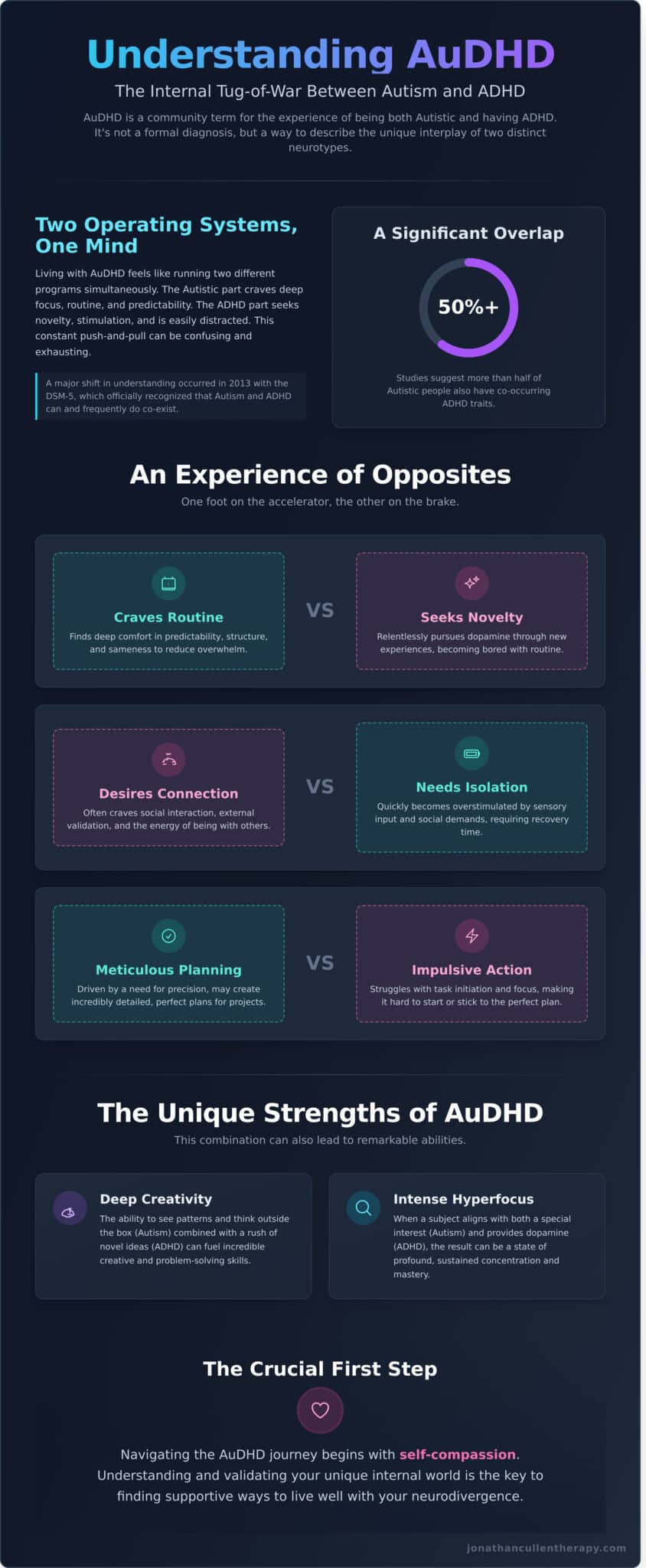
Imagine your mind trying to run two different operating systems at the same time. One part of you (the autistic side) may crave deep focus, routine, and predictability. The other part (the ADHD side) seeks novelty, stimulation, and can be easily distracted. This internal push-and-pull can feel confusing and exhausting, but understanding it is the first step on a journey toward self-compassion.
For many years, it was clinically impossible to be diagnosed with both autism and ADHD. However, a major shift occurred in 2013 with the release of the DSM-5, which finally acknowledged that the two conditions can, and frequently do, co-exist. This change validated the lived experiences of countless people by recognising the significant overlap between the two, an area of study often referred to as conditions comorbid to autism.
Why the Term ‘AuDHD’ is So Important
Having a single term like audhd does more than just combine two labels. It gives a name to a unique, shared experience, helping people feel seen and less alone in their internal conflicts. It moves beyond seeing yourself as a collection of separate diagnoses and toward a more integrated, holistic understanding of who you are. It honours your unique story in a way that separate labels sometimes cannot.
How Common is the Autism and ADHD Overlap?
If you suspect you might have both, you are far from unusual. Research increasingly shows a strong neurobiological link between autism and ADHD. While exact figures vary, studies consistently show a significant overlap. It’s estimated that a large percentage of autistic people-some studies suggest over half-also have co-occurring ADHD. This means that if this experience resonates with you, it’s a recognised and common neurotype.
The Inner World of AuDHD: An Experience of Opposites
Living with AuDHD can feel like a constant internal tug-of-war. Many describe it as having one foot on the accelerator and the other firmly on the brake. One part of your brain craves structure, predictability, and quiet, while another part desperately seeks novelty, stimulation, and social connection. This ongoing internal negotiation is not just confusing; it can be profoundly exhausting.
This experience of opposites is often why one condition can mask the other. The autistic need for planning might compensate for ADHD-driven impulsivity, or the ADHD desire for socialising might hide underlying social anxiety from autism. This internal balancing act can lead to missed or late diagnoses, leaving many feeling misunderstood and without the right support. If this sounds familiar, please know that your experience is valid.
The Clash of Routine vs. Novelty
A core conflict exists between the autistic need for sameness and the ADHD brain’s relentless pursuit of dopamine. The autistic side of you may find deep comfort in predictable routines and structured days. Yet, the ADHD side feels understimulated and bored by that very same predictability, craving new experiences. The result is often a cycle of creating a routine for stability, only to feel agitated and restless within it.
Social Energy: The Need for Connection vs. The Fear of Exhaustion
Navigating social situations with AuDHD can be a confusing push-and-pull. The ADHD brain often desires social interaction, external validation, and the energy of being around others. At the same time, the autistic nervous system can become quickly overwhelmed by sensory input and the complex demands of socialising. This can lead to fluctuating between being the life of the party one day and needing complete isolation to recover the next.
Executive Functioning: Meticulous Planning vs. Impulsive Action
Perhaps nowhere is the internal conflict more apparent than in getting things done. The autistic drive for precision can lead to creating incredibly detailed, colour-coded plans for a project. However, the ADHD challenge with task initiation and focus can make it almost impossible to start. This classic audhd paralysis means you might have a perfect plan but struggle to act on it, or impulsively abandon it for a new, more exciting idea.
Recognising AuDHD: Common Traits and Experiences
Exploring whether you might have AuDHD can feel like trying to solve a complex puzzle. It’s important to remember that this information is for self-recognition and understanding, not as a diagnostic tool. If these experiences resonate with you, it may be a gentle signpost on your journey of self-discovery. The internal world of audhd is often a landscape of contradictions, where traits don’t simply add up-they interact in unique and often confusing ways.
Many describe a feeling of ‘AuDHD paralysis,’ a state of being stuck between the autistic need for routine and the ADHD craving for novelty. This internal push-and-pull, combined with a heightened experience of Rejection Sensitive Dysphoria (RSD), can make navigating daily life feel incredibly demanding. You don’t have to make sense of it all alone.
Intense Emotions and Sensory Profiles
You might experience emotions with profound depth but find it difficult to identify or express what you are feeling. Your sensory profile is often a similar paradox. This can look like:
- Craving the intense stimulation of loud, bass-heavy music through headphones (a sensory-seeking ADHD trait).
- Feeling completely overwhelmed and distressed by the unpredictable, layered noise of a busy café (a sensory-avoidant autistic trait).
This creates a constant, tiring negotiation between your need for more stimulation and your need for less.
Special Interests and Hyperfocus
The deep, long-term special interests characteristic of autism combine with the powerful, short-term hyperfocus of ADHD. Instead of one or two lifelong passions, you may find yourself cycling through a series of intense, all-consuming hobbies or subjects. For a few weeks or months, you’ll learn everything there is to know about a topic, only for that intense focus to suddenly shift, leaving a trail of fascinating but half-finished projects in its wake.
The Complexity of Masking
Masking, or camouflaging neurodivergent traits to fit in, is profoundly exhausting. In AuDHD, this becomes even more complex because the traits can mask each other. For example, an autistic need for planning and structure might hide underlying ADHD impulsivity, making it harder for you and others to see the full picture. This constant, subconscious effort to manage conflicting inner drives can lead to significant burnout and a feeling of being disconnected from your authentic self.
The Unique Strengths of the AuDHD Mind
While navigating the world with both autism and ADHD presents undeniable challenges, it’s crucial to shift our perspective from one of deficit to one of difference. The audhd neurotype is not a flaw to be fixed, but a unique neurocognitive profile with its own remarkable set of strengths. When we learn to understand and honour this internal landscape, we can begin to see the incredible potential that arises from this combination. This is not about ignoring difficulties, but about celebrating the whole person.
Deep Creativity and Problem-Solving
The AuDHD mind can be a powerhouse of innovation. It often combines the autistic talent for deep focus and pattern recognition with the ADHD flair for divergent, non-linear thinking. This fusion creates a unique ability to see connections others miss and approach problems from entirely unconventional angles. The result is a natural gift for creative problem-solving and out-of-the-box solutions that can be truly transformative in any field.
Resilience and Adaptability
Living with the constant internal push-and-pull of AuDHD builds a profound and often unrecognised resilience. The daily experience of navigating conflicting needs-for routine and novelty, for social connection and solitude-requires constant adaptation. This lifelong journey of adjusting to neurotypical expectations fosters a quiet strength and a unique capacity to handle complex, rapidly changing environments with a level of flexibility that can be surprising.
Profound Empathy and a Strong Sense of Justice
Many people with AuDHD experience a deep, analytical form of empathy. They don’t just feel for others; they strive to understand their experiences on a fundamental level. This, combined with a passionate drive for fairness and truth, creates a powerful sense of justice. It’s a quality that allows for incredibly strong bonds, particularly with fellow neurodivergent individuals, fostering a sense of community built on genuine understanding and compassion.
Exploring these strengths is a vital part of the journey. If you’d like to better understand how your unique mind works in a supportive, non-judgmental space, you don’t have to do it alone. You can learn more about a neurodivergent-affirming approach to therapy at jonathancullentherapy.com.
Living Well with AuDHD: Finding Support and Understanding
Realising you might have AuDHD is often the first, most powerful step on a journey of self-discovery. For many, it’s a moment of profound clarity, where a lifetime of seemingly contradictory experiences finally makes sense. This new understanding is an invitation to replace self-criticism with self-compassion and to begin exploring what you truly need to thrive.
Living well with this unique neurotype isn’t about “fixing” yourself; it’s about creating a life that honours both the autistic and ADHD parts of you. It’s about finding a supportive space where you can explore your identity without judgment and learn to work with your brain, not against it.
Strategies for Finding Balance
Navigating the push-and-pull of AuDHD means finding strategies that are both structured and adaptable. The goal is to create a supportive framework for your life that doesn’t feel like a cage. Some practical approaches include:
- Creating ‘flexible routines’: Honour your autistic need for predictability with a core daily structure, but build in space for your ADHD need for novelty and spontaneity. This might look like a set morning routine followed by an open block of time for hyperfocus projects.
- Using executive functioning tools: Externalise your brain’s workload. Tools like visual timers, body doubling (working alongside someone), noise-cancelling headphones, and task-management apps can provide the scaffolding you need to manage focus, time, and energy.
- Honouring your sensory needs: Learn to identify what soothes or overwhelms your nervous system. This could mean embracing stimming, creating a ‘sensory toolkit’ with fidgets and weighted blankets, or giving yourself permission to leave overstimulating environments.
How Therapy Can Help Your AuDHD Journey
Therapy can offer a warm, non-judgmental space to process your diagnosis and explore what it means for you. Working with a neurodivergent-affirming therapist who understands the specific challenges and strengths of the audhd experience is key. They can validate your feelings and help you unlearn a lifetime of masking-the exhausting process of hiding your authentic self to fit in.
In this supportive environment, you can learn to unmask safely, build self-advocacy skills, and develop compassionate strategies tailored to your unique mind. This is a journey toward building a more authentic and fulfilling life. You don’t have to navigate this alone. Learn more about therapy.
Embracing Your AuDHD Identity: The Path Forward
Understanding the overlap between Autism and ADHD is a profound step towards self-compassion and clarity. It’s about recognising that the inner world of conflicting needs-the drive for novelty versus the comfort of routine-is not a personal failing, but a core part of your experience. By embracing both the challenges and the remarkable strengths of the audhd mind, you can begin to build a life that feels more authentic, connected, and aligned with who you truly are.
This journey of self-discovery can feel overwhelming, but you don’t have to face it alone. Finding the right support is a crucial next step. I provide therapy from a neurodivergent-affirming perspective, grounded in a down-to-earth approach that honours your unique story. As a therapist with lived experience of neurodivergence, I offer a space built on genuine, non-judgmental understanding. If this resonates with you, I offer a warm, supportive space to explore your experience. Contact me to begin.
Frequently Asked Questions About AuDHD
Is AuDHD an official medical diagnosis?
AuDHD is not currently an official medical diagnosis in the UK’s diagnostic manuals, such as the ICD-11 used by the NHS. It is a community-created term that powerfully describes the lived experience of having both Autism Spectrum Condition (ASC) and Attention Deficit Hyperactivity Disorder (ADHD). While you won’t see it on a formal diagnostic letter, it’s a valid and incredibly useful way to understand and communicate this unique neurodivergent profile and its specific challenges.
Can a person be formally diagnosed with both autism and ADHD?
Yes, absolutely. It is now common practice in the UK for clinicians to assess for and diagnose both autism and ADHD at the same time. Previously, this was discouraged, but it is now widely recognised that the two conditions frequently co-occur. A comprehensive neurodevelopmental assessment can identify the presence of both, leading to a more accurate understanding of your needs and helping you access the right support for your unique journey. You don’t have to choose between them.
How is the AuDHD experience different from just having autism or just having ADHD?
The AuDHD experience is often described as a constant internal push-and-pull. For example, the autistic need for predictable routines can be in direct conflict with the ADHD brain’s craving for novelty and stimulation. You might have a deep, autistic desire to focus on a special interest, only to be constantly derailed by ADHD-related distractibility. This internal contradiction can be uniquely exhausting and feel like you are navigating two opposing sets of needs at once.
Does having AuDHD make my autism or ADHD ‘milder’?
This is a common misconception, but the answer is generally no. Instead of making the conditions milder, the traits often mask or complicate one another. For instance, the impulsivity of ADHD might be hidden by autistic social anxiety, while the executive dysfunction from ADHD can make it much harder to implement the structured routines an autistic person needs. The result is not a ‘milder’ experience, but a more complex and often more confusing internal landscape to navigate.
What kind of support or therapy is best for someone who is AuDHD?
The most effective support is highly personalised and neuro-affirming, offered by a therapist who understands the unique interplay of AuDHD. Therapy often focuses on developing practical strategies for executive functioning challenges (like planning and emotional regulation) while honouring your autistic needs for sensory comfort and routine. A compassionate, down-to-earth approach that respects your unique story, rather than a rigid one-size-fits-all model, is key to finding balance and building a more fulfilling life.
Can medication help with AuDHD?
Medication can be a very helpful piece of a wider support plan. While there are no specific medications for autism, ADHD medications prescribed in the UK can help manage challenges with focus, impulsivity, and executive function. For many AuDHD individuals, this can reduce the internal ‘noise’ from ADHD, making it easier to connect with their autistic needs for calm and structure. This is a personal choice to explore with a qualified psychiatrist or medical professional.