
Have you ever felt like you’re running on a different operating system to everyone else? If you’ve spent years feeling misunderstood-wrestling with focus, organisation, or intense emotions that seem to hijack your day-you may have found yourself asking a fundamental question: what is ADHD? Far from the outdated stereotypes you might have seen, adult ADHD is a complex and often invisible experience. It’s not a character flaw or a lack of willpower, but a genuine difference in how your brain is wired, and you don’t have to face it alone.
This compassionate guide is here to offer the clarity you deserve. We’ll move beyond the confusing jargon and judgment to explore the real, lived experiences of ADHD in adults. Our goal is to help you understand the ‘why’ behind your challenges, feel validated in your unique story, and begin to replace self-blame with self-compassion. Together, let’s explore a path towards understanding yourself more deeply and finding supportive ways to move forward.
Key Takeaways
- Move beyond common stereotypes to understand ADHD as a fundamental difference in brain wiring, not a character flaw.
- Answering the question ‘what is adhd’ for yourself is the first compassionate step toward self-understanding and finding supportive strategies that work for you.
- Discover how the core traits of ADHD connect to often-overlooked emotional challenges like rejection sensitivity and overwhelm.
- Reframe your perspective by exploring the unique strengths that can accompany an ADHD brain, such as creativity, resilience, and intense focus.
Beyond the Stereotypes: What ADHD Really Is (and Isn’t)
If you’ve found your way here, you might be feeling overwhelmed, confused, or simply curious about what ADHD is. Perhaps you’ve seen it portrayed in the media or heard casual remarks, but the stereotypes rarely capture the full picture. It’s important to begin this journey with a clear, compassionate understanding: ADHD is not a character flaw, a behavioural issue, or a lack of willpower. It is a neurodevelopmental difference.
This means the ADHD brain is wired differently from a neurotypical brain, a difference that you are born with and that persists throughout your life. It isn’t something you outgrow. This neurological variance primarily impacts a set of skills known as executive functions. For a comprehensive overview of ADHD, it’s helpful to see it as a recognised medical condition, not a personal failing.
Debunking Common ADHD Myths
To truly understand ADHD, we first need to clear away the misconceptions that so often cause confusion and shame.
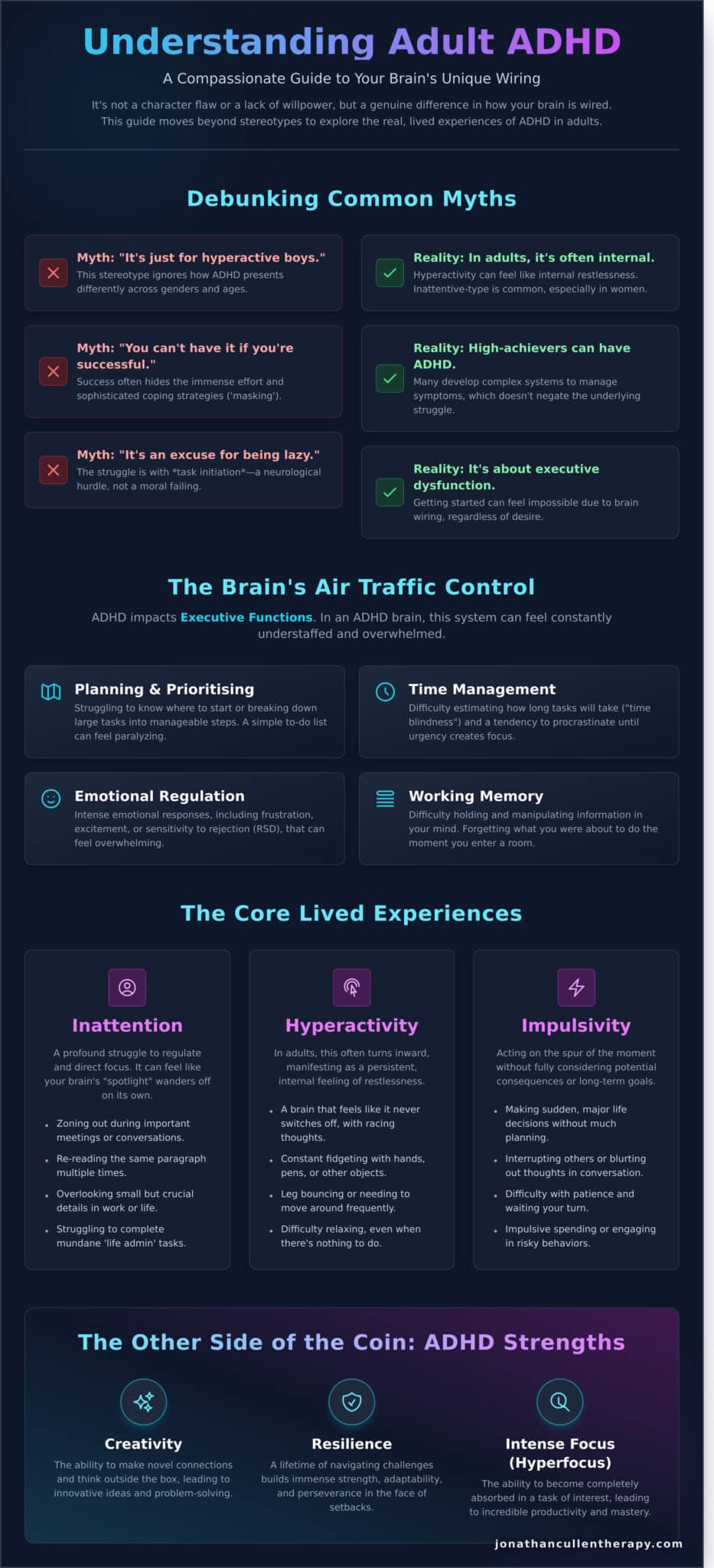
- Myth: ‘It’s just for hyperactive boys.’ This is one of the most persistent myths. In adults, hyperactivity often presents as an internal feeling of restlessness rather than constant physical motion. Women, in particular, are more likely to have inattentive-type ADHD, with symptoms that can be misdiagnosed as anxiety or depression.
- Myth: ‘You can’t have ADHD if you’re successful.’ Many high-achieving adults with ADHD develop sophisticated coping strategies, or ‘masking’, to navigate a world not built for their brains. Success doesn’t erase the immense underlying effort; it often just hides the struggle.
- Myth: ‘It’s an excuse for being lazy.’ The challenge for someone with ADHD is often not a lack of desire, but a struggle with task initiation. It’s a neurological hurdle in getting started, not a moral failing.
Understanding Executive Function
Imagine your brain has an ‘air traffic control system’ responsible for directing, organising, and managing all of your mental tasks. These are your executive functions. In an ADHD brain, this control tower can feel consistently understaffed and overwhelmed. This directly affects:
- Planning and prioritising tasks.
- Time management and estimating how long things will take.
- Emotional regulation and managing frustration or excitement.
- Working memory (holding information in your mind to use it).
For example, you might have a simple to-do list: pay a bill, reply to an important email, and book a dentist appointment. Instead of tackling them, you find yourself completely stuck, overwhelmed by where to start, and end up spending hours researching an unrelated topic. This isn’t a choice; it’s executive dysfunction in action.
The Core Experiences of ADHD: Inattention, Hyperactivity & Impulsivity
Understanding ADHD means looking beyond simple labels and exploring the internal, lived experiences that define it. While often discussed as a single condition, it shows up differently in each person. Clinically, these experiences are grouped into three core presentations: inattentive, hyperactive-impulsive, or a combination of both. To truly explore what is adhd, it’s helpful to see these not as character flaws, but as persistent patterns in how the brain processes the world. An individual might experience challenges primarily in one area or a blend of all three, and these can change over a lifetime. For a detailed clinical breakdown, the NIMH provides comprehensive information on ADHD and its presentations.
What Inattention Feels Like in Adults
This goes far deeper than simply ‘not paying attention’. For adults, inattention is often a profound struggle to regulate and direct focus. It can feel like your brain’s “spotlight” wanders off on its own, especially during tasks that are not immediately stimulating. You might find yourself zoning out during important work meetings, only to realise you’ve missed a key decision. It’s the frustration of re-reading the same paragraph four times, starting a project with immense enthusiasm but struggling to see it through, or consistently overlooking small but crucial details. This often makes mundane but necessary ‘life admin’-like paying bills or booking appointments-feel like climbing a mountain.
Hyperactivity in the Adult World
As we get older, the visible hyperactivity often seen in children tends to turn inward. For many adults, it manifests as a persistent, internal feeling of restlessness. It’s a brain that feels like it never switches off, filled with racing thoughts that can make it difficult to relax or fall asleep. This inner energy often finds small, physical outlets:
- Constant fidgeting with a pen or your hands
- Bouncing your leg under the table
- Feeling a compulsive need to be busy or multi-tasking
It can also show up in social situations as talking excessively, speaking very quickly, or unintentionally interrupting others because a thought feels too urgent to hold onto.
Impulsivity and Its Consequences
Impulsivity is the experience of a very short runway between a thought and an action. It’s acting on a whim without having the space to fully consider the potential outcomes. In adult life, this can have significant consequences, impacting everything from your finances to your relationships. It might look like making a large impulse purchase that strains your budget, abruptly quitting a job, or making a sudden, life-altering decision. Socially, it can mean speaking without a filter or having immense difficulty with patience, whether waiting in a queue or for your turn to speak in a conversation. It’s a challenge that can create instability, but it often stems from a place of passion or urgency rather than carelessness.
The Hidden Challenges: How ADHD Affects Adult Life
When we ask the question, what is adhd, the conversation often stops at the ‘big three’ symptoms: inattention, hyperactivity, and impulsivity. While these are certainly part of the picture, they don’t capture the full story of the adult experience. The reality of ADHD in adults is often far more complex and internal, defined by hidden emotional and psychological challenges.
These internal struggles are frequently the most distressing part of living with ADHD and are often what finally leads someone to seek support. After years of feeling like you’re not meeting your potential, it’s completely understandable that your self-worth and identity can be deeply affected. You are not alone in this feeling.
Emotional Dysregulation: The ADHD Rollercoaster
Emotional dysregulation means feeling your emotions more intensely than others might, and finding it much harder to manage them. It can feel like being on a difficult emotional rollercoaster. A small frustration might feel like a catastrophe, or your mood can shift suddenly with little warning. This emotional intensity is closely linked to a low frustration tolerance, making everyday setbacks feel overwhelming and exhausting.
Rejection Sensitive Dysphoria (RSD)
Many adults with ADHD experience what is known as Rejection Sensitive Dysphoria (RSD). While not an official clinical term, it describes an extreme and painful emotional response to perceived rejection, criticism, or failure. This intense fear of disapproval can lead to people-pleasing behaviours to avoid upsetting others, or it can cause social avoidance altogether as a way to protect yourself from potential hurt.
Impact on Relationships, Work, and Self-Esteem
The daily realities of ADHD can create significant friction in key areas of your life. Over time, these challenges can build up, shaping the way you see yourself and the world.
- In Relationships: Forgetfulness, chronic lateness, or difficulty with household organisation can be misinterpreted by partners as a lack of care or respect, leading to conflict and misunderstanding.
- At Work: The cycle of procrastination driven by overwhelm, followed by frantic, last-minute hyperfocus to meet a deadline, is a common pattern that often leads to chronic stress and burnout.
- With Yourself: Perhaps the heaviest burden is the internal one. After a lifetime of struggling in a world not built for your brain, it’s easy to internalise a narrative that you are lazy, flawed, or simply not good enough. This can have a profound impact on your self-esteem.
The Other Side of the Coin: Recognising ADHD Strengths
For too long, the conversation around ADHD has focused almost exclusively on deficits and difficulties. While the challenges are real and significant, this one-sided view misses the full picture. A core part of understanding what is adhd is shifting our perspective to a more compassionate, neurodivergent-affirming one that honours the entire person.
Many of the traits that cause difficulty are simply the other side of a coin that also holds incredible strengths. Learning to see, appreciate, and harness these unique advantages is not just about feeling better; it’s about building genuine self-esteem and finding a path in life that feels authentic and fulfilling. You are not broken; your brain is simply wired differently, and that difference comes with its own set of gifts.
Hyperfocus: The ADHD Superpower
While an ADHD brain can struggle to engage with mundane or uninteresting tasks, it has the remarkable ability to enter a state of ‘hyperfocus’. This is an intense, prolonged period of concentration on something that captivates your interest. When in this state, you can learn, create, and produce at an astonishing rate, often losing all track of time. It’s the engine behind the artist who paints for 12 hours straight or the programmer who solves a complex problem overnight.
Creativity and Innovative Thinking
The same brain that produces ‘racing thoughts’ is also a powerhouse of creativity. The rapid, non-linear thinking style of an ADHD mind allows it to make novel connections between seemingly unrelated ideas. This leads to exceptional ‘out-of-the-box’ problem-solving and innovative thinking. It’s no coincidence that many successful entrepreneurs, artists, and inventors have ADHD traits; their minds are built to challenge convention and forge new paths.
Resilience and Empathy
Navigating a world that wasn’t designed for your brain builds a quiet, profound resilience. Overcoming daily obstacles and misunderstandings cultivates a unique strength and perseverance. Furthermore, the experience of often feeling like an outsider can foster a deep and genuine empathy for others. This, combined with the characteristic high energy and passion ADHDers bring to their interests, can make them incredibly loyal friends, dedicated partners, and passionate advocates for the causes they believe in.
Reframing your understanding of what is adhd to include these powerful strengths is a crucial step on your journey. If you’d like to explore how to harness these gifts in a supportive, non-judgmental space, please know that you don’t have to face it alone.
Understanding Your Brain: What Are the Next Steps?
Learning about ADHD in adulthood can feel like finding a missing piece of a puzzle you didn’t even know you were solving. For many, this discovery brings a wave of relief, a sense of validation for a lifetime of experiences. But it can also feel overwhelming. Suddenly, you have a name for the challenges, but what do you do with that information? It’s important to remember that this journey isn’t about ‘fixing’ yourself, but about understanding and supporting yourself in a way that honours how your brain works.
The path forward is unique to you, but it often involves a combination of self-education, considering a formal diagnosis, and finding the right support. Finally having a framework for the question, what is adhd and how does it affect me, is the first empowering step.
The Power of Self-Compassion
One of the most profound shifts you can make is to look back on your life through the lens of ADHD. Moments where you felt you failed, weren’t trying hard enough, or were labelled as “lazy” or “scattered” can be re-framed. This isn’t about making excuses; it’s about replacing years of self-blame with compassionate understanding. Letting go of that shame is crucial. When you understand the ‘why’ behind your challenges, you can begin to create practical, effective strategies that work with your brain, not against it.
How ADHD-Informed Therapy Can Help
You don’t have to navigate this journey alone. Therapy offers a calm, non-judgmental, and supportive space to explore what this new understanding means for you. It’s a collaborative process where we can make sense of your unique story and experiences with ADHD.
An ADHD-informed therapist can help you develop practical coping strategies for things like time management, organisation, and emotional regulation. More than that, therapy is a place to process the emotional impact of a late diagnosis-the grief for what could have been, the anger at being misunderstood-and to rebuild your self-esteem from a place of authenticity and strength.
If you feel ready to take this step, exploring therapy with a neurodivergent-affirming therapist can be a powerful way to move forward with clarity and confidence.
Understanding Your Path Forward with ADHD
The journey to understanding what is adhd is a deeply personal one, and it starts by moving beyond outdated stereotypes. As we’ve explored, ADHD is a complex neurotype that can present hidden challenges in adult life, from emotional regulation to executive function. But it’s crucial to remember this is only half the story. Recognising and embracing your inherent strengths-like creativity, resilience, and the capacity for deep focus-is the key to building a life that truly works for you.
If this guide has resonated with you, please know you don’t have to navigate this journey alone. As a qualified, neurodivergent-affirming therapist at Jonathan Cullen Therapy, I provide a warm, non-judgmental, and supportive space to explore your experience. Together, we can work with a down-to-earth approach that honours your unique story and helps you find clarity and confidence. You don’t have to figure this out alone. Learn more about my approach to ADHD therapy.
Taking this first step is an act of self-compassion. A more grounded and fulfilling life is not just a possibility; it’s within your reach.
Frequently Asked Questions About ADHD in Adults
Can you develop ADHD as an adult, or are you born with it?
ADHD is a neurodevelopmental condition, which means it originates in childhood. You don’t develop it as an adult, but it’s very common for it to go unrecognised until later in life. The increasing demands of a career, family, and finances can make ADHD traits, which may have been manageable before, feel much more overwhelming. This often prompts adults to seek an explanation and support for the first time, leading to a later-in-life diagnosis and a new journey of self-understanding.
How is ADHD different in women compared to men?
While ADHD affects all genders, its presentation can differ. Historically, diagnosis has been based on the hyperactive-impulsive presentation more often seen in boys. Women and girls more frequently present with inattentive ADHD, which can look like being ‘daydreamy,’ disorganised, or experiencing intense internal restlessness and emotional dysregulation. This difference has often led to women being overlooked or misdiagnosed with anxiety or depression, and receiving a diagnosis much later in life, if at all.
What is the difference between ADD and ADHD?
This is a common point of confusion, and it’s helpful to clarify. ‘ADD’ (Attention Deficit Disorder) is an outdated term for what is now officially called Predominantly Inattentive ADHD. Today, ‘ADHD’ (Attention-Deficit/Hyperactivity Disorder) is the official umbrella term. Understanding what is ADHD in its modern definition means recognising it covers all presentations of the condition: the inattentive type (formerly ADD), the hyperactive-impulsive type, and the combined type. It’s simply a more accurate and inclusive medical term.
Is ADHD considered a learning disability or a mental illness?
ADHD is officially classified as a neurodevelopmental disorder, meaning it relates to the development and wiring of the brain. It is not a learning disability, though it can significantly impact executive functions that are crucial for learning and often co-exists with conditions like dyslexia. It is also not a mental illness, but the challenges of living with unmanaged ADHD can certainly contribute to or worsen conditions like anxiety and depression. A compassionate perspective sees it as a difference, not a deficit.
Do I need an official diagnosis to start getting support for ADHD traits?
You absolutely do not need an official diagnosis to begin exploring your traits and getting support. Many people find therapy or coaching incredibly helpful for managing challenges like emotional regulation, procrastination, and organisation, regardless of a formal label. While a diagnosis is necessary in the UK for accessing medication through the NHS or specific workplace accommodations under the Equality Act, seeking compassionate, non-judgmental support for your experiences is a valid and powerful first step you can take at any time.
Can you have ADHD and still be very organised or successful in some areas of life?
Yes, absolutely. This is a common misconception that can make people doubt their own struggles. Many adults with ADHD are highly successful, creative, and intelligent. They often develop sophisticated coping mechanisms to stay organised in specific areas, like their career, while other parts of life feel chaotic. Traits like hyperfocus can even be a great strength, allowing intense concentration on tasks of interest. Success in one area doesn’t invalidate the real challenges you may face in others.