
The silence between you can feel heavier than the words you’re no longer saying. Or perhaps the words are there, but they’re stuck in a repeating cycle of arguments that leaves you both feeling exhausted and misunderstood. If you’re feeling lost and wondering if your problems are ‘big enough’ for therapy, know that you are not alone. Taking that first step can feel daunting, but finding supportive relationship counselling London is about creating a safe space to breathe, talk, and truly listen to each other again.
This gentle guide is designed to ease your worries and offer a clear path forward. Together, we will explore when it might be the right time to seek support, what you can expect from the process, and how to find a compassionate, non-judgmental counsellor who can help you and your partner navigate difficult decisions. It’s a journey towards rebuilding trust, improving communication, and rediscovering the connection you both deserve. You don’t have to face it alone.
Key Takeaways
- Recognise the common signs that your relationship could benefit from support and see why seeking help early is a proactive sign of strength.
- Understand what to expect inside the therapy room, where a therapist acts as a neutral facilitator to create a safe, non-judgmental space for you both.
- Discover how to choose the right professional for relationship counselling London, ensuring you find a therapist you both feel comfortable and connected with.
- Learn a simple, step-by-step approach to starting your journey, making the process of booking your first session feel clear and manageable.
Is It Time? Common Signs Your Relationship Could Benefit from Counselling
Deciding to seek help for your relationship can feel like a monumental step, but it’s a sign of courage and commitment, not failure. Many couples wait until problems feel insurmountable, yet exploring relationship counselling in London early on is often far more effective. It’s rarely a single argument that brings people to therapy, but rather recurring, painful patterns that leave you both feeling stuck. If you’re wondering what is couples therapy, think of it as a dedicated, supportive space to understand and break these negative cycles. Recognising these signs is the first step towards building a more connected and fulfilling partnership.
If any of the following patterns feel familiar, it may be a good time to consider professional support. You don’t have to face these challenges alone.
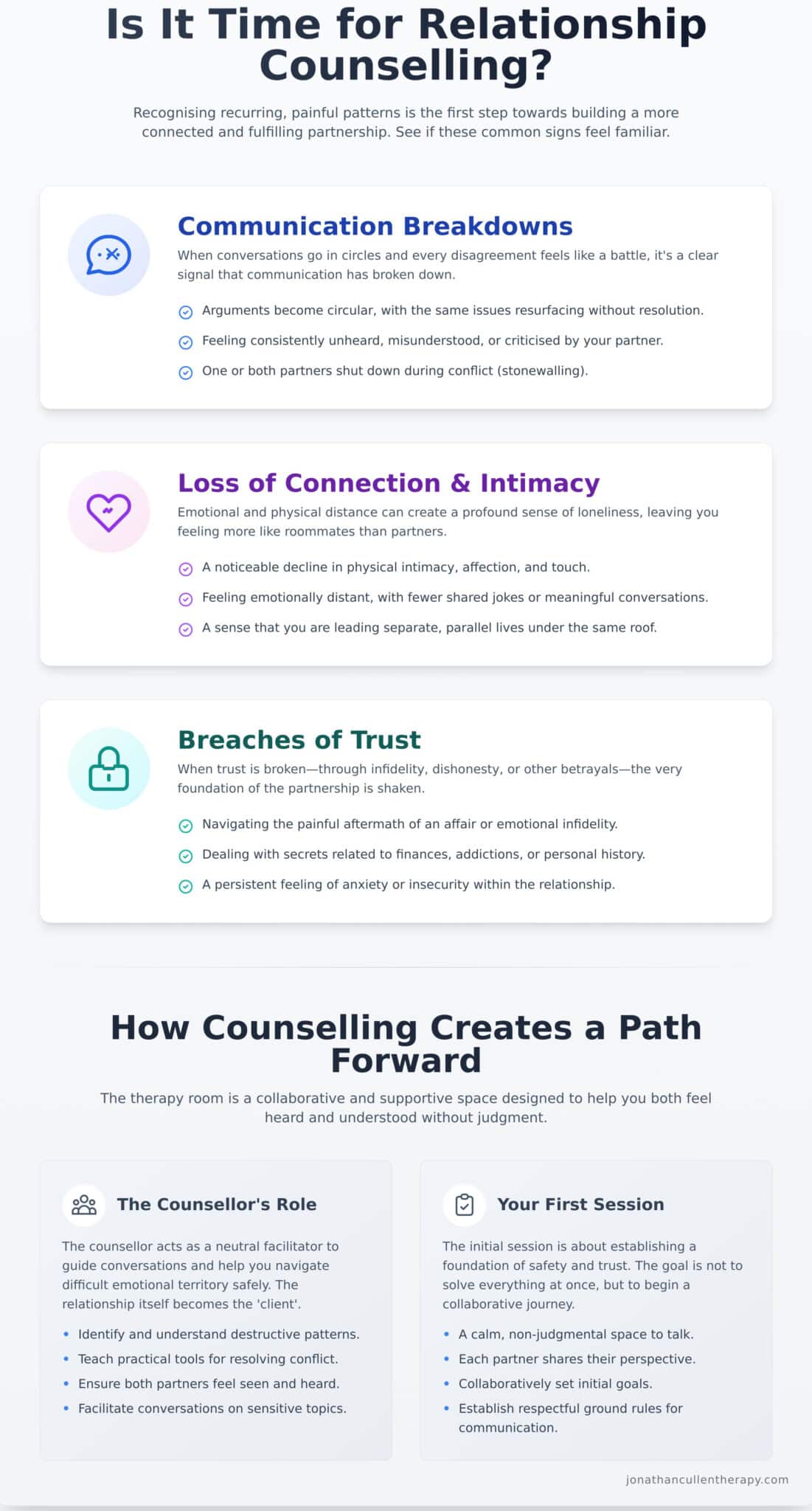
Communication Breakdowns
When conversations go in circles and every disagreement feels like a battle, it’s a clear signal that communication has broken down. You might feel like you’re walking on eggshells, unable to express your true feelings for fear of starting another fight. This often looks like:
- Arguments become circular, with the same issues resurfacing without resolution.
- You feel consistently unheard, misunderstood, or criticised by your partner.
- One or both of you shut down during conflict (a pattern known as stonewalling).
- Disagreements about fundamental values or life goals feel impossible to navigate.
Loss of Connection and Intimacy
Over time, the spark that once defined your relationship can dim, leaving you feeling more like roommates than partners. This emotional and physical distance can grow quietly, creating a profound sense of loneliness even when you’re together. It’s a common challenge that dedicated relationship counselling in London can help you address. Signs include:
- A noticeable decline in physical intimacy, affection, and touch.
- Feeling emotionally distant, with fewer shared jokes, interests, or meaningful conversations.
- A sense that you are leading separate, parallel lives under the same roof.
- The presence of secrets or a lack of vulnerability with one another.
Breaches of Trust
Trust is the bedrock of any secure relationship. When it’s broken, whether through infidelity, financial dishonesty, or other betrayals, the foundation of your partnership is shaken. Rebuilding that sense of safety is a delicate and challenging journey, but it is possible with compassionate support. Key struggles include:
- Navigating the painful aftermath of an affair or emotional infidelity.
- Dealing with secrets related to finances, addictions, or personal history.
- A persistent feeling of anxiety or insecurity within the relationship.
- Struggling to find a path towards genuine forgiveness and moving forward together.
How Relationship Counselling Works: A Look Inside the Therapy Room
Stepping into a therapist’s room for the first time can feel daunting. You might be wondering what to say, who will speak first, or if you’ll be blamed for the problems you’re facing. It’s important to know that relationship counselling is a collaborative and supportive process, designed to help you both feel heard and understood. The focus isn’t on finding fault; instead, the relationship itself becomes the ‘client’. Together, we work to uncover the root of your challenges and build a stronger, more connected future. This is a journey of rediscovery, not a quick fix, and it begins with creating a space where you can both feel safe to be open.
What to Expect in Your First Session
Your initial session is about establishing a foundation of safety and trust. It’s a calm, non-judgmental space where each of you will have the opportunity to share your perspective on what’s brought you to therapy. We won’t try to solve everything at once. Instead, we will collaboratively set some initial goals for our work together and establish clear, respectful ground rules for communication, ensuring that every conversation, no matter how difficult, remains constructive.
The Role of the Counsellor
My role is not to act as a judge or take sides. Think of me as a neutral facilitator, here to guide your conversations and help you both navigate difficult emotional territory. My primary goal in providing relationship counselling in London is to create an environment where you can explore your dynamic safely. This often involves:
- Helping you identify and understand recurring, destructive communication patterns.
- Teaching practical tools and new strategies for resolving conflict effectively.
- Acting as an impartial guide to ensure you both feel seen and heard.
- Facilitating conversations about sensitive topics that feel too challenging to have at home.
This structured support is vital for creating lasting change, a principle echoed by resources like the NHS relationship support services, which also emphasise the importance of seeking guided help.
An Integrative Approach to Couples Work
Every couple’s story is unique, which is why I use an integrative approach. This simply means I draw from various therapeutic models and techniques to tailor the counselling specifically to your needs and goals. We might explore how past experiences are influencing your present dynamic, while also focusing on practical, here-and-now solutions to improve your daily interactions. The therapy adapts to you, honouring your unique journey, rather than forcing you into a one-size-fits-all framework.
Choosing the Right Relationship Therapist in London
London offers a vast number of therapists, and the sheer volume of choice can feel overwhelming when you’re already feeling stuck. Finding the right person is the most crucial step in your journey. The effectiveness of therapy often hinges on the quality of the relationship you build with your counsellor, so it’s vital that both of you feel comfortable, understood, and safe.
Making an informed decision from the start can create a strong foundation for your work together. Think of your initial search not just as finding a service, but as finding a partner to guide you through a challenging time. An initial consultation should feel like a ‘chemistry check’-an opportunity to see if the therapist’s approach resonates with you both.
Key Qualifications and Credentials
Beyond a personal connection, professional standards are essential for ensuring you receive ethical and effective support. When searching for relationship counselling London, look for:
- Professional Accreditation: Check if the therapist is registered with a major UK professional body, such as the British Association for Counselling and Psychotherapy (BACP) or the UK Council for Psychotherapy (UKCP).
- Specialist Training: Not all individual therapists are trained to work with couples. Look for specific qualifications or advanced training in couples or relationship therapy.
- Relevant Experience: Consider if the therapist has experience working with the specific issues you’re facing, whether it’s communication breakdown, infidelity, or navigating life changes.
- Understanding the Approach: It can be helpful to understand the difference between counselling (often focused on specific issues) and psychotherapy (which may explore deeper patterns). You can find excellent general NHS information on talking therapies to clarify these terms.
The Importance of ‘The Right Fit’
Qualifications provide a baseline, but the right fit is about human connection. During an initial call or session, ask yourselves: Do we feel listened to and not judged? Is the therapist’s communication style clear and easy to understand? Most importantly, do they create a sense of balance and safety where both of you have a voice? Feeling truly seen and heard is the bedrock of successful therapy. Learn more about my down-to-earth approach.
Logistics: Location, Fees, and Availability
Finally, practicalities matter. Discuss whether online sessions or in-person therapy in London would work best for your schedules. Be sure to ask about session fees (typically ranging from £80-£150 per session in London) and the therapist’s cancellation policy to avoid any future misunderstandings. Finding a regular time that works for both of you is key to building momentum. My own practice is based in Hendon, NW London, offering an accessible and calm space for our sessions.
Common Relationship Challenges We Can Explore Together
Every relationship has its own unique story, and every story includes chapters of difficulty. If you and your partner are feeling stuck, overwhelmed, or disconnected, please know that you are not alone. These challenges are a normal part of life, but you don’t have to face them without support. In a compassionate and non-judgmental space, we can explore the patterns that are causing pain and find a more fulfilling way forward.
Many couples seek relationship counselling in London for issues just like yours. Below are some of the common areas we can work on together.
Navigating Life Transitions
Major life changes can put an enormous strain on a partnership, even when they are positive ones. Whether you’re adjusting to life with a new baby, blending families, facing an empty nest, or coping with a career change or illness, therapy offers a grounded space. Together, we can find constructive ways to communicate through the upheaval, adapt as a team, and strengthen your connection during times of uncertainty.
External Pressures and Stress
Sometimes, the greatest challenges to a relationship come from the outside. The pressures of work, financial worries, or difficult dynamics with extended family can easily spill over, creating tension and distance between you. Similarly, individual mental health struggles like anxiety or ADHD can significantly impact how you relate to one another. Counselling helps you identify these external stressors and build a stronger, more resilient partnership that can weather them together.
Reconnecting and Rebuilding
Are you caught in a cycle of frequent arguments that never seem to get resolved? Perhaps resentment has built up over time, or you’ve lost the physical intimacy and emotional closeness you once shared. These are common signs that the core connection needs attention. We can work to break down negative communication patterns, rebuild trust, and explore how to rediscover intimacy in a way that honours both of your needs, allowing you to decide on the future of your relationship with clarity and care.
Whatever your unique story, exploring it is a sign of strength. If you’re ready to take the next step, you can learn more about my down-to-earth approach to relationship counselling in London and how we can work together.
Your First Steps: How to Begin Your Journey in London
Deciding to seek support is a significant and courageous step, but the path forward can feel uncertain. My goal is to make the process of starting therapy feel simple, manageable, and free from any added stress. This guide is designed to demystify the next steps, helping you feel grounded and confident as you begin your journey with relationship counselling London. Together, we can work to build a more connected and fulfilling future for your relationship.
The Initial Consultation
The very first step is a brief, no-obligation introductory phone call. This is a complimentary 15-minute chat where we can connect, you can share a little about what brings you to counselling, and I can explain my down-to-earth approach. It’s also your opportunity to ask any questions you might have about the process. The most important outcome of this call is for you to feel that we are a good fit. Feeling safe, heard, and understood is the foundation of effective therapy, and this initial conversation ensures you feel comfortable before committing to a session.
Preparing for Your First Session
Many couples worry about what to prepare for their first session, but you can put those concerns aside. There is no need to prepare anything specific. The most valuable things you can bring are an open mind and a willingness to explore your experiences together. It’s perfectly okay if you don’t have all the answers or a clear list of goals; discovering that clarity is part of our work. All that’s needed is to:
- Come as you are, ready to be open and honest.
- Gently reflect on what you hope might change for your relationship.
- Agree to give the process a genuine and committed try.
Booking Your Appointment
Once you feel ready to proceed, booking is straightforward. Our sessions together will be 50 minutes long and are typically held weekly, as this consistency helps to build momentum and create lasting change. I offer flexibility to suit your needs, with both in-person sessions at my warm, supportive practice in Hendon, North London, and online video sessions available. My fee structure is completely transparent and will be discussed during our initial call, ensuring there are no surprises. Finding the right support for relationship counselling in London should be a clear and empowering process from the very beginning.
You have already taken the most difficult step by seeking out help. You don’t have to face this alone. Contact me to begin.
Your Path to a More Connected Relationship Begins Here
Recognising that your relationship could benefit from support is a courageous first step. As we’ve explored, the journey involves understanding the process, finding the right therapist, and feeling safe to be vulnerable. The goal of effective relationship counselling london is not to assign blame, but to build a bridge back to one another, fostering communication and deeper understanding.
I offer a warm, supportive, and non-judgmental space where we can explore these challenges together. As an experienced therapist, my ADHD-informed approach honours the neurodiversity within your partnership, ensuring your unique story is heard and respected. You don’t have to navigate this alone.
If you feel ready to explore what’s possible for your relationship, I invite you to take the next gentle step. Ready to take the first step? Book a no-obligation introductory call. Your journey towards healing and reconnection can begin today.
Frequently Asked Questions About Relationship Counselling
What if my partner is reluctant to attend relationship counselling?
It’s very common for one partner to feel hesitant about starting therapy. This can stem from anxiety about being blamed or uncertainty about the process. I suggest framing it as a supportive space to improve communication for both of you. Sometimes, attending the first session alone can be a gentle and effective first step. This gives you a space to explore the dynamic, and often, the positive changes you experience can encourage your partner to join the journey later on.
How much does relationship counselling cost in London?
The cost of relationship counselling in London can vary based on the therapist’s experience and location. Typically, you can expect to pay between £80 and £150 per 50-minute session for a qualified private practitioner. Some therapists may offer a sliding scale or lower-cost introductory sessions. It’s always best to discuss fees directly with your chosen counsellor to find a solution that feels sustainable for you both on your therapeutic journey.
How many sessions will we need?
The number of sessions is unique to every couple and honours your specific story and goals. Some couples find that 6-12 sessions are enough to work through a particular issue and learn new communication tools. For more deep-seated challenges, therapy can be a longer-term journey of exploration. We will regularly review our progress together, ensuring the pace feels comfortable and supportive for you both. The process is always collaborative and tailored to you.
Is online relationship counselling as effective as in-person?
Yes, for many couples, online counselling is just as effective as meeting in person. It offers great flexibility and allows you to attend from the comfort of your own home, which can feel less intimidating. While some people prefer the dynamic of being in the same room, a strong, supportive therapeutic connection can absolutely be built online. The most important factor is finding the right therapist and a format that works for your relationship and lifestyle.
What is the difference between couples counselling and marriage guidance?
These terms are often used interchangeably, but “relationship counselling” is a more modern and inclusive term. “Marriage guidance” is an older phrase that was traditionally focused on married couples. Relationship or couples counselling provides a non-judgmental space for all kinds of partnerships, regardless of marital status, gender, or sexual orientation. The core aim is the same: to provide a supportive space to explore and improve your connection with your partner.
Will our conversations be confidential?
Absolutely. Confidentiality is the cornerstone of a safe and trusting therapeutic relationship. Everything you share in our sessions is held in the strictest confidence, in line with the ethical frameworks of professional bodies like the BACP. The only legal exception to this is if there were a serious risk of harm to yourself or others. This boundary of confidentiality will be explained clearly in our first session together so you feel completely secure.