
Does a simple, offhand comment sometimes send you into a spiral of shame and self-doubt? Have you spent years believing you are simply ‘too sensitive’ because your emotional reactions to perceived criticism feel overwhelming and all-consuming? If this experience feels deeply familiar, you may be living with rejection sensitive dysphoria (RSD), an intense emotional response that is very real, even though it’s often misunderstood.
Please know that what you’re feeling is valid, and you don’t have to face it alone. The emotional pain of RSD can be isolating, making you want to withdraw from the very connections you crave for fear of being hurt. But there is a path toward understanding and healing, one that honours your unique story and helps you feel more grounded and in control of your emotional world.
This compassionate guide offers a down-to-earth look at RSD. Together, we will explore what it feels like, its strong connection to neurodivergence like ADHD, and practical, supportive strategies to help you navigate these powerful moments. Our journey is to find calm in the storm, helping you build the fulfilling, connected life you deserve.
Key Takeaways
- Understand that the intense emotional pain you feel from perceived rejection is a valid experience, not just “being too sensitive.”
- Discover the strong connection between rejection sensitive dysphoria and neurodivergent brains, helping to explain the ‘why’ behind these powerful responses.
- Identify the two primary ways RSD shows up-internalising or externalising pain-to better understand your own reaction patterns.
- Begin building a compassionate toolkit of practical, down-to-earth strategies to manage overwhelming emotions and soothe your nervous system.
What is Rejection Sensitive Dysphoria? More Than Just Sensitivity
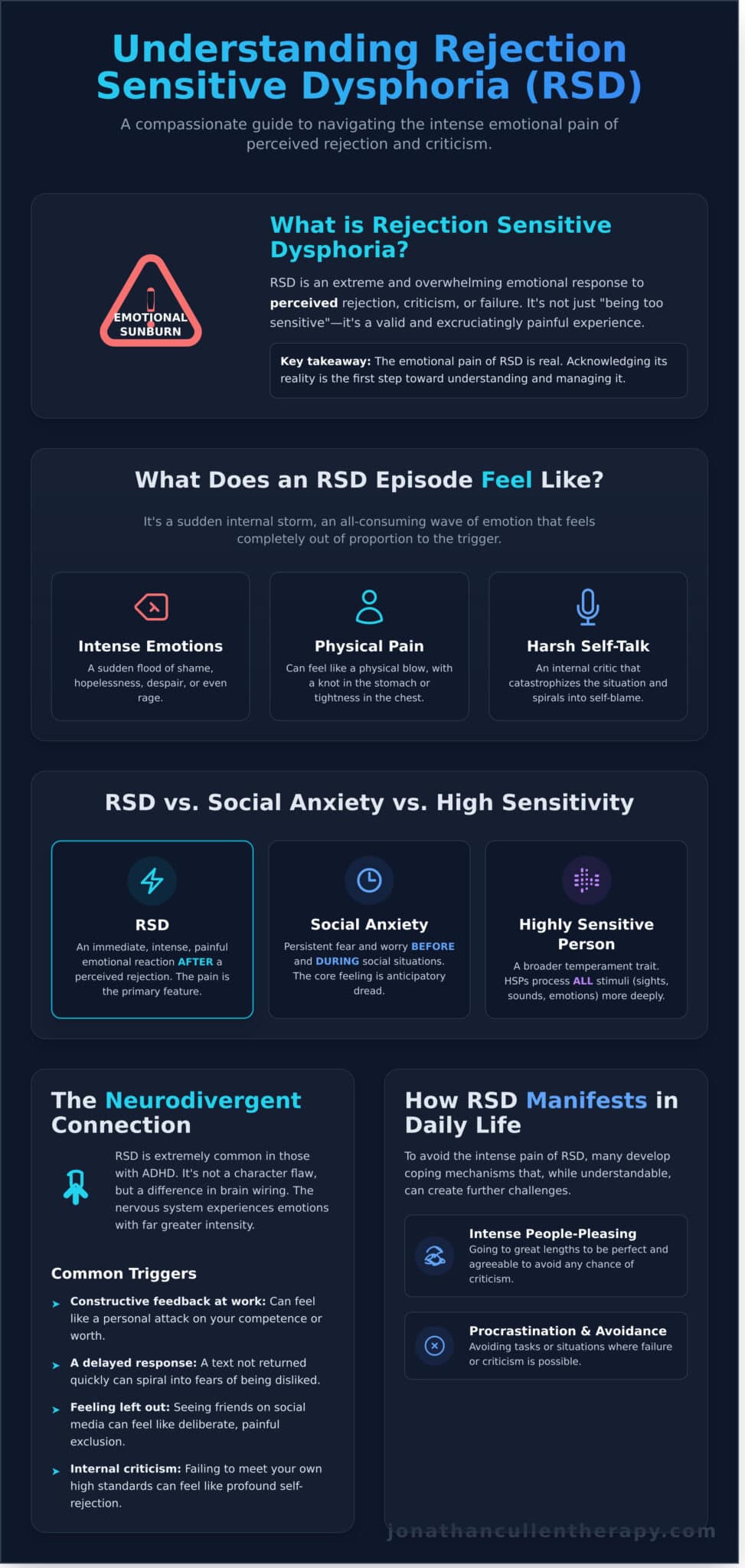
Have you ever felt a physical ache from a critical comment or a wave of despair from an unreturned message? If so, you may be familiar with the profound emotional pain of rejection sensitive dysphoria. This isn’t just about feeling a bit sad or disappointed; it’s an extreme and overwhelming response to perceived rejection, criticism, or failure. While not a formal diagnosis in clinical manuals, it is a widely recognised and deeply felt experience, particularly for many neurodivergent individuals.
The concept is closely related to the broader psychological trait of Rejection sensitivity, but its intensity sets it apart. Imagine having an emotional sunburn, where even the slightest, most unintentional touch causes excruciating pain. This is the reality of RSD. It’s crucial to understand that this pain is real and valid-it is not an overreaction you can simply ‘get over’ or a choice you are making. Acknowledging its reality is the first step on a journey to understanding and managing it.
What Does RSD Actually Feel Like?
For many, an RSD episode feels like a sudden, internal storm. One moment you might feel fine, and the next, you are hit by an all-consuming wave of emotion. This can manifest as intense shame, hopelessness, or even rage that feels completely out of proportion to the trigger. Physically, you might feel a knot in your stomach or a tightness in your chest. Your internal monologue can become incredibly harsh, catastrophizing the situation and launching into a spiral of self-criticism.
RSD vs. Social Anxiety vs. High Sensitivity
It can be easy to confuse RSD with other experiences, but there are key differences. While they can co-exist, understanding their distinctions is vital for finding the right support. Here’s a simple breakdown:
- Rejection Sensitive Dysphoria (RSD): An immediate, intense, and painful emotional reaction that happens after a perceived rejection. The pain is the primary feature.
- Social Anxiety: Characterised by persistent fear and worry before and during social situations. The core feeling is anticipatory dread about being judged.
- Being a Highly Sensitive Person (HSP): A broader temperament trait. HSPs process all stimuli-sights, sounds, and emotions-more deeply. While they may be sensitive to criticism, it is part of a much wider pattern of sensory processing.
The Connection Between RSD and ADHD: Understanding the ‘Why’
If you live with ADHD, the intense, gut-wrenching pain of rejection might feel deeply and personally familiar. While not exclusive to ADHD, rejection sensitive dysphoria is extremely common in neurodivergent individuals. This isn’t a personal failing or a sign of being ‘too sensitive’; it is a genuine difference in brain wiring. The ADHD nervous system often struggles with emotional regulation, meaning feelings are experienced with far greater intensity. Leading experts at ADDitude Magazine describe it as an extreme emotional sensitivity and pain triggered by the perception of being rejected or criticised. Brain structures like the amygdala, the brain’s emotional processing centre, can be more reactive, leading to bigger emotional responses. Understanding that this is a neurological difference, not a character flaw, is a crucial step toward self-compassion.
Common Triggers for RSD in Adults
The emotional pain of RSD can be set off by events that might seem minor to others. It’s important to remember that even the perception or fear of rejection can feel just as real and painful as an actual event. Common triggers include:
- Constructive feedback at work: Even when delivered kindly, it can feel like a personal attack on your worth or competence.
- A delayed response: A friend not texting back immediately can spiral into fears of having upset them or being disliked.
- Feeling left out: Seeing friends socialise without you on social media can feel like a deliberate and painful exclusion.
- Internal criticism: Failing to meet your own high standards can feel like a profound form of self-rejection.
How RSD Can Manifest in Daily Life
To protect yourself from this intense pain, you might develop coping mechanisms that, while understandable, can create further challenges. RSD often shows up in behaviours designed to avoid disapproval at all costs:
- Intense people-pleasing: Going to great lengths to be perfect, agreeable, and helpful to avoid any possibility of criticism.
- Procrastination and avoidance: Putting off tasks or avoiding situations where you might be judged or fail, as the potential pain feels too great to risk.
- Sudden emotional outbursts: Reacting with sudden anger, tears, or defensiveness in a way that seems disproportionate to the situation, because the internal pain is so overwhelming.
Recognising the Two Sides of RSD: Internalising vs. Externalising
When the intense emotional wave of rejection sensitive dysphoria hits, the reaction can look very different from person to person, or even from day to day. If you feel confused by your own responses, please know that this is common. The reactions often follow one of two main paths: turning the pain inward (internalising) or projecting it outward (externalising). It’s important to understand that neither path is ‘wrong’; both are powerful, often unconscious, attempts to cope with what experts describe as the severe emotional pain of perceived rejection. You might find you lean heavily towards one style, or you may switch between them. Recognising your pattern is a compassionate first step toward managing it.
Internalising the Pain: Shame Spirals and Withdrawal
For many, the pain of RSD implodes. This internalising response means the perceived rejection triggers an immediate and devastating drop in self-esteem. You might feel a crushing sense of shame, as if you’ve been exposed as fundamentally flawed or unlovable. This can look and feel like a sudden depressive episode, often leading to behaviours such as:
- Abruptly withdrawing from conversations or social situations.
- Going completely silent, unable to find the words to articulate the hurt.
- Ruminating for hours or even days, replaying your perceived ‘failure’ in your mind.
This inward spiral can be incredibly isolating, leaving you feeling alone with your pain.
Externalising the Pain: Anger and Lashing Out
The other side of the coin is an explosive, externalising reaction. Instead of absorbing the hurt, you might immediately lash out at the person you feel has rejected or criticised you. This sudden, often disproportionate, anger can be shocking both for you and the other person. It’s crucial to see this not as simple aggression, but as a desperate defense mechanism. The anger creates a protective shield against the raw, unbearable feeling of being rejected, pushing the source of pain away before it can hurt you more. While it serves to protect you in the moment, this pattern can be deeply confusing and damaging for your relationships over time.
Gentle and Practical Strategies for Managing RSD
Living with rejection sensitive dysphoria can feel overwhelming, but you can learn to navigate its intense emotional waves. Think of the following strategies as building an emotional first aid toolkit. The foundation of this kit is self-compassion; meeting yourself with kindness, rather than judgment, is the first and most crucial step. The goal is to create a small, powerful space between a trigger and your reaction. In that pause, you can choose a different, more supportive response.
In-the-Moment Techniques to Calm Your Nervous System
When you feel that familiar, sudden drop, your nervous system is in high alert. The key is to gently guide it back to a state of calm. These simple, physical actions can help ground you in the present moment.
- Name it to Tame it: Simply say to yourself, “This is RSD. This feeling is intense, but it will pass.” Acknowledging it can reduce its power over you.
- Grounding Exercise: Engage your senses to pull your focus away from the emotional pain. Notice 5 things you can see, 4 things you can touch, 3 things you can hear, 2 things you can smell, and 1 thing you can taste.
- Mindful Breathing: Try box breathing. Inhale slowly for four counts, hold your breath for four, exhale for four, and hold again for four. Repeat this cycle several times to regulate your heart rate.
- Physical Release: Splash cold water on your face to activate the mammalian dive reflex, which slows the heart rate. Or, try some gentle stretching to release physical tension.
Long-Term Strategies for Building Resilience
While immediate coping skills are essential, building long-term resilience helps soften the impact of RSD over time. This is a compassionate process of learning to trust yourself and others more deeply.
- Find a Reality-Checker: Have a trusted friend or partner you can check perceptions with. A simple message like, “I’m worried I offended someone with my comment, did it come across that way?” can provide crucial external validation.
- Celebrate Small Wins: Your brain is wired to spot rejection. Actively train it to spot acceptance. Keep a small log of compliments, positive interactions, or moments you felt valued and included.
- Re-frame Criticism: Learn to separate constructive feedback from a personal attack. Ask yourself: Is this comment about my action or my worth as a person? This helps you take on board helpful advice without it crushing your spirit.
Developing these skills takes time, patience, and support. You don’t have to build this toolkit alone. Working with a professional in ADHD-informed therapy can provide a safe, non-judgmental space to explore these strategies and create a more grounded, fulfilling life.
How Therapy Can Help You Heal From Rejection Sensitive Dysphoria
While self-help strategies can provide valuable in-the-moment relief, therapy offers a dedicated, supportive space for deeper and more lasting healing. It’s a place to move beyond simply coping and begin to understand the roots of the intense pain that comes with rejection sensitive dysphoria. This isn’t about becoming less sensitive; your sensitivity is a part of who you are. The goal is to learn how to hold that sensitivity without the overwhelming emotional pain.
In therapy, we can work together to explore the experiences and beliefs that fuel these intense reactions. It’s a collaborative journey to gently challenge old narratives-like “I’m not good enough” or “I always get it wrong”-and replace them with a more compassionate, grounded understanding of yourself. You don’t have to face this alone.
What to Look For in a Therapist for RSD
Finding the right therapist is the most important step. Because RSD is so closely linked to neurodivergence, it’s vital to work with someone who gets it. Look for a professional who offers:
- Experience with ADHD and emotional dysregulation. They will understand the neurological underpinnings of your experience and won’t dismiss its intensity.
- A compassionate, non-judgmental approach. You need a safe space where you can be vulnerable without fear of criticism.
- A blend of depth and practical skills. Someone who helps you explore your past while also equipping you with tools to manage emotional floods in the present.
Your Next Steps Towards a Calmer Life
Acknowledging that you need support takes immense courage, and it’s the first step towards feeling more secure and connected. If you are looking for a therapist who understands the nuances of ADHD and neurodiversity from both professional and lived experience, I may be able to help.
I offer a down-to-earth, integrative approach to therapy that honours your unique story. If my way of working resonates with you, I invite you to explore my website and see if it feels like a good fit. A calmer, more fulfilling life is possible.
Your Journey Towards Healing from RSD
Understanding and healing from RSD is a journey, not a destination. Remember that your intense emotional responses are valid, and recognising the connection between rejection sensitive dysphoria and ADHD is a powerful first step towards self-compassion. By implementing gentle strategies and learning to identify your triggers, you can begin to soften its impact on your life and build a more grounded sense of self.
If you’re ready to explore this path with guidance, you don’t have to do it alone. As an ADHD-informed and neurodivergent therapist, I provide a warm, supportive, and non-judgmental space where we can work together. My down-to-earth, integrative approach is designed to help you heal and feel more connected. You don’t have to face this alone. Learn more about my approach to ADHD therapy.
Frequently Asked Questions
Is Rejection Sensitive Dysphoria a real medical diagnosis?
While Rejection Sensitive Dysphoria (RSD) is not currently listed as a standalone diagnosis in major manuals like the DSM-5, it is a widely recognised concept among clinicians, particularly those specialising in ADHD. It describes a very real and severe emotional response to perceived rejection. Recognising it as a legitimate experience is a crucial first step toward finding compassionate support that honours your unique story and emotional landscape.
Can you have RSD without having ADHD?
Yes, it is possible. While RSD is very strongly linked with ADHD, it is not exclusive to it. This intense emotional response to rejection can also be a feature of other conditions, including autism, social anxiety, and complex trauma. The core feature is the experience of extreme emotional pain from perceived criticism, regardless of any other diagnosis you may or may not have. You don’t have to navigate this confusion alone.
How do I know if I have RSD or am just being ‘too sensitive’?
The difference lies in the intensity and impact of the feeling. While most people feel hurt by rejection, RSD involves an overwhelming and unbearable emotional pain that can feel physical. If perceived criticism sends you into an emotional tailspin, causes you to ruminate for hours, or leads you to avoid social situations out of fear, it is more than just sensitivity. It’s a sign that your emotional response is causing significant distress and deserves compassionate attention.
Does medication help with Rejection Sensitive Dysphoria?
There are no medications specifically licensed for RSD in the UK. However, some individuals find that certain medications help manage the intensity of the emotional response. Medications prescribed for related conditions like ADHD (such as Guanfacine) or anxiety can sometimes lessen the severity of RSD symptoms. It is essential to have a thorough discussion with your GP or a qualified psychiatrist to explore if medication could be a supportive part of your journey.
How can I explain RSD to my partner or family?
Explaining this can feel vulnerable, but it is a step toward building connection. You could use an analogy, like having an “emotional sunburn” where even the gentlest touch of criticism causes extreme pain. It helps to clarify that it’s a neurological response, not a choice or a reflection of their intentions. Sharing a trusted article can also provide a grounded, down-to-earth starting point for a supportive conversation, helping them understand your experience.
What is the difference between RSD and Borderline Personality Disorder (BPD)?
While both can involve a deep fear of abandonment, their patterns differ. The emotional pain of rejection sensitive dysphoria is typically a sudden and intense reaction to a specific trigger, which can often pass relatively quickly. In contrast, BPD involves a more chronic and pervasive pattern of instability across relationships, self-image, and emotions, alongside other specific criteria. A formal diagnosis from a qualified professional is vital for clarity and finding the right support.
Can children experience Rejection Sensitive Dysphoria?
Yes, children can absolutely experience RSD. In a child, it might look like an intense emotional outburst over a minor correction, a deep-seated fear of making mistakes at school, or extreme people-pleasing to avoid disapproval. They may also withdraw from social activities for fear of not being included. Creating a warm, non-judgmental, and reassuring environment is vital to help them feel safe and connected while managing these powerful feelings.