
When you’re navigating the profound pain of loss, your feelings can feel overwhelming and chaotic. One moment might bring a deep sadness, the next a surprising numbness, leaving you to wonder if you’re grieving ‘correctly’ or if you’ll feel this way forever. This confusion is a completely normal part of the process. You may have heard about the stages of grief, perhaps worrying that your own experience doesn’t fit a textbook definition. It’s important to remember that you don’t have to face this journey alone.
This gentle guide is here to offer a supportive and non-judgmental space to make sense of it all. We will explore these stages not as a rigid set of rules you must follow, but as a compassionate framework that can give language to your experience. Our goal is to help you understand that your grieving process is uniquely yours and entirely valid. Together, we can find gentle ways to cope with your pain and uncover a sense of hope for the path ahead.
Key Takeaways
- Learn to view the five stages of grief not as a strict checklist, but as a compassionate framework to understand your feelings.
- Your grief journey is entirely your own; there is no ‘right’ way or correct timeline to process a loss.
- Discover the protective purpose behind difficult emotions like denial and anger, helping you approach them with more self-compassion.
- Understand that seeking support is a proactive sign of strength, providing a safe, non-judgmental space to honour your experience.
What Are the Stages of Grief? (And Why They Aren’t a Checklist)
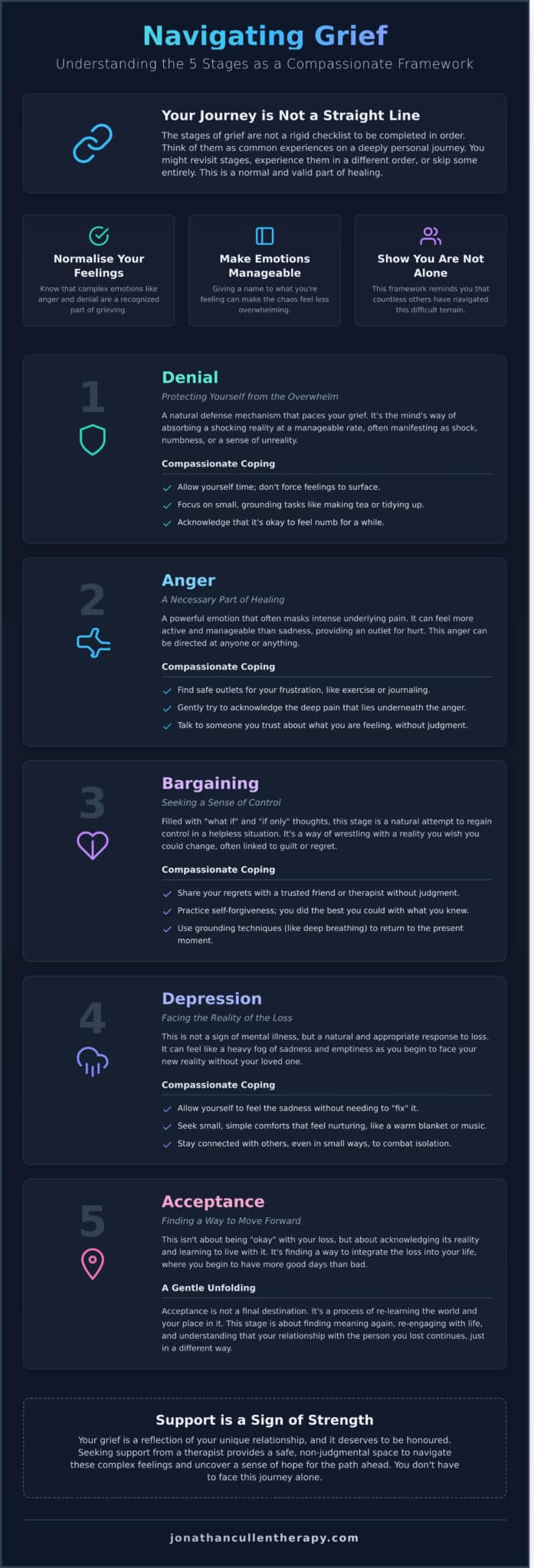
When we experience a profound loss, it’s natural to search for a way to understand the overwhelming emotions that follow. You’ve likely heard of the five stages of grief-denial, anger, bargaining, depression, and acceptance. This framework offers a language for our pain, but it’s vital to see it as a compassionate guide, not a rigid set of rules. It was first introduced by Elisabeth Kübler-Ross from her work with terminally ill patients, helping them process their own mortality, and was later adapted for the bereaved. It’s helpful to think of the Kübler-Ross model of grief not as a checklist, but as a map. A map shows you the possible terrain on a journey, but it doesn’t dictate the exact path you must walk. Your journey through grief is deeply personal, and this model simply illuminates some common landmarks you may encounter along the way.
The Purpose of a Grief Model
If this model isn’t a strict sequence, what is its purpose? Its true value lies in providing comfort and validation during a chaotic time. It helps to:
- Normalise your feelings: Knowing that emotions like anger or denial are a recognised part of grieving can be deeply reassuring.
- Make emotions manageable: Giving a name to what you’re feeling can make the chaos feel a little less overwhelming and more contained.
- Show you are not alone: It reminds you that countless others have navigated this difficult terrain. You don’t have to face it alone.
Moving Beyond a Linear Path
It’s crucial to release any pressure to grieve in the ‘right’ way. The reality of grief is often messy and unpredictable. You might skip a stage entirely, experience them in a completely different order, or find yourself revisiting a feeling you thought you had moved past weeks or even months later. This is not a setback; it is a normal part of the healing process. The nature of your loss, your support system, and your own personality will all shape your experience. Your grief is a reflection of your unique relationship, and it deserves to be honoured in its own time and in its own way.
Understanding these potential emotional states can empower you to navigate them with more compassion for yourself. In the following sections, we will gently explore each of these common experiences in more detail, always remembering that they are simply signposts on your unique journey-not destinations you must reach. The goal is not to complete the stages, but to find a way to move forward with your loss in a way that feels true to you.
Exploring the Five Stages with Self-Compassion
The five stages of grief, first proposed by Elisabeth Kübler-Ross, can be a helpful map for the emotional landscape of loss. It’s vital to see these not as a rigid checklist but as a gentle guide to understanding your feelings. Your journey is unique, and you may not experience these stages in order. Other frameworks, like The Four Phases of Grief, also exist, reminding us that the goal is not to fit a model, but to approach your feelings with compassion.
Denial: Protecting Yourself from the Overwhelm
Denial often feels like shock or a sense of unreality. This isn’t about ignoring the truth; it’s a natural defence that paces your grief so you aren’t completely overwhelmed. It gives you time to absorb the initial shock.
- Allow yourself time; don’t force feelings to surface.
- Focus on small, grounding tasks like making a cup of tea.
- Acknowledge that it’s okay to feel numb for a while.
Anger: A Necessary Part of Healing
You might feel rage or frustration directed at anyone or anything. Anger is a powerful emotion that often masks intense pain. It can feel more active and manageable than profound sadness, providing an outlet for your hurt.
- Find safe outlets like exercise or journaling.
- Gently acknowledge the pain underneath the anger.
- Talk to someone you trust about your frustration.
Bargaining: Seeking a Sense of Control
This stage is filled with “what if” and “if only” thoughts, often linked to guilt. Bargaining is a natural attempt to regain control in a helpless situation. It’s a way of wrestling with a reality you wish you could change.
- Talk about your regrets without judgment.
- Practice self-forgiveness for things you cannot change.
- Use grounding techniques to focus on the present.
Depression: Facing the Reality of the Loss
This can feel like a heavy fog of sadness and emptiness. This is not a sign of mental illness but a natural and appropriate response to a significant loss. It is the quiet process of beginning to face the new reality.
- Allow yourself to feel sadness without needing to “fix” it.
- Seek small, simple comforts that feel nurturing.
- Stay connected with others, even in small ways.
Acceptance: Finding a Way to Move Forward
Acceptance isn’t about being “okay” with your loss, but about acknowledging its reality and learning to live with it. This is where you begin to have more good days than bad and re-engage with life in a new way.
- Create gentle new routines that honour your new reality.
- Find meaning by honouring your loss in a personal way.
- Be patient as you integrate this change into your life story.
Beyond the Five Stages: The Complex Reality of Grieving
While the five stages of grief provide a useful map, it’s important to remember that it is just one map, not the only territory. If you feel your experience doesn’t fit neatly into these boxes, please know you are not alone. Grief is not a linear checklist to be completed; it is a deeply personal and often messy journey that looks different for everyone.
The path of grieving is rarely a straight line. It’s more like a spiral or a maze, where feelings are revisited and re-experienced over time. Understanding this can bring a sense of relief and self-compassion.
The ‘Grief Cycle’: Revisiting Feelings
Have you ever felt you were making progress, only for a song, a date on the calendar, or a familiar scent to pull you right back into a wave of sadness or anger? This is incredibly common. It is not a setback, but a natural part of the healing process. Each time you revisit a feeling, you do so with a little more understanding and resilience. It is a testament to the love you carry, not a sign of failure.
Finding Meaning: A ‘Sixth Stage’ of Grief
Grief expert David Kessler proposed a sixth stage: meaning. This isn’t about finding a reason for your loss, which can feel impossible and unfair. Instead, it’s about finding a way to honour your loved one and integrate their memory into your life in a way that feels purposeful. This could mean:
- Starting a project in their name.
- Sharing their stories with others.
- Finding a new sense of purpose inspired by their life.
When Your Grief Doesn’t Fit the Model
The classic stages of grief don’t cover every emotion. Your experience might also include intense feelings of guilt, profound relief, persistent anxiety, or physical symptoms like fatigue and brain fog. All of these are valid. There is no ‘right’ or ‘wrong’ way to grieve. The most compassionate thing you can do is allow yourself to feel whatever comes up, without judgment. The goal is to honour your unique story and your feelings, whatever they are. If you are struggling to make sense of it all, you don’t have to face it alone.
How Therapy Can Support You on Your Grief Journey
Grief can be an incredibly isolating experience, leaving you feeling adrift in a world that keeps moving. While friends and family offer vital support, sometimes you need a space that is dedicated entirely to your pain. Deciding to seek professional help is a profound act of self-compassion-a sign of strength, not weakness. A therapist acts as a compassionate, grounded guide, walking alongside you as you find your way through the complex emotions of loss.
Creating a Safe Space for Your Feelings
Therapy provides a confidential and non-judgmental environment where every feeling is valid. It’s a place where you don’t have to worry about burdening others or censoring your thoughts. A trained counsellor can hold space for the raw, difficult emotions that often accompany grief-the anger, the deep sadness, the confusion, and even the moments of relief-without passing judgment. This dedicated space allows you to explore the full spectrum of your experience freely and safely.
Navigating Complicated Grief
Sometimes, the journey through the stages of grief doesn’t follow a clear path. If you feel stuck, and the intense pain of loss remains debilitating for a prolonged period, you may be experiencing what is known as complicated grief. Therapy is especially helpful here. A therapist can help you identify the sticking points and provide you with supportive tools and strategies to process the trauma, manage overwhelming emotions, and begin to move forward in a gentle, supported way.
Honouring Your Unique Story of Loss
Your relationship with the person you lost was unique, and so is your grief. A therapist helps you make sense of your personal experience, honouring your unique story and the significance of your loss. Together, you can explore ways to remember and honour your loved one, finding a way to integrate their memory into your life as you build a new future. This process isn’t about “getting over” your loss, but about learning to carry it with meaning and compassion.
You don’t have to navigate this alone. Learn more about grief counselling.
Honouring Your Path Through Grief
Remember, your journey with grief is deeply personal. The well-known stages of grief are not a rigid checklist to complete, but rather a framework to help you understand your feelings. The most important takeaways are to approach yourself with compassion, allow your emotions to unfold without judgment, and recognise that there is no ‘right’ way to grieve. Your path is your own, and every step you take is valid.
Navigating this journey can feel overwhelming, but you don’t have to face it alone. As a therapist experienced in helping clients with loss and trauma, I offer a warm, supportive, and non-judgmental space. My integrative approach is designed to honour your unique story, helping you find a way to carry your loss with greater peace and understanding.
If you’re struggling with loss, you don’t have to face it alone. Reach out to start your journey.
Frequently Asked Questions About the Stages of Grief
How long do the stages of grief last?
There is no set timeline for grief; it’s a deeply personal journey that unfolds at its own pace. Some people may move through feelings in months, while for others, the process can take years. It is important to be gentle with yourself and allow your feelings to exist without a deadline. Your experience is unique, and honouring your own timing is a crucial part of healing. There is no right or wrong way to grieve.
Is it possible to get stuck in one stage of grief?
It can certainly feel like you’re stuck in one place, perhaps in deep anger or persistent denial. While grief is not a linear path, if you feel that your grief is overwhelming and not easing over a long period, it might be helpful to seek support. This isn’t a sign of failure but a compassionate step toward understanding your feelings. Together, we can explore what’s keeping you there and find a gentle way forward.
What is the difference between grief and clinical depression?
While grief and depression share symptoms like sadness, they are different. Grief often comes in waves, with moments of relief, and is directly tied to a specific loss. Clinical depression, however, tends to be a more constant state of low mood and loss of interest that pervades all areas of life. If you are experiencing persistent feelings of worthlessness or are struggling with daily functioning, it is wise to speak with a GP or a therapist to get the right support.
Do you have to experience all five stages of grief to heal?
Absolutely not. It’s helpful to view the stages of grief as a guide, not a checklist. They provide a language for what we might feel, but your journey is your own. You may experience them in a different order, skip some entirely, or revisit them over time. The most important thing is to allow yourself to feel whatever comes up, without judgment. Healing doesn’t require you to fit into a specific model; it honours your unique emotional landscape.
What if I feel relief alongside my grief? Is that normal?
Feeling relief is completely normal and is a very common part of the grieving process. This is especially true if your loved one was suffering from a long illness or if the relationship was complicated. Grief is not one single emotion; it’s a complex tapestry of feelings. Allowing yourself to acknowledge relief without guilt is a compassionate act. It doesn’t diminish your love or your loss-it simply honours the full truth of your experience.
How can I support a friend or family member who is grieving?
The most powerful support you can offer is your calm, non-judgmental presence. Instead of saying “let me know if you need anything,” offer specific, practical help like, “I’m going to the shops, what can I get you?” Listen more than you speak, and avoid clichés. Simply sitting with them in their sadness, without trying to fix it, can be the most compassionate gift you can give. You don’t have to have the answers; you just have to be there.