
If you’re exploring therapy, the sheer number of options can feel overwhelming. You might be worried about choosing the ‘wrong’ type, or that a one-size-fits-all approach won’t truly honour your personal story. It’s a common anxiety, but what if therapy could be shaped to fit you, rather than the other way around? This is the gentle, human-centred philosophy at the heart of integrative psychotherapy UK. It’s a compassionate approach that acknowledges your unique experience by thoughtfully combining different therapeutic tools to create a supportive space that is as individual as you are.
In this down-to-earth guide for 2026, we’ll walk you through exactly what this means in simple, clear terms. Together, we’ll explore how this flexible approach can be tailored to your specific needs, giving you the confidence to take the next step. We’ll also provide a practical checklist to help you find a qualified and supportive therapist here in the UK. You don’t have to figure this all out alone; let’s begin this journey with clarity and warmth.
Key Takeaways
- Understand how integrative psychotherapy tailors different therapeutic tools to fit your unique story, not the other way around.
- Discover why this flexible approach can be effective for complex challenges, especially if you’ve felt that other types of therapy haven’t quite fit.
- Receive a clear, 4-step plan for finding qualified integrative psychotherapy UK professionals, starting with which official accreditations to look for.
- Get a gentle preview of what to expect in your first sessions, focusing on building a warm, non-judgmental therapeutic relationship.
What is Integrative Psychotherapy? A Simple, Human Explanation
The term ‘integrative psychotherapy’ can sound a bit academic, and that’s understandable. But at its heart, the idea is deeply human and straightforward: it’s a form of therapy designed to fit you, not the other way around. It acknowledges that no single approach holds all the answers because no two people are the same.
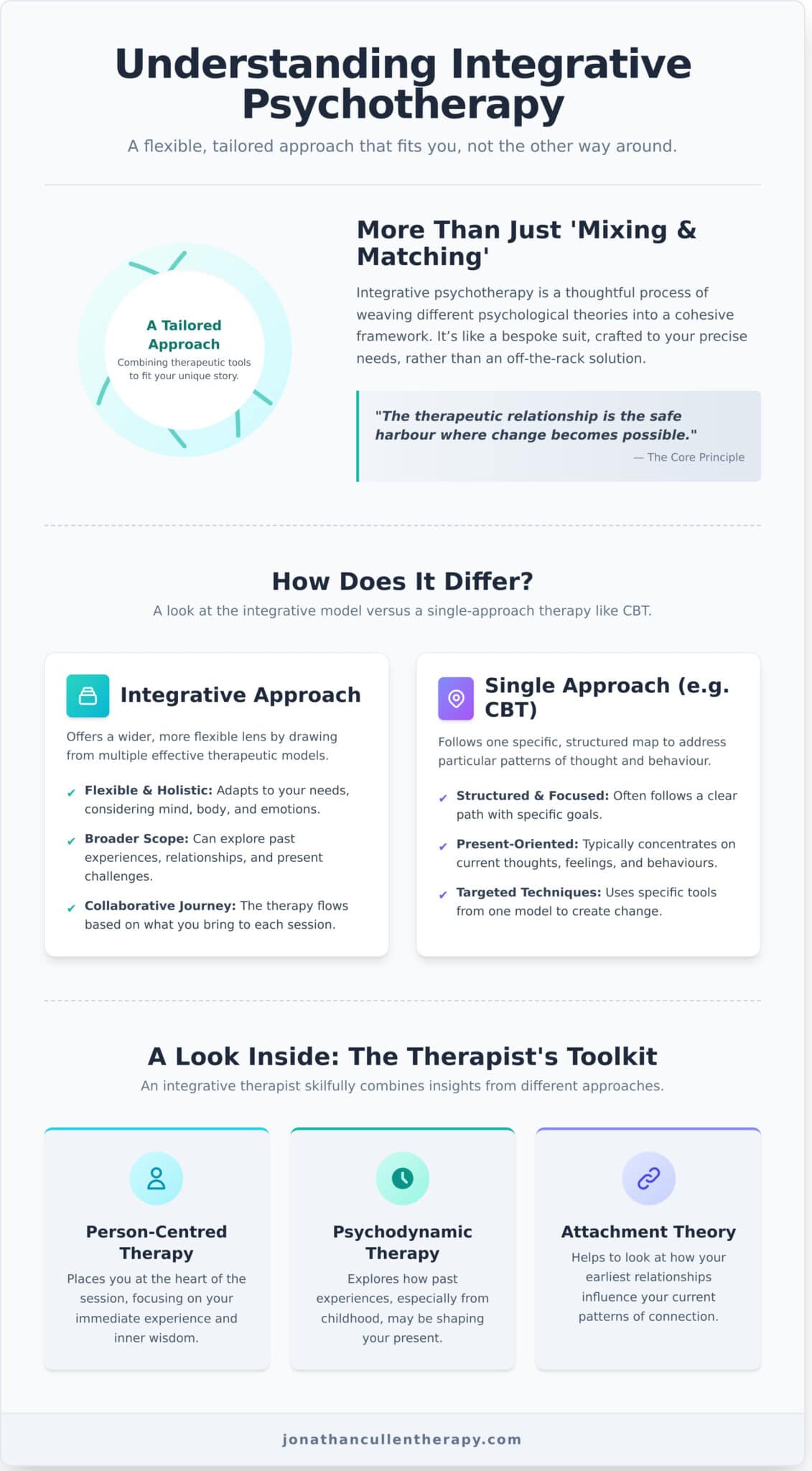
Think of it like the difference between an off-the-rack suit and a bespoke, tailored one. An off-the-rack suit might fit reasonably well, but a tailored one is crafted to your precise measurements, movements, and style. In the same way, while a single therapy model can be helpful, an integrative approach draws from different psychological theories to create a supportive framework that truly honours your unique story. At its core, integrative psychotherapy is a compassionate and flexible way of working where the most important element is always the trusting, non-judgmental relationship between you and your therapist.
It’s More Than Just ‘Mixing and Matching’
It’s a common misconception that this approach involves a therapist simply picking random tools from a toolbox. In reality, it is a highly skilled and thoughtful process. A qualified integrative therapist has been trained to understand various psychological theories-such as psychodynamic, person-centred, and cognitive-behavioural-and weave them together into a single, cohesive framework. The goal is to create a grounded and consistent therapy that works for the whole person: mind, body, and emotions.
How It Differs From Single-Approach Therapies (like CBT)
Many people have heard of therapies like Cognitive Behavioural Therapy (CBT), which is a powerful and effective model. A single-approach therapy like this tends to follow one specific map, often focusing on the connection between your thoughts, feelings, and behaviours in the present moment. This is incredibly useful, but it’s one of many possible paths.
The integrative model offers a wider, more flexible lens. It allows us to explore your past and how it shapes your present, to focus on your relationships, or to use practical, forward-looking tools when you feel stuck. This adaptability is a key reason why the practice of integrative psychotherapy UK wide has become so valued. It means we can still use effective techniques from CBT if they are right for you, while also having the freedom to explore other parts of your experience that are just as important.
A Look Inside an Integrative Session: What to Expect
Stepping into a therapy room for the first time can feel daunting. However, a core principle of integrative psychotherapy is creating a space that feels safe, warm, and completely non-judgmental. There is no rigid formula here. Instead, the first few sessions are dedicated to building a trusting relationship, allowing your therapist to understand your unique story and what has brought you here. This is your journey, and you are an active collaborator. The sessions will adapt and flow based on what you bring each week, ensuring the process always feels relevant and supportive.
The Role of the Therapeutic Relationship
The connection between you and your therapist is the very foundation of the work. It is more than just talking; it’s about building a secure, compassionate, and trusting alliance where you feel truly seen and heard. For many, this relationship itself becomes a powerful source of healing and insight, providing a space to explore new ways of relating to yourself and others. As the saying goes, ‘The therapeutic relationship is the safe harbour where change becomes possible.’
Examples of Theories an Integrative Therapist Might Use
An integrative therapist skilfully weaves together insights from different therapeutic models to honour your individual needs. This flexible, tailored method is supported by a growing body of evidence for integrative psychotherapy, which highlights its effectiveness. Rather than fitting you to a single theory, the theory is adapted to fit you. Here are a few examples of approaches a professional offering integrative psychotherapy in the UK might draw upon:
- Person-Centred Therapy: This approach places you at the heart of the session, focusing on your immediate experience and feelings. For example, we might explore what you are feeling in the here-and-now to help you connect more deeply with your own inner wisdom.
- Psychodynamic Therapy: This perspective helps us understand how past experiences, particularly from childhood, may be shaping your current thoughts and behaviours. For instance, we could gently explore how a past pattern of seeking approval might be causing anxiety in your work life today.
- Attachment Theory: This helps us look at how your earliest relationships have influenced the way you form bonds and connect with others as an adult. We might discuss your early attachment style to shed light on why you feel secure or insecure in your current relationships.
Who Can Benefit? How This Approach Helps With Real-Life Challenges
We are all complex, multi-faceted human beings, and a one-size-fits-all approach to therapy doesn’t always honour our unique story. The core benefit of integrative psychotherapy is its flexibility. It’s a grounded, down-to-earth method designed for the real world, especially for those who feel ‘stuck’ or have found that a single therapeutic model didn’t quite fit.
Because it’s not tied to one rigid framework, this therapy can adapt with you through different life stages and evolving needs. It creates a supportive space to explore deeper questions of meaning, identity, and purpose. As the UK Council for Psychotherapy notes, Humanistic and integrative psychotherapy is built on the idea that the therapeutic relationship itself is key, allowing a therapist to tailor their work to you, the individual.
Support for Anxiety and Depression
If you’re grappling with anxiety or depression, you may feel torn between wanting practical relief and needing to understand the deeper ‘why’. An integrative therapist can blend practical coping strategies from approaches like CBT with a compassionate exploration of the root causes. This dual focus helps you manage symptoms in the here-and-now while also working towards more sustainable, long-term change by understanding the source of your distress.
A Compassionate Approach to Trauma
Trauma is a deeply personal experience held not just in our memories, but in our bodies and nervous systems. It requires a non-rigid, safety-focused approach. An integrative therapist can draw on body-based (somatic) and relational techniques to help you process difficult experiences without feeling overwhelmed. The therapy moves at your pace, creating a secure environment that honours your story and supports your healing journey.
Understanding Neurodivergence (like ADHD)
For many neurodivergent people, including those with ADHD, challenges go far beyond simple symptom management. The experience often involves a lifetime of navigating a world not built for your brain, which can impact self-esteem, relationships, and emotional wellbeing. The landscape of integrative psychotherapy UK offers a way to combine practical coaching with deeper work on identity, helping you understand and embrace your unique way of being in the world.
Finding an Integrative Psychotherapist in the UK: Your 4-Step Guide
Taking the first step to find a therapist can feel overwhelming, but you don’t have to do it alone. This simple guide is designed to make the process feel clearer and more manageable, helping you find the right support for your unique journey. Think of it as a calm, steady path forward.
Step 1: Check for UK Qualifications and Memberships
Your safety and confidence are paramount. In the UK, a therapist’s membership with a professional body shows they have met high standards of training and adhere to a strict ethical code. Look for registration with one of the main governing organisations, such as the BACP (British Association for Counselling and Psychotherapy) or the UKCP (UK Council for Psychotherapy). You can usually find their registration details on their website or directory profile.
Step 2: Use Trusted Directories to Search
The BACP and UKCP websites have searchable directories of their members, which are excellent starting points. When searching, you can often filter for therapists who specialise in integrative psychotherapy UK wide, as well as by location, specific issues (like anxiety or relationships), and whether they offer online or in-person sessions. This helps you narrow down the options to find people who feel like a good fit from the start.
Step 3: Prepare for the Initial Consultation
Most therapists offer a brief, often free, initial call. This isn’t a therapy session but a ‘chemistry check’ – a chance for you both to see if you connect. It’s a supportive, no-pressure conversation. Having a few gentle questions ready can help you feel more grounded.
- How would you describe your integrative approach in practice?
- What is your experience of working with people who are facing [your issue]?
- Could you tell me about your fees, session length, and cancellation policy?
- Do you currently have availability for online or in-person sessions?
Step 4: Trust Your Gut Feeling
While qualifications and experience are crucial, the single most important factor in successful therapy is the relationship you build with your therapist. After your initial chat, take a moment to check in with yourself. Did you feel heard, respected, and safe? The right therapist will create a warm, non-judgmental space where your unique story is honoured. Trust that feeling – it’s your most reliable guide.
My Approach: Down-to-Earth Integrative Therapy in London
Throughout this guide, we’ve explored the theory behind integrative therapy. But what does it look like in the room? My philosophy is simple: therapy should be human, relatable, and grounded in your reality. I believe the most profound healing happens not through rigid techniques, but within a trusting, collaborative relationship where you feel truly seen and heard. It’s this personal, tailored approach that defines the best integrative psychotherapy UK has to offer.
My work is built on the core principle of honouring your unique story. This means I draw from different therapeutic models to create an approach that fits you, not the other way around. Whether we’re exploring patterns in your relationships, managing the overwhelm of anxiety, processing past trauma, or navigating the challenges and strengths of ADHD, our work will be tailored to your specific needs. As a neurodivergent therapist myself, I bring a layer of lived experience to my practice, offering a space of genuine understanding and affirmation.
A Space That Honours Your Unique Story
My primary goal is to provide a warm, compassionate, and non-judgmental space where we can make sense of your experiences together. Whatever you are going through, please know you don’t have to face it alone. Together, we can explore the challenges you’re facing, help you connect more deeply with yourself, and find a way to feel more grounded and resilient in your daily life. This collaborative partnership is at the heart of my therapeutic work.
Ready to Take the Next Step?
I understand that reaching out for support can often be the most difficult part of the journey. To make it easier, I offer an initial consultation. This is simply a 50-minute conversation for us to discuss what’s on your mind, for you to ask any questions, and for us both to get a sense of whether we are a good fit. There is no pressure or obligation to continue. It’s just a chance to connect.
Let’s explore if we’re a good fit. Reach out for a consultation.
Your Path Forward: Embracing a More Connected You
As we’ve explored, therapy isn’t a one-size-fits-all solution. Integrative psychotherapy honours your unique story, blending different therapeutic tools to help you navigate life’s challenges with more clarity and self-compassion. Finding the right support within the world of integrative psychotherapy UK is a powerful first step, and one you have the strength to take.
My approach is grounded, non-judgmental, and built on trust. As a Registered Member of the BACP and a specialist in ADHD-informed therapy, I offer a warm, down-to-earth space where your experiences are validated. Together, we can work to understand the patterns holding you back and find a way forward that feels right for you.
If you feel an integrative approach could be your next step, I invite you to book an initial consultation. You don’t have to walk this path alone.
Frequently Asked Questions About Integrative Psychotherapy
Is integrative psychotherapy effective?
Yes, integrative psychotherapy is widely considered to be a very effective approach. Its strength lies in its flexibility, allowing the therapy to be tailored to your unique story, needs, and goals. By drawing on different proven theories, it provides a comprehensive and adaptable form of support. The collaborative and trusting relationship you build with your therapist is central to the process and a key factor in achieving positive, lasting change.
How is integrative psychotherapy different from counselling?
While both offer a supportive space, psychotherapy often explores issues at a greater depth. Counselling might focus on a specific, current problem over a shorter period. Integrative psychotherapy tends to be more open-ended, exploring how past experiences and ingrained patterns affect your present feelings and behaviours. It’s a gentle journey to understand the root of your difficulties, helping you create meaningful and sustainable change in your life.
How many sessions of integrative therapy will I need?
There is no set number of sessions, as your therapeutic journey is entirely your own. Some people find that short-term work (around 6-12 sessions) is enough to address a specific concern. Others benefit from longer-term, open-ended therapy to explore deeper issues. Together, we will regularly and compassionately review our progress to ensure the pace feels supportive and is meeting your needs as they evolve.
What are the main theories used in integrative psychotherapy?
An integrative psychotherapist thoughtfully combines elements from different schools of thought. Common theories include Person-Centred therapy, which honours your unique experience; Psychodynamic theory, which explores how the past shapes the present; and Cognitive Behavioural Therapy (CBT), which looks at the links between thoughts and actions. This allows your therapy to be tailored specifically to you, rather than fitting you into a single, rigid model.
How much does integrative psychotherapy cost in the UK?
The cost for private integrative psychotherapy UK can vary based on location and the therapist’s experience. Typically, you can expect to pay between £50 and £90 for a 50-minute session. In larger cities like London, rates can be higher, sometimes exceeding £100. Many therapists offer a free or lower-cost initial consultation, so it is always a good idea to check their individual websites for specific fee information.
Can integrative therapy be done online?
Absolutely. Many integrative psychotherapists offer secure and confidential online sessions. This provides a wonderfully flexible and accessible way to receive compassionate support from the comfort and privacy of your own space. The core principles of building a warm, non-judgmental, and trusting relationship remain exactly the same, making online therapy just as effective as meeting in person for many people seeking help.
Is an integrative psychotherapist the same as an eclectic therapist?
While the terms sound similar, there is an important difference. An eclectic therapist may use techniques from different models without a single, unifying theory. An integrative psychotherapist, however, purposefully combines different theories into one cohesive framework. This creates a grounded and intentional approach that is more than just a collection of tools, ensuring your therapy is structured to honour your unique journey towards healing and growth.