
If you’ve spent years wondering why certain things feel so much harder for you, or if you’ve ever felt like an imposter in your own life, please know you are not alone. The thought of figuring out how to get diagnosed with ADHD as an adult in the UK can feel just as overwhelming. The path can seem tangled with long waiting lists, confusing choices between the NHS and private routes, and the very real fear of not being taken seriously by your doctor.
This guide is here to quiet the noise. We’ve created a calm, clear, and compassionate roadmap to help you navigate the entire process. It’s designed to honour your unique story and give you the confidence to take that first, often difficult, step. Step-by-step, we’ll walk you through preparing for your GP appointment, understanding your options, and knowing what to expect from an assessment. Our goal is to demystify the journey, helping you feel seen, understood, and fully prepared for what comes next.
Key Takeaways
- Learn to recognise the key signs of adult ADHD beyond online quizzes, helping you validate the feeling that ‘something has always been different’.
- Discover how to get diagnosed with ADHD by effectively preparing for your GP appointment to clearly communicate your experiences and secure a referral.
- Understand the crucial differences between the NHS and private assessment routes, empowering you to choose the path that best suits your circumstances.
- Demystify the assessment process and learn about the supportive next steps after a diagnosis, helping you feel prepared for the journey ahead.
Recognising the Signs: Is It Time to Seek an ADHD Diagnosis?
For many adults, the path to considering an ADHD diagnosis begins not with a single event, but with a quiet, lifelong feeling that something is just… different. While online quizzes can be a starting point, understanding the real-life impact of these challenges is far more important. This section is not for self-diagnosis, but to offer a compassionate space for self-reflection. It’s about validating that feeling you’ve carried and exploring whether it’s time to seek professional clarity.
Common Adult Struggles That May Point to ADHD
While everyone experiences challenges, for adults with potential undiagnosed ADHD, these issues often form a persistent and disruptive pattern. You don’t have to face it alone. See if any of the following feel familiar in your own unique story:
- Chronic procrastination and task paralysis: A constant battle to start or finish important tasks, even when you understand the negative consequences. It’s more than just laziness; it can feel like a mental wall.
- Difficulty with organisation and time management: A sense of ‘time blindness’ where deadlines frequently sneak up, appointments are forgotten, and keeping your home or workspace tidy feels like an impossible, ongoing battle.
- Emotional dysregulation: Experiencing emotions with great intensity. This can mean feeling quickly overwhelmed, frustrated by small things, or having mood swings that feel out of your control.
- Relationship challenges: Misunderstandings that stem from forgetfulness (like missing a birthday), interrupting others without meaning to, or feeling emotionally distant because your mind is always somewhere else.
These experiences are often central to the challenges of the condition, and you can Learn about Adult ADHD in more detail to see the full clinical picture.
The Emotional Toll of Undiagnosed ADHD
The practical struggles are only half the story. Living with these challenges day after day can take a significant emotional toll, often in ways that are invisible to others. This internal experience is a key reason many people start looking into how to get diagnosed with adhd.
This can manifest as a persistent feeling of failure, shame, or underachievement, as if you’re not living up to your potential despite your best efforts. It’s no surprise that anxiety and depression often co-exist with ADHD, fuelled by years of feeling overwhelmed. Many also experience intense imposter syndrome, believing their successes are just luck and fearing they will be ‘found out,’ because their internal reality doesn’t match their external achievements. If this resonates, know that your feelings are valid and you are not alone.
Step 1: Preparing for Your First Conversation with Your GP
Approaching your GP is the first official step on the NHS pathway, and it’s completely normal to feel anxious about it. Many people worry about not being taken seriously or struggling to find the right words. Remember, this conversation isn’t a test; it’s about clearly and calmly explaining your experiences to get the support you need. Your GP is the gateway to a specialist assessment, so preparing for this appointment is the most empowering thing you can do. Thinking about how to get diagnosed with ADHD can feel overwhelming, but this structured preparation will help you feel grounded and confident.
Gathering Your Evidence
Before your appointment, take some time to collect specific, real-life examples of how you think ADHD affects you. Vague statements like “I’m disorganised” are less helpful than concrete examples. Your goal is to create a clear picture of lifelong challenges. Consider:
- Childhood Examples: Can you find old school reports that mention being “chatty,” “disruptive,” or “a daydreamer”? Did you often lose things or struggle with homework?
- Adult Life Examples: Note down challenges that impact different areas of your life. This could be missing deadlines at work, feeling overwhelmed by household chores, forgetting appointments, or finding it hard to relax in social situations.
- Input from Others: Ask a trusted partner, family member, or close friend for their honest observations. They may have noticed patterns that you haven’t.
Using Self-Screening Tools
A helpful tool to bring to your appointment is a completed Adult ADHD Self-Report Scale (ASRS) checklist. This is a short questionnaire used by professionals to screen for ADHD symptoms. While it is not a diagnostic tool, it provides a structured way to present your symptoms to your GP. Filling it out beforehand and bringing a printed copy can focus the conversation and show that you have thoughtfully considered your concerns.
How to Structure the Conversation
When you begin your appointment, it helps to be direct. Start by clearly stating your reason for the visit: “I’ve been struggling with symptoms I believe might be adult ADHD, and I would like to be referred for a specialist assessment.” This direct approach helps your GP understand your goal and follow the official NHS diagnosis process for ADHD. From there, you can briefly present your list of key examples and explain the significant impact these challenges have on your daily life. Be prepared to be patient, but also be persistent. You are your own best advocate on this journey.
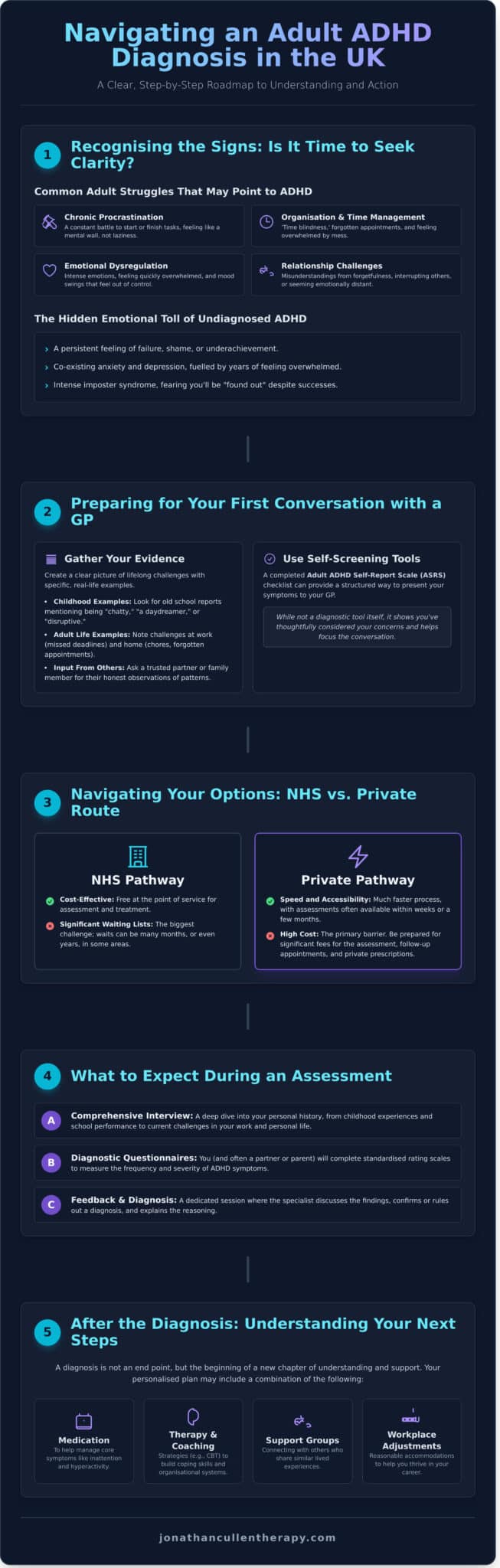
Navigating Your Options: The NHS vs. Private Assessment Route
Deciding how to get diagnosed with ADHD in the UK can feel like a significant first step, and it’s common to feel unsure about which path to take. There are two main routes available: seeking a diagnosis through the NHS or pursuing a private assessment. It’s important to know that there is no ‘right’ or ‘wrong’ choice. The best option depends entirely on your personal circumstances, including your financial situation, how urgently you need support, and your capacity to wait. A formal diagnosis from either pathway is valid and can open the door to understanding and support.
The NHS Pathway: Patience and Process
The journey to an NHS diagnosis typically begins with a conversation with your GP. If they agree that your symptoms warrant further investigation, they will refer you to your local adult ADHD service. Your GP will follow the official NHS guidance on ADHD to make the referral. The most significant advantage of this route is that the assessment and any subsequent treatment, such as medication or therapy, are free of charge. However, the challenge is the waiting time, which can unfortunately be very long-often between one and five years. For those in England, it’s worth exploring the ‘Right to Choose’ scheme, which may allow you to be referred to a different NHS-funded provider with a shorter waiting list.
The Private Pathway: Speed and Cost
If waiting for an NHS assessment feels unmanageable, the private pathway offers a much faster alternative. You can self-refer to a private psychiatrist or a specialist clinic, often getting an appointment within weeks or a few months. This speed, however, comes at a significant financial cost. An initial assessment can range from £700 to £2,000 or more, with additional costs for follow-up appointments and private prescriptions. Once your condition is stabilised, many people successfully arrange a ‘shared care agreement’ with their GP, which allows medication to be prescribed on the NHS, reducing the ongoing expense.
NHS vs. Private: A Quick Comparison
To help you weigh your options, here is a simple breakdown of the key differences:
| Feature | NHS Pathway | Private Pathway |
|---|---|---|
| Cost | Free | £700 – £2000+ for assessment |
| Wait Time | 1 – 5+ years | Weeks to a few months |
| Process | GP referral required | Self-referral is usually possible |
A private diagnosis is recognised and can often be transferred to your NHS record, making it a valid starting point for your support journey. Making this choice can feel overwhelming, and you don’t have to navigate it alone. Feeling unsure? Therapy can help you process your options.
What to Expect During an Adult ADHD Assessment
The thought of a formal assessment can feel daunting, but knowing what to expect can help ease any anxiety. An adult ADHD assessment is not a quick chat or a single test. It’s a comprehensive and compassionate evaluation designed to build a complete and nuanced picture of you-honouring your unique story, both past and present. The process is typically led by a specialist, such as a psychiatrist or a clinical psychologist with expertise in neurodiversity, who will guide you through each step in a supportive way.
The ultimate goal is to achieve clarity, understand how your brain works, and identify the right support for you moving forward. It’s a collaborative journey of discovery.
The Clinical Interview: Exploring Your Lived Experience
The core of the assessment is an in-depth, guided conversation about your life. This is a non-judgmental space to share your experiences. Your clinician will ask about the symptoms you’re facing now, but they will also explore your history, including:
- Your childhood and experiences at school
- Your career path and workplace challenges
- Your relationships with family, partners, and friends
- How symptoms may have changed or persisted over time
This historical context is a crucial part of understanding how to get diagnosed with ADHD accurately, as it helps the clinician see long-term patterns of behaviour consistent with the condition.
Questionnaires and Rating Scales
Alongside the interview, you will likely be asked to complete several standardised questionnaires. These are not pass-or-fail tests but tools that help provide objective data about your symptoms. Sometimes, with your permission, a partner, parent, or close friend who has known you for a long time may also be asked to fill one out. This provides a valuable external perspective and adds another layer of information to the assessment.
Ruling Out Other Conditions
A thorough assessment involves more than just looking for signs of ADHD. Your clinician will also carefully consider other conditions that can have similar or overlapping symptoms, such as anxiety, depression, bipolar disorder, or the effects of trauma. Differentiating between these is vital because an accurate diagnosis is the foundation for effective and meaningful support. This ensures that any treatment plan created is tailored specifically to your needs.
The journey to understanding yourself is significant, and you don’t have to walk it alone. If you have questions about the process or need support, feel free to explore how therapy can help.
After the Diagnosis: Understanding Your Next Steps
Receiving an ADHD diagnosis is not an endpoint; it is a new beginning. The journey of how to get diagnosed with adhd can feel like the final hurdle, but it’s really the starting line for a new chapter of self-understanding. It can bring a wave of complex emotions-relief that you finally have an explanation, validation for past struggles, and sometimes even a sense of grief for the challenges you faced without support. This is the moment you begin to build a toolkit that honours your unique brain, focusing on strategies and support rather than trying to ‘fix’ a deficit.
Processing the News
Give yourself time and space to process this new information. An ADHD diagnosis can act as a lens, re-framing your life story and helping you see past difficulties not as personal failings, but as the recognisable traits of a neurotype. This is a journey that requires immense self-compassion. You are learning a new language for how your mind works, and it’s okay to take that one step at a time.
Exploring Treatment and Support
With a diagnosis, you unlock access to a range of supportive options in the UK. This is about finding what works for you, and you don’t have to face it alone. Your support plan may include:
- Medication: Your psychiatrist may discuss stimulant (e.g., methylphenidate) or non-stimulant (e.g., atomoxetine) medications to help manage core symptoms. This is a personal choice, made in collaboration with your specialist.
- Therapy & Coaching: Learning practical strategies is often life-changing. ADHD coaching can help with executive functions like planning and organisation, while therapy provides a supportive space to explore the emotional impact of ADHD.
- Workplace Adjustments: Under the Equality Act 2010, you have the right to request ‘reasonable adjustments’ at work. This could include noise-cancelling headphones, flexible working hours, or software to help with organisation.
Finding Your Community
Connecting with other neurodivergent adults can be incredibly validating. Suddenly, you’re in a room (real or virtual) with people who just get it. UK-based charities like ADHD UK and The ADHD Foundation offer invaluable resources, webinars, and support groups. Sharing experiences and strategies with peers reduces isolation and builds confidence. For many, navigating this new path is made easier with professional guidance; ADHD-informed therapy can be a vital part of your support system, offering a compassionate space to explore your identity and build a fulfilling life.
Taking the Next Step with Confidence
Navigating the path to an ADHD diagnosis can feel overwhelming, but it’s a journey toward understanding and self-compassion. This guide has walked you through the crucial stages, from preparing for your GP appointment to choosing the assessment route that’s right for you. Understanding how to get diagnosed with adhd is the first, powerful step towards living a more authentic life.
A diagnosis isn’t an endpoint; it’s a new beginning. As a qualified, neurodivergent therapist with my own lived experience of ADHD, I offer a warm, non-judgmental space-either online or in North West London. My integrative approach is designed to honour your unique story and help you explore what comes next.
Remember, seeking clarity is a courageous act. You are already on your way to a more connected and fulfilling future.
Frequently Asked Questions About Getting an ADHD Diagnosis
How long does it take to get an ADHD diagnosis in the UK?
The waiting time for an ADHD diagnosis in the UK varies significantly. Through the NHS, the journey can be lengthy, often taking many months or even several years from referral to assessment. Pursuing a private diagnosis is much faster, usually taking a few weeks to a couple of months. While the wait can feel discouraging, understanding these timelines can help you decide on the best path forward for your unique situation.
How much does a private ADHD assessment cost in the UK?
A private ADHD assessment in the UK typically costs between £700 and £2,000. This price can vary depending on the clinic, the clinician’s experience, and what is included, such as follow-up appointments or initial medication reports. It’s always a good idea to request a clear breakdown of costs from any potential provider so you feel fully informed and prepared before you begin the process.
Can I get diagnosed with ADHD online?
Yes, you can get diagnosed with ADHD online through many private clinics in the UK. These virtual assessments are conducted by qualified psychiatrists or clinical psychologists and are just as valid as in-person ones. It is important, however, to choose a reputable provider whose diagnostic reports are recognised by the NHS, especially if you plan to seek a shared care agreement for medication with your GP later on.
Will an ADHD diagnosis affect my job or driving licence?
This is a common and understandable concern. In the UK, ADHD is recognised under the Equality Act 2010, meaning employers must make reasonable adjustments and cannot discriminate against you. For driving, you only need to inform the DVLA if your ADHD symptoms or any medication you take negatively affect your ability to drive safely. A diagnosis itself does not automatically impact your licence.
Do I need a formal diagnosis to get ADHD therapy?
You do not need a formal diagnosis to begin therapy for ADHD-like symptoms. Many people seek support to manage challenges with focus, organisation, or emotional regulation while they are on a waiting list or exploring their options. A compassionate therapist can offer strategies and a non-judgmental space to explore your experiences, helping you feel more grounded and in control, with or without a formal diagnosis.
What’s the difference between an ADHD assessment for a child and an adult?
The assessment process differs mainly in the sources of information. For a child, the assessment relies heavily on input from parents and teachers to build a picture of their behaviour and developmental history. For adults, the process of figuring out how to get diagnosed with ADHD focuses more on your own life experiences, from childhood to the present. It involves self-reporting, in-depth interviews, and sometimes input from a partner or close relative.