
If you’re scrolling through endless online directories, ticking boxes and filtering by postcode, the search itself can feel deeply overwhelming. It’s easy to feel like just another number in a clinical system, especially when what you’re truly seeking is a genuine, human connection. The journey to find a therapist in North London shouldn’t add to your burden; it should be the first step toward feeling supported. You deserve to find someone who sees you, hears you, and won’t greet your story with a cold, judgmental distance.
This guide is here to offer a calmer, more grounded path forward. We’ve created a practical, down-to-earth framework to help you cut through the noise and find a professional who truly honours your unique experience. Here, you’ll discover what to look for beyond a profile, what to ask in a consultation to gauge a real connection, and how to trust your instinct in finding a warm, non-judgmental space to explore what’s on your mind. You don’t have to face this alone.
Key Takeaways
- Learn why the connection you feel with your therapist is the most important factor for success, often outweighing the specific therapy model used.
- Get a clear, down-to-earth explanation of therapy types like CBT and Integrative Psychotherapy to help you feel more confident in your options.
- Follow a simple, step-by-step framework to confidently find a therapist north london, from identifying your core needs to verifying professional credentials.
- Discover the benefits of local, in-person therapy and how a therapist who honours your unique story can make all the difference in your journey.
Why the “Therapeutic Alliance” is the Most Important Factor in Your Search
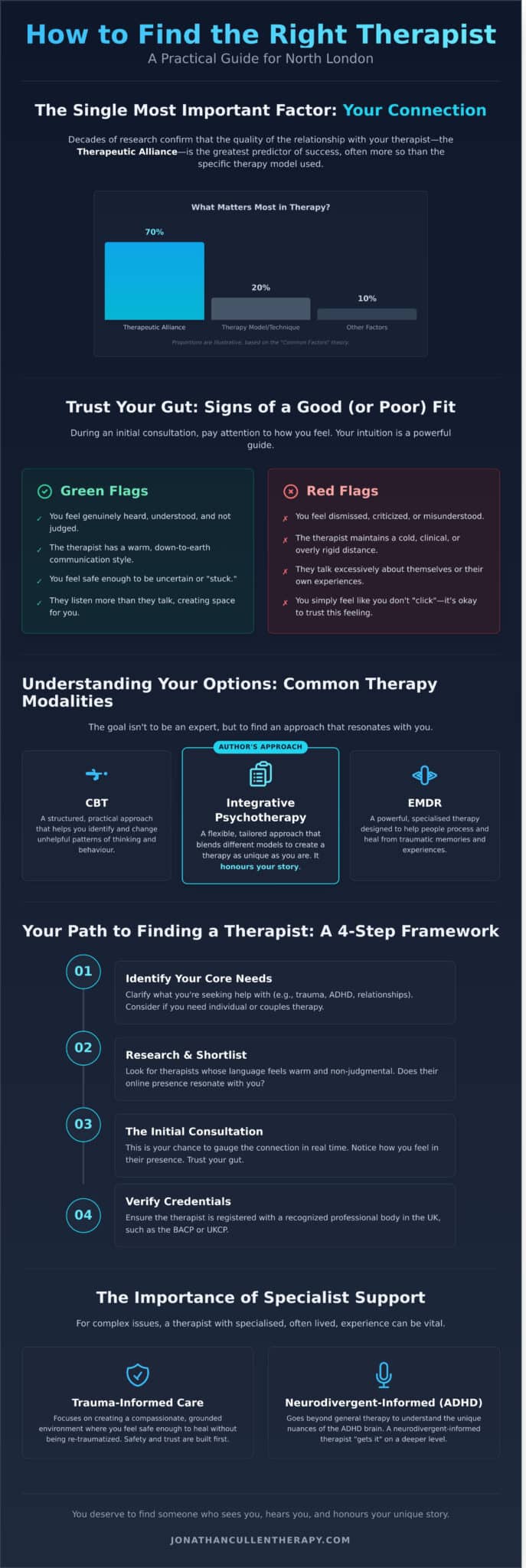
When you begin to find a therapist in North London, you’ll encounter a wide range of qualifications, specialisms, and therapeutic models. While these are important, decades of research consistently point to one factor that outweighs all others: the quality of the relationship you build with your therapist. This connection is known as the Therapeutic Alliance, and it is the foundation upon which all meaningful progress is built.
It’s about moving beyond a clinical mask to find a therapist who is grounded, human, and genuinely present with you. The goal isn’t to find the most academically decorated therapist, but to find the person with whom you feel safe enough to be vulnerable. You can often get a sense of this from their website or profile. Look for language that feels warm, non-judgmental, and honours your unique story.
The Science of Connection in Therapy
The “Common Factors” theory in psychotherapy suggests that the success of therapy is less about a specific technique (like CBT or psychodynamic) and more about the shared elements present in all effective therapy. The most significant of these is the alliance. Feeling truly heard, understood, and respected is a clinical necessity, not a luxury. When you feel this connection, your nervous system begins to relax its defences, creating the safety needed to explore difficult feelings and experiences without being overwhelmed.
Signs of a Good Fit vs. a Poor Fit
Trusting your gut during an initial consultation is crucial. Pay attention to how you feel in the therapist’s presence. Are you tensing up, or do you feel a sense of ease? Here are some simple flags to watch for:
- Green Flags: You feel a sense of being truly understood and not judged. The therapist has a warm, down-to-earth communication style, and you feel safe enough to be uncertain or “stuck.” They listen more than they talk.
- Red Flags: You feel dismissed, criticised, or judged. The therapist talks excessively about their own experiences, maintains a cold clinical distance, or you simply feel like you don’t “click.”
Remember, you are not obligated to continue with the first therapist you meet. Finding the right fit is a perfectly normal and essential part of your therapeutic journey.
Understanding Your Options: Therapy Modalities in North London
When you begin to look for support, you’ll quickly encounter a world of acronyms and different therapeutic styles. It can feel overwhelming, but understanding these options is the first step toward finding a therapist in North London who truly fits your needs. The goal isn’t to become an expert, but to find an approach that resonates with you and feels right for your journey.
Here’s a simple, down-to-earth guide to some common terms:
- CBT (Cognitive Behavioural Therapy): A structured, practical approach that helps you identify and change unhelpful patterns of thinking and behaviour.
- EMDR (Eye Movement Desensitization and Reprocessing): A powerful, specialised therapy designed to help people process and heal from traumatic memories and experiences.
- Integrative Psychotherapy: A flexible and collaborative approach that blends different therapeutic models to suit the individual.
What is Integrative Psychotherapy?
Instead of fitting you into a rigid framework, an integrative approach draws from different schools of thought to create a therapy that is as unique as you are. This tailored model honours your unique story and experiences, providing a more holistic and responsive path to healing than a one-size-fits-all method. As a practitioner of Integrative Psychotherapy, I believe this flexibility is essential for building a trusting and effective therapeutic relationship.
Specialist Support: ADHD and Trauma
For complex issues like trauma or neurodivergence, a specialist approach is often vital. General therapy can sometimes miss the nuances of an ADHD brain, but a neurodivergent-informed therapist understands these differences, often from lived experience. Similarly, trauma-informed care is about creating a compassionate, grounded environment where you feel safe enough to heal without being re-traumatized. It’s about building a foundation of trust first.
Finally, consider whether you need individual or couples therapy. Are the challenges you’re facing rooted in your personal journey, or are they playing out primarily within your relationship dynamics? Deciding on the right path is a key step, and the mental health charity Mind offers an excellent guide on How to Narrow Down Your Search to help clarify your needs. Knowing your focus will make it much easier to find a therapist in North London who can offer the right kind of support.
How to Narrow Down Your Search: A Step-by-Step Framework
Once you’ve made the brave decision to seek support, the next step can feel just as daunting: how do you actually choose the right person? This can feel overwhelming, but you don’t have to face it alone. This simple framework is designed to guide you gently through the process, helping you move from a sea of options to a shortlist of trusted professionals who feel right for you.
Start by gently clarifying what you’re hoping to work on. Is it managing anxiety, navigating relationship challenges, or seeking support for ADHD? Knowing your primary need helps you search with purpose. There are many different approaches, and understanding the main Therapy Modalities in North London can provide a helpful starting point. From there, you can begin to look for someone who honours your unique story and has experience in that area.
Using Directories Effectively Without the Overwhelm
Professional directories like the BACP (British Association for Counselling and Psychotherapy) and UKCP (UK Council for Psychotherapy) are the best places to start when you want to find a therapist in North London. Use their filters to narrow down by location and therapeutic approach, such as ‘Integrative’ or ‘CBT’. Seeing that a therapist is accredited by one of these bodies offers peace of mind that they meet rigorous professional standards. But don’t stop there. Read their profile carefully-does their language feel warm and compassionate? Look for a voice that resonates with you and makes you feel understood before you even reach out.
What to Ask During a Consultation Call
Most therapists offer a free initial consultation call. This is your chance to see if you ‘click.’ It’s not an interrogation, but a conversation to see if the connection feels safe and supportive. Trust your intuition. To help guide the chat, consider asking a few questions:
- Practical: “How do you typically work with someone experiencing [your specific issue]?”
- Vibe-check: “Could you describe your therapeutic style? Are you more directive or do you follow the client’s lead?”
- Logistical: “Do you offer in-person sessions in North London, and what is your availability and fee per session?”
Booking two or three of these calls can give you a clear sense of who you feel most comfortable with, empowering you to make a grounded and confident choice for your journey ahead.
The Benefits of Finding a Local Therapist in North West London
In our increasingly digital world, the convenience of online therapy is undeniable. Yet, for many, the decision to find a therapist in North London for in-person sessions offers a unique sense of connection and grounding that a screen cannot always replicate. There is a powerful, unspoken dynamic that comes from sharing a physical space-a feeling of being truly seen and heard in a dedicated, confidential environment.
Choosing a local therapist means more than just convenience; it’s about creating a supportive anchor within your own community. It bridges the gap between your therapeutic journey and your daily life, making self-care an integrated part of your local routine rather than a disconnected appointment in your calendar.
Therapy in Hendon: A Quiet Space for Reflection
My practice in Hendon (NW4) is designed to be a calm, supportive sanctuary away from the bustle of London life. Easily accessible for residents of Golders Green (NW11), Finchley, and surrounding areas, it provides a peaceful space to explore your thoughts and feelings. For many, the short journey to the session becomes a valuable transition time-a few moments to gather your thoughts beforehand and a quiet walk to process your reflections afterwards.
In-Person vs. Online: Making the Choice in 2026
While online therapy offers vital flexibility for busy Londoners, some therapeutic approaches, like Integrative Psychotherapy, truly flourish with face-to-face interaction. So much of our communication is non-verbal, and being in the same room allows for a deeper understanding of body language and subtle emotional cues. This shared presence can often accelerate the process of building a strong, trusting therapeutic relationship.
Unsure which is right for you? You might find it helpful to read our guide: Is Online Therapy as Effective as In-Person?
Ultimately, the choice is deeply personal. When you decide to find a therapist in North London, the goal is to find a space where you feel safe and understood, whether online or in-person. If you are ready to explore what a down-to-earth, supportive therapy journey could look like for you in Hendon, I invite you to get in touch.
Starting Your Journey with Jonathan Cullen Therapy
The decision to begin therapy is a significant one, and my goal is to make that first step feel less daunting. My “down-to-earth” approach is designed to remove the intimidation of starting, creating a grounded, human connection from our very first conversation. When you decide to find a therapist in North London, what matters most is finding a space where you feel seen, heard, and truly understood.
I am committed to honouring your unique story. As an integrative therapist, I draw from various therapeutic models to create a personalised approach that fits your specific needs-not the other way around. My practice is also neurodivergent-informed, which means my work is grounded in a deep, personal understanding of different ways of thinking and experiencing the world. This isn’t just a professional specialism; it’s a commitment to authentic empathy and creating a truly inclusive space where you can be yourself without judgment.
A Compassionate Space for Individuals and Couples
Whether you are navigating personal challenges or seeking to heal and strengthen your relationship, support is here for you. My practice offers a warm, confidential environment for both individuals and couples to explore their difficulties and build a more connected future. You don’t have to face it alone. For those specifically looking for relationship support, you can learn more about my approach to Couples Counselling London.
Ready to Move Forward?
Taking the next step is simple. You can reach out through my website to book a warm, supportive initial conversation. This is a no-obligation opportunity for us to connect, for you to ask any questions, and to see if we are a good fit. My practice is a non-judgmental, inclusive atmosphere for everyone. Your search to find a therapist in North London can end with a conversation that feels safe and hopeful.
Your journey towards clarity and healing deserves to begin in a place of calm and acceptance.
Taking the Next Step on Your Journey
As we’ve explored, the path to finding support is a deeply personal one. Remember that the most crucial factor is the ‘therapeutic alliance’-that genuine connection that allows you to feel safe and truly understood. Having a clear framework demystifies the process, turning the often daunting task to find a therapist north london into a manageable and hopeful step forward.
If my down-to-earth, compassionate approach resonates with you, I invite you to reach out. As a BACP Accredited Therapist with a specialism in ADHD-informed and trauma therapy, I provide a non-judgmental space from my convenient North West London practice in Hendon. You don’t have to navigate this journey alone.
Taking that first step is an act of courage and self-compassion. Book a warm, supportive consultation with Jonathan Cullen Therapy today and let’s begin the conversation.
Frequently Asked Questions
How much does a private therapist in North London typically cost in 2026?
In 2026, you can expect the cost for a private therapist in North London to range from approximately £70 to £150 per 50-minute session. This fee often reflects the therapist’s experience, qualifications, and specific location. Some practitioners may offer a limited number of lower-cost sessions or a sliding scale based on income. It’s always a good idea to discuss fees directly during your initial enquiry to ensure clarity and comfort as you begin your therapeutic journey.
What is the difference between a counsellor and a psychotherapist?
While the terms are often used interchangeably in the UK, there can be a subtle distinction. Counselling is often shorter-term, focusing on a specific current issue like stress or bereavement. Psychotherapy tends to be a longer-term process, exploring deeper, recurring patterns of thought and feeling that may originate in your past. Both offer a supportive, non-judgmental space, and the most important factor is finding a professional who feels right for you and honours your unique story.
How long does a typical course of therapy last?
The duration of therapy is a deeply personal journey with no set timeline. Some individuals find that a short-term approach of 6 to 12 sessions is sufficient to navigate a specific challenge. Others benefit from longer-term, open-ended work to explore more complex issues. This is a collaborative decision between you and your therapist, and it can be reviewed together as you progress. The right pace is the one that feels supportive and effective for you.
Can I find a therapist in North London who specializes in ADHD?
Yes, absolutely. It is becoming much easier to find a therapist in North London who specialises in ADHD and other forms of neurodivergence. Many therapists now have specific training and even lived experience, offering a deeply compassionate and informed space. When searching, look for terms like “ADHD-informed” or “neurodivergent-affirming.” Working with someone who truly understands the ADHD experience can be a powerful step in feeling seen and supported.
Is therapy covered by private health insurance in the UK?
Many private health insurance providers in the UK, such as Bupa, AXA, and Aviva, do offer coverage for psychotherapy and counselling. However, policies vary greatly, so it is crucial to contact your provider directly. You will need to confirm the extent of your coverage, including how many sessions are authorised, whether you need a referral from your GP, and if your chosen therapist is registered with them before you begin your sessions.
What happens if I don’t feel a connection with my therapist after the first session?
This is a completely normal and important part of the process. The therapeutic relationship is the foundation of effective therapy, and a strong sense of connection and safety is vital. If it doesn’t feel like the right fit, you should feel empowered to seek another therapist. A professional practitioner will understand and respect your decision. The initial consultation is just as much for you to assess the therapist as it is for them to assess your needs.
Do therapists in North London offer evening or weekend appointments?
Yes, many therapists recognise the need for flexibility around work and family life. A significant number of practitioners offer evening appointments during the week, and some also provide sessions on Saturdays. These slots are often in high demand, so it’s wise to mention your availability needs during your initial contact. Most therapists will clearly state their working hours on their website or professional directory profile, helping you find a time that fits your schedule.