
Living with Obsessive Compulsive Disorder can feel incredibly isolating, especially if you’ve tried therapy before and felt misunderstood. The fear of being judged for your intrusive thoughts can be overwhelming, and the process of finding the right obsessive compulsive therapist can feel like another daunting task on an already long list. It’s common to feel stuck, unsure of where to turn or what qualifications to even look for. But you don’t have to face this journey alone.
This guide is designed to be a warm, supportive resource to help you navigate this process with confidence. We will walk you through how to identify a true OCD specialist in the UK, understand the most effective treatment approaches, and find a professional who creates a safe, non-judgmental space that honours your unique story. Together, let’s find the support you deserve to regain control and begin the journey toward a more connected, fulfilling life.
Key Takeaways
- Your recovery journey is unique; learn why specialised, evidence-based therapy is essential for managing OCD effectively.
- Finding the right obsessive compulsive therapist means knowing which specific credentials and treatment experience to look for.
- Feel empowered in your first consultation by asking targeted questions that reveal a therapist’s true expertise and approach to OCD.
- Discover why the connection you feel with your therapist is just as important as their qualifications, and how to assess this personal ‘fit’.
Why Specialist OCD Therapy is Crucial for Your Recovery
If you are living with the weight of obsessive thoughts and compulsive behaviours, you might feel misunderstood or alone. It’s a common misconception that OCD is simply about being extra tidy or worrying a bit too much. In reality, Obsessive-compulsive disorder is a complex and often debilitating condition that requires a very specific therapeutic approach. While any therapy can feel like a step forward, working with a specialist is essential for meaningful, long-term recovery.
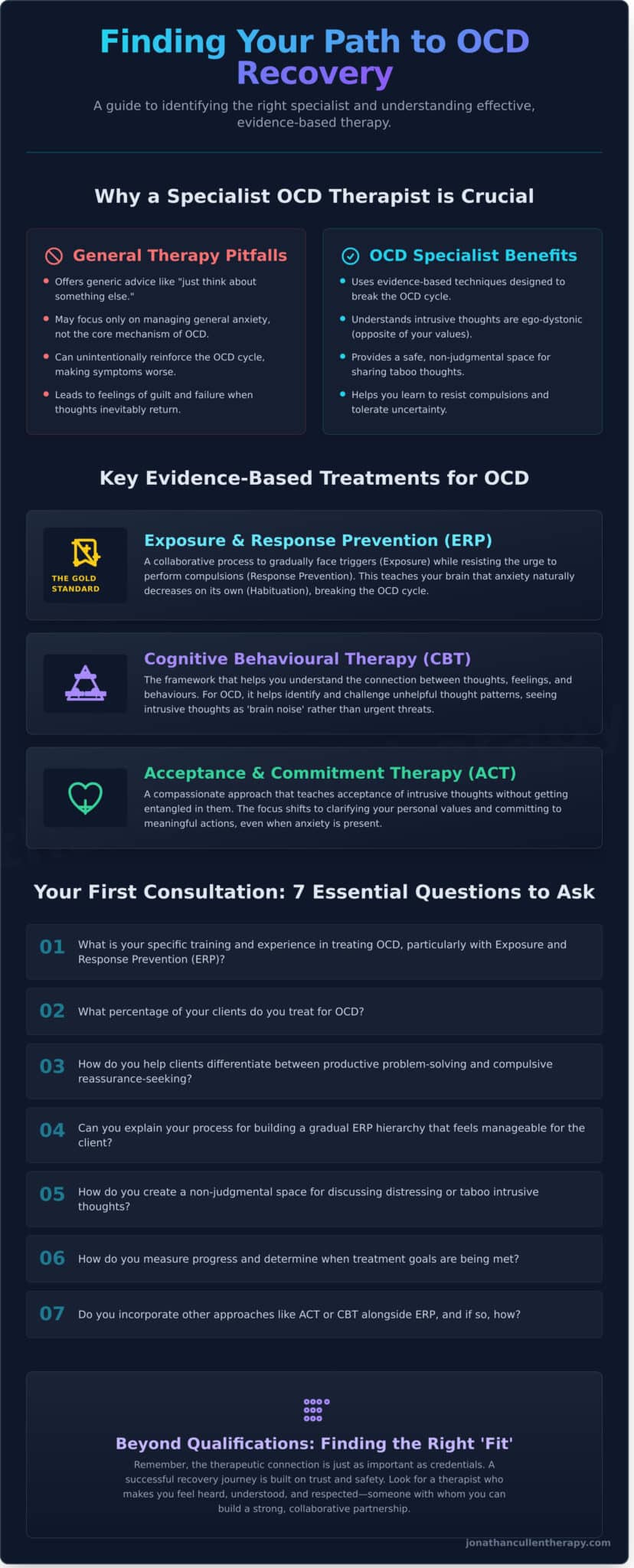
A well-meaning therapist without specialised training may offer generic advice like “just try to think about something else” or focus only on managing anxiety. For someone with OCD, this advice can be counterproductive, increasing feelings of guilt and failure when the thoughts inevitably return. Incorrect therapeutic methods can unintentionally reinforce the OCD cycle, making symptoms worse. A dedicated obsessive compulsive therapist understands the precise mechanics of the disorder and uses evidence-based techniques designed to break the cycle, not just cope with it.
Understanding Intrusive Thoughts
We all have strange or unwanted thoughts from time to time. However, for someone with OCD, these intrusive thoughts become persistent, distressing obsessions. A specialist understands that these thoughts are ego-dystonic-meaning they are the opposite of your true values and desires. They provide a compassionate, non-judgmental space where you can share even the most taboo or frightening thoughts without fear of being misunderstood.
The Role of Compulsions and Rituals
Compulsions are the actions you feel driven to perform to reduce the intense anxiety caused by an obsession. This creates a temporary feeling of relief, but it’s a trap that strengthens the cycle. These rituals can be overt, like checking or cleaning, or covert, such as mental reassurance-seeking. An experienced obsessive compulsive therapist helps you resist these urges and learn to tolerate the uncertainty, which is the key to breaking free.
Key Treatments for OCD: Understanding Your Therapeutic Options
When you begin your search for support, it’s important to know that not all therapy is equally effective for Obsessive Compulsive Disorder (OCD). The journey to recovery is unique, but it is guided by specific, evidence-based approaches. Understanding these options empowers you to have a confident conversation with a potential therapist and find the right fit. The goal is to find a path that helps you regain control from the grips of OCD, and there are well-researched treatments for OCD that can guide you there. An experienced obsessive compulsive therapist will be trained in these gold-standard methods.
Exposure and Response Prevention (ERP): The Gold Standard
Exposure and Response Prevention is widely considered the most effective treatment for OCD. While the idea can sound intimidating, it is a gentle and collaborative process. Together, we would work at your pace to gradually face situations or thoughts that trigger your obsessions (Exposure) while you learn to resist the urge to perform compulsions (Response Prevention). The aim is to learn through direct experience that your anxiety naturally decreases on its own, a process called habituation. It is challenging work, but it is also incredibly empowering.
Cognitive Behavioural Therapy (CBT) for OCD
Cognitive Behavioural Therapy (CBT) provides the framework for understanding how your thoughts, feelings, and behaviours are connected. For OCD, it helps you identify and challenge the unhelpful thought patterns that fuel the cycle of obsessions and compulsions. You’ll learn practical skills to see intrusive thoughts for what they are-just ‘brain noise’ or mental spam-rather than urgent threats you must act on. It’s helpful to know that ERP is a highly specialised behavioural therapy that sits within the broader CBT family.
Acceptance and Commitment Therapy (ACT)
Acceptance and Commitment Therapy (ACT) offers a complementary and compassionate approach. Instead of fighting to eliminate intrusive thoughts, ACT teaches you to accept their presence without getting entangled with them. The focus shifts towards clarifying what is truly important to you-your values-and committing to actions that align with them, even when anxiety is present. A skilled obsessive compulsive therapist often uses ACT alongside ERP to build psychological flexibility and help you create a more fulfilling life.
How to Find a Qualified OCD Therapist: A Step-by-Step Guide
Taking the first step to find support can feel like a huge task, especially when you’re already feeling overwhelmed. The sheer number of choices can be daunting, but you don’t have to face it alone. Let’s break down the process into simple, manageable steps, focusing on what truly matters: finding a qualified professional who understands the nuances of OCD and feels like the right fit for you.
Where to Look for Therapists
A great starting point is to use trusted directories that vet their members. This ensures a baseline of professional standards and qualifications. Here are some of the most reliable places to begin your search in the UK:
- Professional Bodies: Directories from the British Association for Counselling and Psychotherapy (BACP), the UK Council for Psychotherapy (UKCP), and the British Association for Behavioural and Cognitive Psychotherapies (BABCP) are excellent resources.
- Specialist Charities: Organisations like OCD Action and OCD-UK often have lists of therapists who specialise in treating obsessive-compulsive disorder.
- Targeted Online Searches: Using specific search terms like ‘obsessive compulsive therapist North London’ can help you find practitioners in your local area.
- GP Referrals: Your GP can be a valuable source of information and may be able to refer you to trusted local services or private therapists.
What to Look for on Their Website or Profile
Once you have a few names, their online profile is your next stop. This is where you can get a real sense of their expertise and approach. Look for clear indicators that they are experienced in this area. Do they specifically list OCD as a specialism? Pay close attention to the treatments they mention. A well-qualified therapist will often highlight evidence-based approaches like Exposure and Response Prevention (ERP) and Cognitive Behavioural Therapy (CBT), which are fundamental to how OCD is diagnosed and treated effectively. Reading their ‘About Me’ page will also give you a feel for their personality and therapeutic style.
Creating Your Shortlist
Aim to create a shortlist of two or three therapists who seem like a good potential fit. Consider the practical details that will make therapy sustainable for you, such as their location (e.g., whether they are easily reachable in Hendon or offer online sessions), their session fees, and their availability. As you review each one, jot down any questions you might have about their experience or methods. This preparation helps you make the most of an initial consultation call. Remember, this is about finding a supportive, collaborative relationship. My approach honours your unique story and experience.
Your First Consultation: 7 Essential Questions to Ask
Making that first call to an obsessive compulsive therapist can feel daunting, but it helps to remember that this is a two-way conversation. You are not just being assessed; you are interviewing them to see if they are the right partner for your journey toward recovery. This is your opportunity to gauge their expertise, understand their approach, and most importantly, see if you feel a sense of safety and connection.
Feeling prepared with a few questions can transform anxiety into empowerment. To help you feel more grounded and confident, here are seven essential questions to guide your conversation:
Questions About Their Experience and Approach
- What is your experience treating someone with my specific type of OCD?
OCD manifests in many unique ways, from contamination or checking compulsions to purely obsessional themes (Pure O). An experienced therapist should be able to speak to their familiarity with your specific challenges, which can be incredibly reassuring.
- What does a typical OCD therapy session with you look like?
This question helps demystify the process. Will it be structured? Will you be setting goals together? Understanding the flow of a session helps you know what to expect and reduces uncertainty.
- How do you approach Exposure and Response Prevention (ERP) in a collaborative and manageable way?
ERP is the gold standard for OCD treatment, but it can sound intimidating. A compassionate therapist will explain how they’ll work with you to create a hierarchy of exposures that feels challenging but never overwhelming, honouring your unique story and pace.
Questions About the Therapeutic Process
- How do you measure progress in therapy?
Knowing how you’ll track your journey can be motivating. Do they use specific scales, or is progress measured against the personal goals you set together? This shows they have a structured, client-centred approach.
- What would be expected of me between sessions?
Effective OCD therapy often involves work outside of the therapy room. Asking about “homework” helps you understand the level of commitment required and what your week-to-week journey might involve.
- What are your fees, and do you offer a free initial chat?
It’s essential to understand the financial investment. Ask clearly about the cost per session (e.g., £60, £80), payment methods, and cancellation policies. Many therapists in the UK offer a brief, free introductory call to ensure a good fit.
- Do you offer online or in-person sessions?
Finally, consider the practicalities. Does their availability and format-whether online, in-person, or a hybrid model-work with your life and preferences?
Above all, pay attention to how you feel during the conversation. Do you feel heard, respected, and understood? The right obsessive compulsive therapist will create a non-judgmental space where your questions are welcomed. Trust your intuition-it’s one of your most valuable guides in this process. If you feel ready to take that next step, I offer a free introductory chat to explore if we’re a good fit to work together.
Beyond Qualifications: Finding a Therapist Who is the Right ‘Fit’
You’ve checked their credentials and confirmed they specialise in Exposure and Response Prevention (ERP). But the final, and perhaps most crucial, step in your search is finding an obsessive compulsive therapist who feels right for you. Effective therapy is built on a strong, trusting relationship. While specialist qualifications are the essential foundation, feeling safe, understood, and respected is what allows the real work of recovery to begin.
Think of your therapist as a partner on your journey, not just a clinical instructor. They should be someone you feel comfortable being vulnerable with, someone who honours your unique story and champions your progress. This connection, often called the ‘therapeutic alliance’, is a powerful predictor of successful outcomes. It’s the space where you can feel empowered to face your fears.
Signs of a Good Therapeutic Fit
During an initial consultation call, pay close attention to how you feel. Are you simply being told what to do, or are you having a genuine conversation? Here are a few positive signs to look for:
- You feel heard and respected. They listen without judgment, validate your experiences, and make you feel that your struggles are taken seriously.
- They explain things clearly. They can describe their approach in a way that makes sense to you and patiently answer any questions you have, avoiding overly clinical jargon.
- Their communication style is warm and empathetic. You get a sense of genuine compassion and reassurance from the way they speak to you.
- You feel a sense of hope. Even after a brief conversation, you should feel a small sense of relief or optimism that recovery is possible with their support.
Trusting Your Gut
If something feels ‘off’ during an initial call, it’s important to listen to that feeling. It is perfectly okay if the first person you speak to isn’t the right one for you. Don’t feel pressured to commit to sessions if you feel dismissed, misunderstood, or uncomfortable in any way.
Finding the right therapist is a deeply personal process and one of the most important investments you can make in your own wellbeing. You deserve to work with someone who not only has the right skills but also provides a supportive space where you feel you can truly heal. If you’re ready to see if we might be a good fit, I invite you to take the next step.
Schedule a free, no-obligation call to see if we’re a good fit.
Taking the Next Step Towards Freedom from OCD
Finding the right support is the most critical step in managing Obsessive Compulsive Disorder. As we’ve explored, recovery is most effective with a specialist who understands evidence-based treatments, and your personal connection with them is just as vital as their qualifications. The process of finding a qualified obsessive compulsive therapist might feel overwhelming, but by asking the right questions and trusting your instincts, you can find a true partner for your healing journey.
You don’t have to navigate this path alone. As a BACP-registered therapist with a specialism in OCD, Anxiety, and ADHD-informed therapy, I provide a warm, down-to-earth, and compassionate space for my clients. If my approach resonates with you and you feel ready to move forward, I invite you to connect.
You don’t have to face this alone. Contact me to schedule a free 15-minute consultation.
Reclaiming your life from OCD is possible. Reaching out for support is the first, most powerful move you can make.
Frequently Asked Questions About OCD Therapy
How long does therapy for OCD usually take?
The journey of therapy is unique to each person, so there is no fixed timeline. However, for evidence-based treatments like Exposure and Response Prevention (ERP), many people see significant progress within 12 to 20 weekly sessions. The goal isn’t a quick fix, but to build lasting skills and confidence. Together, we will work at a pace that feels supportive and right for you, focusing on creating sustainable change in your life.
What is the difference between an OCD specialist and a general counsellor?
While a general counsellor can provide wonderful emotional support, an OCD specialist has specific, advanced training in treatments proven to work for OCD, like ERP. They understand the unique cycles of obsessions and compulsions and have the precise tools to help you break free. Choosing a dedicated obsessive compulsive therapist ensures you are receiving the most effective, evidence-based care tailored to your specific needs, which is a crucial step in your recovery journey.
Can OCD be treated with medication alone, or do I need therapy?
Medication, like SSRIs, can be very effective in reducing the anxiety and intensity of obsessive thoughts, making daily life more manageable for many. However, therapy is where you learn the practical skills to confront your fears and resist compulsions long-term. For this reason, the most effective and recommended approach is often a combination of both medication and specialised therapy, creating a comprehensive and supportive plan for your well-being.
Is online therapy as effective as in-person therapy for OCD?
Yes, for many people, it absolutely is. Numerous studies have shown that online therapy, especially ERP delivered via video call, is just as effective as face-to-face sessions. The most important factor for success isn’t the location, but the quality of the therapeutic relationship and the expertise of your therapist. Online sessions can offer a comfortable, accessible, and equally supportive space for you to do this important work from home.
What if I’m too scared to do the exposure tasks in ERP?
This is a completely understandable and very common fear, and please know you don’t have to face it alone. A compassionate therapist will never force you into a situation you’re not ready for. We start small, creating a hierarchy of fears together. We will move at your pace, building your confidence step-by-step in a warm, non-judgmental space. The entire process is a collaboration, designed to empower you, not overwhelm you.
How much does private OCD therapy typically cost in the UK?
The cost of private therapy can vary depending on the therapist’s location and experience. In the UK, you can typically expect to pay between £60 and £150 per session. Therapists with specialist training in OCD may be at the higher end of this range. It’s always a good idea to ask a potential therapist about their fees upfront. Some may offer a sliding scale, and it’s also worth checking if your private health insurance provides any coverage.