
The thought of searching for an anxiety therapist near me can feel like another weight on already heavy shoulders. If you’re feeling stuck or overwhelmed by the process, you are not alone. Where do you even begin? The endless list of names, the confusing acronyms like CBT and integrative therapy, and the daunting task of making that first call can be enough to stop you from starting. It’s a courageous step to seek support, and this journey is one you don’t have to navigate by yourself.
This guide was created to offer a supportive, down-to-earth companion for your search. We will gently walk you through each part of the process, from demystifying different therapy types available in the UK to offering practical tips on what to ask in a first consultation. Our hope is to help you feel grounded, prepared, and confident in your choice, so you can connect with a compassionate professional who truly honours your unique story and can support you in finding lasting relief.
Key Takeaways
- Acknowledging you need support is a brave first step. Learn to recognise the key signs that it might be time to find professional help for anxiety.
- Discover the most effective places to begin your search for an anxiety therapist near me, from trusted professional directories to understanding the NHS pathway.
- The connection you have with your therapist is vital. Understand how to find a ‘good fit’ and get simple explanations of different therapeutic approaches.
- Feel prepared and less nervous for your first contact. This guide provides key questions to ask and clarifies what to expect from your initial session.
Recognising You’re Ready: The First Step is the Bravest
If you are reading this, you have already taken a courageous first step. The decision to search for an anxiety therapist near me is a powerful sign of strength and self-awareness. It’s an acknowledgement that you deserve to feel more grounded, calm, and in control. Many people feel overwhelmed or unsure where to begin, and that’s perfectly okay. This journey is about honouring your unique story, and it starts right here, with this moment of recognition.
It can be difficult to distinguish between everyday stress and something more persistent. We all worry from time to time, but when anxiety begins to cast a shadow over your daily life, it might be time to seek compassionate support. Recognising the difference is key to moving forward.
Is It More Than Just Worry? Common Signs of Anxiety
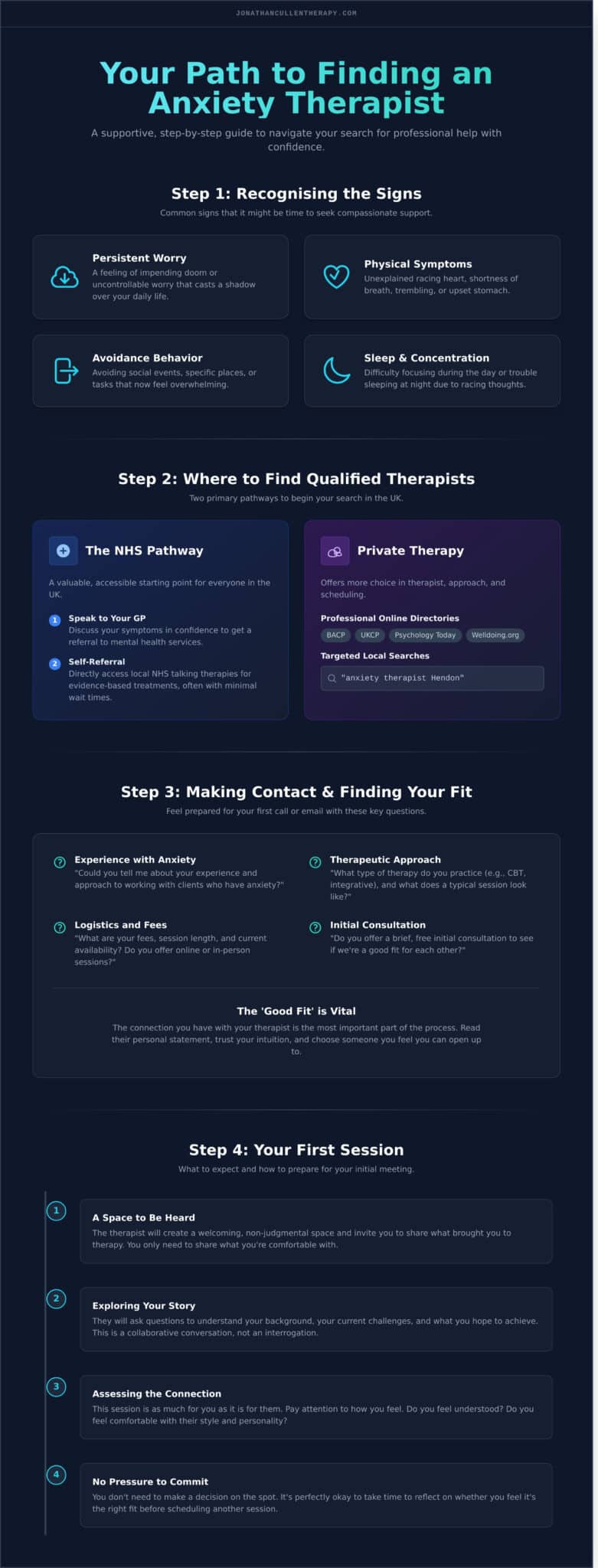
Anxiety can show up in many ways, and it’s not just a feeling in your head. It often manifests physically and behaviourally. You might be ready for support if you consistently experience:
- A persistent sense of worry or a feeling of impending doom that is difficult to control.
- Physical symptoms such as a racing heart, shortness of breath, trembling, or an upset stomach with no clear cause.
- Avoiding social events, specific places, or tasks that you used to handle with ease because they now feel overwhelming.
- Difficulty concentrating during the day or trouble falling asleep at night due to racing, repetitive thoughts.
Why Professional Support Makes a Difference
Navigating these feelings alone can be exhausting. This is where therapy provides a supportive, down-to-earth space to explore what’s happening without judgment. Professional support isn’t about finding a quick fix; it’s a collaborative process of understanding and healing. A core part of this journey involves understanding psychotherapy. It’s a dedicated time and space for you to be heard, understood, and guided toward meaningful change.
Working with an anxiety therapist helps you to not only manage the symptoms but also to gently explore the root causes. Together, we can build a toolkit of practical coping strategies tailored specifically to you, helping you feel more connected and prepared to face life’s challenges. You don’t have to face this alone. Finding the right anxiety therapist near you is about finding a partner for your journey toward a more fulfilling life.
Where to Look: Finding Qualified Anxiety Therapists in London
Beginning your search for support can feel like a significant step, but you don’t have to navigate it alone. In a city as large as London, knowing where to look is key. Fortunately, there are several clear and reliable pathways to connect with a qualified professional who can help you on your journey towards feeling more grounded and in control.
For many people in the UK, a conversation with a GP is a valuable first step. They can discuss your symptoms in confidence and refer you to appropriate mental health services. You can also self-refer directly to find local NHS talking therapies, which provide effective, evidence-based treatments for anxiety, often with minimal waiting times.
Navigating Online Directories Effectively
Professional online directories are one of the most powerful tools for finding a private anxiety therapist near me. These websites allow you to browse detailed profiles, check qualifications, and find someone whose approach truly resonates with you. Key directories include:
- The British Association for Counselling and Psychotherapy (BACP)
- UK Council for Psychotherapy (UKCP)
- Psychology Today
- Welldoing.org
Use the filters to narrow your search by specialism (e.g., ‘Generalised Anxiety’, ‘Panic Attacks’), location, and the type of therapy offered. It’s often worth looking beyond the first page of results. Take time to read each therapist’s personal statement-this is where you’ll get a real sense of their personality and whether you might feel comfortable opening up to them.
Local Searches and Community Resources
A simple, targeted search can be incredibly effective. Using specific phrases like ‘anxiety therapist Hendon’ or ‘counselling North West London’ will yield highly relevant results for your area. Don’t overlook local community centres or charitable organisations, as many offer excellent, low-cost counselling services. For those based in North West London, my practice offers a supportive space in Hendon to explore your feelings in a down-to-earth, non-judgmental environment.
Finally, a recommendation from a trusted friend can be a helpful starting point. However, it’s important to remember that the therapeutic relationship is unique and deeply personal. What works for one person may not be the right fit for another. Always trust your own instincts when making that first connection.
What to Look For: Choosing the Right Anxiety Specialist for You
When you start looking for an anxiety therapist near me, the number of options can feel overwhelming. But finding the right person is about more than just qualifications; it’s about connection. The relationship you build with your therapist is the foundation of your journey towards feeling better. Let’s explore the key things to consider to help you find a supportive, compassionate professional who feels right for you.
Decoding Therapeutic Approaches
Therapists use different methods, or ‘modalities’, to help you explore your anxiety. While the terms can seem complex, the goal is always the same: to provide a safe space for you to understand and manage your feelings. Different therapeutic models are designed to address the complex nature of anxiety; for a deeper dive into the condition, the National Institute of Mental Health offers a helpful guide on Understanding Anxiety Disorders. Here are a few common approaches:
- Cognitive Behavioural Therapy (CBT): A practical, structured approach focused on identifying and changing unhelpful thought patterns and behaviours.
- Integrative Psychotherapy: A flexible and personalised approach where the therapist draws from various models to best honour your unique story.
- Psychodynamic Therapy: This therapy explores how past experiences and unconscious thoughts might be shaping your present feelings of anxiety.
While the approach is important, research consistently shows that the quality of the therapeutic relationship is the most significant factor in a successful outcome. The method matters, but the connection often matters more.
Essential Qualifications and Experience
Feeling safe starts with knowing your therapist is a qualified professional. In the UK, look for registration with a recognised professional body like the BACP (British Association for Counselling and Psychotherapy) or the UKCP (UK Council for Psychotherapy). This ensures they meet strict standards for training and ethical practice. Check their website to see if they specifically list anxiety as a specialism. If your anxiety is linked to other experiences, such as trauma or being neurodivergent (e.g., ADHD), look for a therapist with experience in those areas too. A good therapist will be open and happy to answer questions about their background.
The Importance of ‘The Fit’
This is the most personal part of your decision. Therapy is a relationship built on trust, and it’s essential you feel comfortable. As you browse websites or have initial calls, ask yourself: Do they seem warm and non-judgmental? Does their tone feel reassuring? Trust your intuition. You need to feel that this is someone you can be open and vulnerable with. Remember, this is a collaborative journey, and finding a therapist who makes you feel seen, heard, and safe is paramount.
Finally, consider the practicalities. Think about location (online or in-person), session costs (which typically range from £50 to £90 per session in the UK), and whether their availability matches yours. Many therapists offer a free introductory call, which is a perfect opportunity to discuss these details and, most importantly, see how you feel speaking with them.
Making Contact: What to Ask in Your First Call or Email
You’ve done the research and have a shortlist of potential therapists. Taking that next step to make contact can feel like the hardest part of the entire journey. It’s completely normal to feel apprehensive or unsure of what to say. Please know that therapists expect this; they understand the courage it takes to reach out.
To make the process feel more grounded and less overwhelming, it helps to prepare a few questions beforehand. Remember, this initial contact is a two-way street. While the therapist is learning about you, you are also interviewing them to see if they are the right fit for your unique story. Finding a good anxiety therapist near me or you is about connection and comfort, and this first interaction is your chance to gauge that.
A Simple Template for Your First Email
Sending an email can be a gentle way to break the ice. It gives you time to gather your thoughts without the pressure of a live conversation. Here is a straightforward, effective template you can adapt:
Subject: New Client Enquiry
Dear [Therapist’s Name],
I am writing to you today as I am seeking therapy to help with anxiety. I found your details on [e.g., Psychology Today, your website] and your approach seems like it could be a good fit.
Please could you let me know if you are currently accepting new clients? If so, I would be grateful for the opportunity to book a brief introductory call to discuss working together.
I look forward to hearing from you.
Best regards,
[Your Name]
Key Questions for an Initial Consultation Call
An introductory call, often free and lasting 15-20 minutes, is the perfect opportunity to ask key questions. This conversation will help you determine if their personality, style, and expertise align with your needs.
- Experience and Approach: What is your experience working with people with anxiety? How would you describe your therapeutic approach (e.g., CBT, person-centred)?
- Logistics and Fees: What is your availability for sessions? What are your fees per session, and do you offer any sliding scale rates? What is your cancellation policy? In the UK, fees can range from £50 to over £150, so clarifying this is important.
- The First Session: What can I expect in our first full session together? How do you begin the process of building a therapeutic relationship?
Asking these questions helps demystify the process and empowers you to choose the best possible support. This client-centred focus is crucial for building a trusting and effective therapeutic partnership, an approach I deeply value in my own practice.
Your First Session: What to Expect and How to Prepare
Taking the step to book your first therapy session is a significant achievement. It’s completely normal to feel a mix of hope and nervousness about what comes next. The most important thing to remember is that this initial meeting isn’t about finding an instant ‘fix’. Instead, it’s a dedicated, non-judgmental space for you to begin sharing your story and for us to see if we can build a strong, supportive connection.
The goal is simple: to see how you feel. It’s an opportunity to experience the therapeutic environment and decide if it feels like the right place for you to explore, heal, and grow. You don’t have to face this journey alone.
Before You Arrive
A little preparation can help ease any pre-session jitters, but remember, there is no pressure to perform. The focus is on you and your comfort. Here are a few things to consider:
- Think about your hopes for therapy. You might have specific goals, or you might just have a general feeling that something needs to change. It’s perfectly okay if you don’t have clear answers yet; simply thinking about it can be a helpful starting point.
- Give yourself plenty of time. Rushing can increase anxiety. Plan your journey to the clinic or set up your online space a little early so you can arrive feeling as calm and grounded as possible.
- Let go of expectations. You don’t need to have a perfectly rehearsed story. This is your time, and you can share as much or as little as you feel comfortable with.
What Happens During the Session
The first session is a two-way conversation. While I will guide the discussion, it’s also your chance to ask questions and get a feel for my down-to-earth approach. We will likely touch on what prompted your search for an anxiety therapist near me, explore some of your background, and discuss confidentiality. Together, we’ll start to understand what’s bringing you to therapy now and collaboratively decide if we are a good fit to continue this important work.
After the First Session
Once the session is over, take some time to reflect on the experience. The connection you have with your therapist is one of the most vital parts of the process. Ask yourself:
- Did I feel heard and truly listened to?
- Did I feel respected and understood, without judgment?
- Could I see myself building trust with this person?
If the answer to these questions isn’t a clear ‘yes’, that is perfectly fine. It’s essential that you find the right person for you, and it’s okay to meet with another therapist if the connection doesn’t feel right. Your comfort and safety are the top priorities.
Ready to take this step? Let’s talk.
Your Journey to a Calmer You Starts Here
Taking the first step towards getting support is the most important one. This guide has walked you through recognising you’re ready, finding qualified professionals, and knowing what to expect from your first session. Your search for an anxiety therapist near me is a courageous act of self-care, and the right therapeutic relationship-one built on trust and understanding-can make all the difference.
You don’t have to navigate this path alone. I specialise in anxiety, offering a warm, supportive, and non-judgmental space from my practice in Hendon, North West London. With a down-to-earth, integrative approach and my own lived experience as a neurodivergent therapist, I am here to honour your unique story. If you feel I could be the right therapist for you, please reach out to book an initial consultation. A more grounded, connected life is waiting for you.
Frequently Asked Questions About Finding an Anxiety Therapist
How much does therapy for anxiety cost in London?
Understanding the investment for therapy is an important first step. In London, the cost of seeing a private anxiety therapist typically ranges from £60 to over £150 per 50-minute session. This price can vary based on the therapist’s experience, location, and qualifications. Many therapists also offer a limited number of lower-cost sessions for those on a reduced income, so it is always worth asking if this is a possibility for you.
Is online therapy as effective as in-person for anxiety?
Yes, for many people, online therapy is just as effective as meeting in person. Research has shown that online sessions can provide the same level of support and lead to meaningful, lasting change. The best choice often comes down to your personal preference. Online therapy offers great flexibility and comfort, while in-person sessions provide a different kind of connection. The goal is to find the format where you feel most safe and supported.
How long does therapy for anxiety usually take?
The length of therapy is a unique journey for each individual. Some people find that short-term therapy (around 6-12 sessions) is enough to learn new coping skills for specific anxieties. Others benefit from longer-term work to explore deeper, underlying patterns. There is no “right” amount of time. Together, you and your therapist will create a plan that honours your unique story and moves at a pace that feels comfortable for you.
What’s the difference between a counsellor, psychotherapist, and psychologist?
While these roles often overlap, there are general distinctions. Counsellors typically focus on specific, present-day issues. Psychotherapists often work more in-depth to explore how past experiences and deep-rooted patterns affect you today. Clinical Psychologists are trained to diagnose and treat more complex mental health conditions. Ultimately, the most important factor is finding a professional you feel a strong, trusting connection with, regardless of their title.
Do I need a diagnosis of anxiety to see a therapist?
Absolutely not. You do not need an official diagnosis to seek support. If you are feeling overwhelmed, constantly worried, or struggling with anxious thoughts, that is more than enough reason to reach out. Therapy is a compassionate, non-judgmental space to explore these feelings, whether they fit a specific label or not. Your experience is valid, and a therapist is there to help you understand it and find a way forward.
What if I don’t ‘click’ with the first therapist I see?
This is a very common and completely normal experience. The connection you feel with your therapist is one of the most crucial elements for successful therapy. If it doesn’t feel right, it is perfectly okay to seek someone else. Most professionals understand this and will support your decision. Trust your instincts-finding the right anxiety therapist near me is about discovering a partnership where you feel truly seen, heard, and understood.