
The search for a psychotherapist London UK can feel overwhelming, can’t it? If you’re scrolling through endless profiles, confused by the different titles and approaches, and anxious about making the wrong choice, please know you are not alone. That feeling of being stuck before you’ve even begun is a common and understandable part of this journey. It’s a significant step to take, and it’s okay to want some support in finding the right path forward.
This guide was created with that feeling in mind. We’re here to offer a calm, down-to-earth roadmap to simplify the process. Together, we will explore the different types of therapy, clarify what to look for in a professional, and build your confidence to reach out. Our goal is to help you move from a place of uncertainty to feeling hopeful and prepared to find a compassionate therapist who feels like the right, supportive fit for you.
Key Takeaways
- Focus on finding the right person whose approach resonates with you, rather than getting lost in confusing professional titles.
- Break down your search into a manageable, 5-step process that moves you from feeling overwhelmed to feeling empowered.
- Learn to navigate practical factors like cost and location to find an accessible and affordable psychotherapist london uk.
- Overcome the anxiety of sending that first message with a simple guide on what to ask and what to expect in a reply.
Understanding Your Options: Who to See in London?
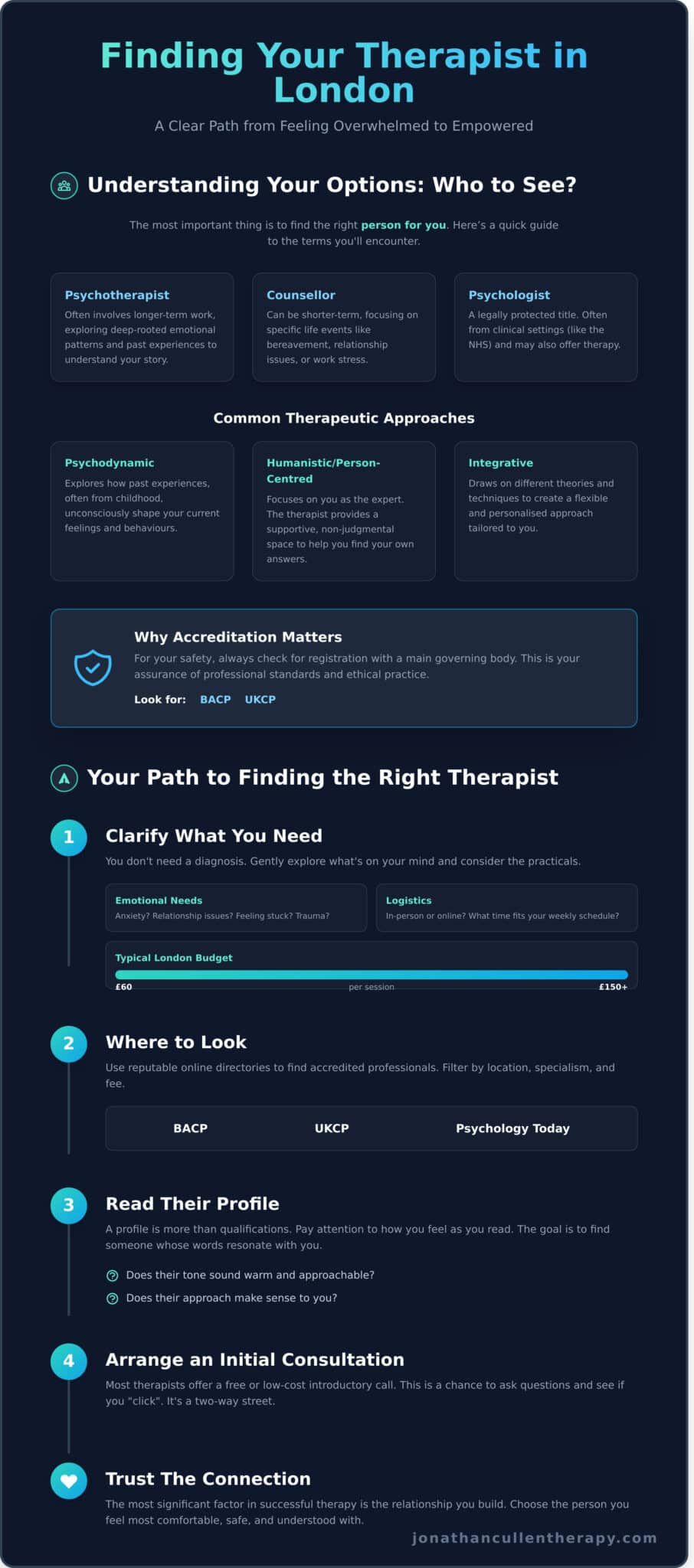
Starting your search for therapy can feel overwhelming, especially when faced with a sea of different titles and terms. It’s completely normal to feel unsure about the difference between a psychotherapist, a counsellor, and a psychologist. The most important thing to remember on this journey is that your goal is to find the right person for you—someone you feel safe and comfortable with. Before we explore the distinctions, it can be helpful to understand the foundational question: What is psychotherapy? In this section, we’ll gently break down the key terms and concepts to help you feel more grounded and confident in your search.
Psychotherapist vs. Counsellor vs. Psychologist
In the UK, the titles ‘psychotherapist’ and ‘counsellor’ are often used interchangeably, and many professionals use both. However, there can be subtle differences in their focus. Psychotherapy often involves longer-term work, exploring deep-rooted emotional patterns and past experiences. Counselling can be shorter-term, focusing on specific life events like bereavement or relationship issues. ‘Psychologist’ is a legally protected title, often held by those with a background in clinical settings like the NHS, who may also offer therapy.
Common Therapeutic Approaches You’ll Find
Therapists draw from different schools of thought to inform their work. You don’t need to be an expert, but knowing a little about the main approaches can help you find a good fit. Many a psychotherapist london uk will use a blend of these methods. Here are a few common ones:
- Psychodynamic: This approach helps you explore how past experiences, often from childhood, unconsciously shape your current feelings and behaviours. It’s a journey of understanding your own story.
- Humanistic/Person-Centred: Here, the focus is on you as the expert in your own life. The therapist provides a supportive, non-judgmental space to help you explore your potential and find your own answers.
- Integrative: An integrative therapist doesn’t stick to just one model. Instead, they draw on different theories and techniques to create a flexible and personalised approach that is tailored specifically to you and your needs.
Why Accreditation Matters: Look for BACP & UKCP
In the UK, the therapy profession is not state-regulated, which makes checking for professional accreditation essential for your safety. The two main governing bodies are the BACP (British Association for Counselling and Psychotherapy) and the UKCP (UK Council for Psychotherapy). Seeing that a therapist is registered with one of these organisations gives you peace of mind. It means they have met rigorous training standards, are committed to ongoing professional development, and work to a strict ethical code. It’s your assurance of their professionalism and accountability.
How to Find the Right Therapist For You: A 5-Step Process
Beginning the search for a therapist can feel overwhelming, especially in a city as vast as London. It’s a deeply personal journey, and it’s perfectly okay to take your time. Think of this not as a clinical search, but as a search for a genuine human connection. This simple, 5-step process is designed to help you navigate your options with confidence and find a professional who feels right for you.
Step 1: Clarify What You Need
You don’t need a diagnosis to seek support. Start by gently exploring what’s on your mind. Are you struggling with anxiety, navigating difficult relationship issues, processing a past trauma, or simply feeling stuck? Alongside your emotional needs, consider the practical side:
- Budget: Private therapy in London typically ranges from £60 to £150+ per session. Knowing your budget will help narrow your search.
- Location & Availability: Do you need someone in-person in a specific area, or are you open to online sessions? Consider what fits your weekly schedule.
Step 2: Where to Look for Therapists in London
Once you have a clearer idea of your needs, you can begin your search. Reputable online directories are an excellent starting point. Websites like the BACP, UKCP, and Psychology Today allow you to filter your search by location, specialism, and fee. It’s crucial to choose a qualified professional, and looking for BACP registered therapists ensures they adhere to high ethical and professional standards. You can also try more specific searches like ‘psychotherapist north west london’ to find practitioners in your local area.
Step 3: How to Read a Therapist’s Profile
A profile is more than just a list of qualifications. As you read, pay attention to how you feel. Does the therapist’s tone of voice sound warm and approachable? Do they explain their therapeutic approach in a way that makes sense to you? Look for clues about their personality and values. The goal is to find a psychotherapist in London UK whose words resonate with you and make you feel that you could be understood.
Step 4: Arrange an Initial Consultation
Most therapists offer a free or low-cost introductory call or session, often lasting around 15-30 minutes. This is not a commitment; it’s a chance for you both to see if you are a good fit. Use this time to ask questions about their experience and approach, and to get a sense of what it feels like to talk to them. It’s your opportunity to gauge the connection.
Step 5: Trust Your Connection
After your initial consultation, take a moment to check in with yourself. How did you feel during the conversation? Did you feel heard, respected, and safe? The relationship you build with your therapist is the foundation of your work together. If the connection doesn’t feel right, it is completely okay to keep looking. This journey is about honouring your needs and finding the supportive space you deserve.
Making First Contact: What to Ask and What to Expect
Taking the first step to contact a therapist can often feel like the most difficult part of the journey. It requires vulnerability and courage, and it’s completely normal to feel a little anxious. Remember, the goal of this first message isn’t to tell your whole story; it’s simply to open a door and see if it’s the right one for you. You don’t have to face this alone, and this initial contact is a brave and positive move towards getting the support you deserve.
Writing Your Initial Email
When you reach out, simplicity is key. A brief, clear message is all that’s needed. There’s no pressure to detail everything you’re going through. Instead, focus on a simple structure that gets straight to the point in a friendly way. Think of it like this:
- Introduce yourself briefly: “My name is [Your Name] and I’m looking for support with…” (e.g., anxiety, life changes, relationship issues).
- Mention how you found them: “I found your profile on…” (e.g., your website, Psychology Today, a recommendation).
- Ask the key questions: “I was wondering if you are currently accepting new clients and if you offer a short, introductory consultation call?”
Key Questions for an Initial Consultation Call
This initial chat, usually around 15-20 minutes, is a two-way conversation. It’s your chance to interview them just as much as it is for them to learn about you. Having a few questions prepared can help you feel more grounded. Consider asking:
- How do you typically work with someone facing challenges like mine?
- What are your fees per session, and what is your cancellation policy? A professional psychotherapist london uk will be transparent about their costs, which are typically in GBP (£).
- What can I expect from our first few sessions together if we decide to work together?
Professional bodies ensure therapists adhere to ethical standards. For instance, any practitioner registered with the UK Council for Psychotherapy (UKCP) is committed to clear communication about their practice and policies.
Trusting Your Gut Feeling
After the call, take a moment to check in with yourself. The connection you feel with your therapist—often called the ‘therapeutic relationship’—is one of the biggest predictors of a positive outcome. Ask yourself: Did I feel heard and understood? Did I feel comfortable and safe speaking with them? Finding the right therapist is about more than qualifications; it’s about finding a space where you feel seen. If you’re looking for this kind of connection, you can learn about my warm, down-to-earth approach.
Practical Considerations for Therapy in London
Once you have an idea of the kind of support you need, it’s time to think about the practical details. Navigating the logistics of therapy in a city as vast and busy as London can feel like a challenge in itself, but breaking it down makes the process much more manageable. Thinking about cost, location, and session format will help you find a sustainable path forward that honours both your emotional needs and your daily life.
The Cost of Psychotherapy in London
The investment in your mental health is invaluable, but it’s important to find a cost that feels sustainable for you. In London, private psychotherapy sessions typically range from £60 to over £150. This variation often reflects the therapist’s experience, their specific specialisms, and the location of their practice. For more affordable options, consider seeking support from mental health charities or from qualified therapists in the final stages of their training, who often offer sessions at a reduced rate.
In-Person vs. Online Therapy
The rise of online therapy has created incredible flexibility, especially for Londoners. Deciding between in-person and virtual sessions is a personal choice, and each has unique benefits.
- In-person therapy offers a dedicated, neutral space away from your home and work, allowing you to focus entirely on yourself. The physical journey to and from the session can also be a valuable time for reflection.
- Online therapy provides convenience, removes travel time, and opens up your options to any psychotherapist london uk, regardless of their location. This can be ideal for fitting therapy into a busy schedule.
Consider which format would feel most comfortable and supportive for your journey.
Finding a Therapist in Your Area
If you choose in-person sessions, finding a therapist close to your home or workplace can make a significant difference. The ease of travel helps integrate therapy into your weekly routine, making it feel less like a logistical hurdle and more like a grounded part of your self-care. For example, working with a therapist in Hendon, North West London, could be ideal if you live or work nearby, creating a sense of local connection and accessibility. This practical choice helps build a strong foundation for consistent, long-term work.
Taking these practical steps ensures you find support that truly fits your life. If you are ready to explore your options, I offer both online and in-person therapy from my practice in London. You can learn more about my down-to-earth approach at jonathancullentherapy.com.
Begin Your Journey: A Supportive Space in North West London
Navigating the steps to find a therapist is a significant achievement, and the final, most personal part of that process is choosing someone to connect with. If the principles of finding a supportive, tailored, and understanding therapeutic relationship resonate with you, I would like to introduce my practice as a potential space for your journey to begin. As a qualified psychotherapist in London, UK, I offer a grounded and down-to-earth approach from my practice in North West London.
A Warm, Integrative Approach
At the core of my practice is the belief that you deserve a compassionate, non-judgmental space to explore whatever is on your mind. I use an integrative method, which simply means that therapy is never a one-size-fits-all solution. Instead, we draw from different, well-researched therapeutic models to create an approach that honours your unique story and individual needs. Together, we work at a pace that feels right for you, ensuring you feel safe and understood every step of the way.
Specialist Support for Anxiety, Trauma, and ADHD
Finding a therapist with experience in the specific challenges you face can make all the difference. I provide informed, specialist support for individuals navigating the complexities of anxiety, the lasting effects of trauma, and the unique experiences of living with ADHD. As a neurodivergent therapist myself, I bring not only professional training but also invaluable lived experience and authentic understanding to our work. You don’t have to face these struggles alone; a space where you are truly seen is possible.
Take the First Step Today
The connection you have with your therapist is the foundation of any meaningful progress. Acknowledging this, I believe it’s essential you have the chance to see if we are a good fit before committing. That is why I offer a free, 20-minute introductory call to all potential clients seeking a psychotherapist in London, UK.
This is not a therapy session, but a relaxed, no-pressure conversation where you can ask questions and get a feel for how we might work together. There is absolutely no obligation to continue. If you feel ready to explore the next step, I warmly invite you to reach out and book your complimentary call today.
Begin Your Journey to a More Fulfilling Life
Finding the right therapist in a city as vast as London can feel daunting, but it doesn’t have to be. As we’ve explored, understanding your options and following a clear process will guide you toward the right support. Remember, the goal is to find a qualified psychotherapist london uk with whom you feel a genuine connection—a space where your unique story is honoured.
If you are seeking a warm, down-to-earth, and non-judgmental approach, I’m here to help. As a registered member of the BACP & UKCP, I offer specialist support for those navigating challenges with ADHD, anxiety, and trauma, creating a compassionate space for you to explore what’s on your mind.
Taking that first step is a courageous act, but you don’t have to face it alone. I invite you to book a free, no-obligation 15-minute call to see if we’re a good fit. A more connected and grounded path forward is possible.
Frequently Asked Questions
How much does psychotherapy cost per session in London?
The cost for a session with a private psychotherapist in London, UK, typically ranges from £60 to over £150. This 50-minute session fee can vary based on the therapist’s experience, location, and specialism. While it is an investment in your wellbeing, many therapists offer a free initial chat. Some also provide low-cost or sliding scale slots for those on lower incomes, so it’s always worth asking about their fee structure.
What is the main difference between a psychotherapist and a psychiatrist?
This is a common and important question. The main difference lies in their training and approach. A psychiatrist is a medical doctor who specialises in mental health, meaning they can diagnose conditions and prescribe medication. A psychotherapist is trained in talking therapies to help you explore your feelings, thoughts, and behaviours. They focus on providing a supportive, non-judgmental space for you to understand yourself better. Sometimes, they work together to provide comprehensive care.
How many therapy sessions will I need?
The number of sessions is unique to each person and their individual journey; there is no one-size-fits-all answer. Some people find short-term therapy (6-12 sessions) helpful for specific issues, while others benefit from longer-term, open-ended work to explore deeper patterns. This is something you and your therapist will discuss and review together, ensuring the pace feels right for you and honours your unique story and needs.
Do I need a referral from my GP to see a private psychotherapist in the UK?
No, you do not need a referral from your GP to see a private psychotherapist in the UK. You have the freedom to research and contact a therapist directly to arrange an initial consultation. While a GP referral is necessary to access therapy through the NHS, the private route allows you to choose who you work with and often begin your journey without a long waiting period. This gives you more control over finding the right support for you.
Is online therapy as effective as meeting a therapist in person?
Research shows that for many individuals, online therapy can be just as effective as in-person sessions. It offers wonderful convenience and accessibility, allowing you to connect from a space where you feel most comfortable. For others, the physical presence of being in the same room feels more grounding and connected. The best choice often comes down to your personal preference, your circumstances, and what helps you feel most safe and supported.
What happens if I don’t ‘click’ with my therapist?
It is completely okay if you don’t ‘click’ with the first therapist you meet. The relationship between you and your therapist is the foundation of the work, so feeling safe and understood is absolutely crucial. A professional therapist will understand this. You can raise your concerns with them, or you can simply decide to find someone else. It’s not a failure; it’s an important part of finding the right person to support you on your journey.