
Have you ever felt like you’re paddling against the current while everyone else seems to be sailing smoothly? If you’ve spent years wondering why simple tasks feel monumental, or if you’ve internalised labels like ‘lazy’ and ‘disorganised,’ please know you are not alone. This constant feeling of being overwhelmed and misunderstood can be deeply isolating. For many, the answer isn’t a character flaw, but a set of often-unrecognised adhd symptoms in adults.
This guide is here to offer a calm, non-judgmental space to explore these experiences. Together, we will gently walk through the common-and often surprising-signs of adult ADHD, helping you to connect the dots and see if they resonate with your own story. The goal is not to diagnose, but to offer validation and clarity. It’s about finding a potential name for what you’re going through and understanding the first steps you can take on this journey. You don’t have to figure this out on your own.
Key Takeaways
- Understand that inattentive ADHD is more than simple distraction; it’s a deeper challenge with regulating your focus and completing tasks.
- Discover how hyperactivity often changes in adulthood, appearing as internal restlessness or racing thoughts rather than constant physical movement.
- Explore the significant but often-missed emotional side of ADHD, which can profoundly impact how you manage intense feelings.
- Recognising these common adhd symptoms in adults is a powerful and validating first step on the journey toward professional clarity and support.
Beyond Distraction: The Reality of Inattentive ADHD Symptoms
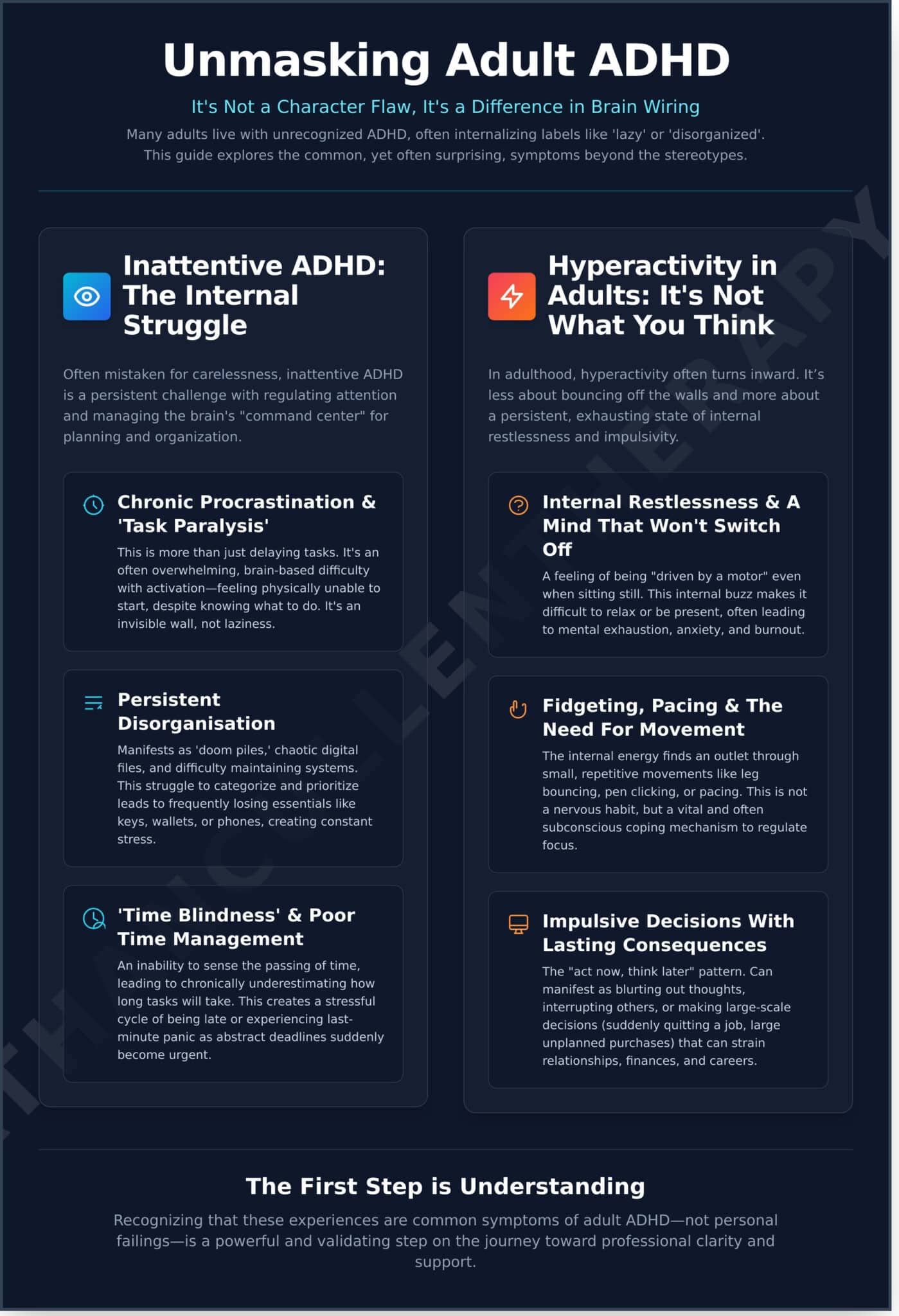
When people think of ADHD, they often picture a child who can’t sit still. But for many, the reality is a quiet, internal struggle that goes unnoticed. The inattentive presentation of Adult attention deficit hyperactivity disorder is not about being distracted by shiny objects; it’s a persistent challenge with regulating attention and managing executive functions-the brain’s command centre for planning, organising, and starting tasks.
This internal chaos can look like moodiness or carelessness to the outside world, which is why so many inattentive adults are misdiagnosed with anxiety or depression first. Understanding these lesser-known adhd symptoms in adults is the first step toward finding clarity and compassionate support. It’s about recognising that the challenge isn’t a lack of willpower, but a difference in brain wiring.
Chronic Procrastination and Trouble Getting Started
Have you ever stared at a task, knowing exactly what you need to do, but feeling physically unable to begin? This is ‘task paralysis’, and it goes far beyond simple procrastination. It’s a brain-based difficulty with activation. Whether it’s avoiding important paperwork, making a necessary phone call, or starting a complex project at work, the invisible wall can feel immense. This isn’t laziness; it’s a core executive function challenge that often leads to deep-seated feelings of guilt and shame.
Persistent Disorganisation in Life and Space
This symptom is more than just a messy desk. It can manifest as ‘doom piles’ of unsorted mail, a chaotic desktop with hundreds of files, or a wardrobe you can’t quite get on top of. The difficulty lies in categorising and prioritising information, making it hard to create and maintain systems. This often leads to frequently losing essential items like keys, your wallet, or phone, which creates a constant, low-level hum of stress in your daily life.
‘Time Blindness’ and Poor Time Management
‘Time blindness’ is the common inability for people with ADHD to sense the passing of time. It’s why you might consistently underestimate how long a task will take, leading to being chronically late despite your best intentions. Or, you might overcompensate and arrive an hour early for appointments out of anxiety. This disconnect from time makes deadlines feel abstract until they are suddenly urgent, creating a stressful cycle of last-minute panic and exhaustion.
Hyperactivity in Adults: It’s Not Always Bouncing Off the Walls
When we picture hyperactivity, the image that often comes to mind is a young boy who can’t sit still in class. For adults, however, this symptom of ADHD often looks very different. As we get older, hyperactivity tends to turn inward, transforming from constant running and climbing into a persistent and often exhausting internal state of restlessness. Understanding this shift is key to recognising one of the most misunderstood adhd symptoms in adults.
Internal Restlessness and a Mind That Won’t Switch Off
You might feel as though you are constantly ‘driven by a motor’, even when your body is sitting still. This internal buzz can make it incredibly difficult to relax, unwind, or simply be present. Many adults with ADHD find they are physically exhausted but mentally unable to switch off, leading them to need background noise like a TV or music just to quieten their thoughts enough to focus or sleep. Over time, this constant mental activity can be a significant source of anxiety and lead to burnout.
Fidgeting, Pacing, and the Need for Physical Movement
That internal energy has to go somewhere. While it may not look like the hyperactivity of childhood, it often manifests in smaller, repetitive physical movements. This isn’t a sign of nervousness or a ‘bad habit’; it’s a subconscious and often effective way to regulate focus and manage restlessness. You may find yourself:
- Constantly bouncing your leg
- Clicking a pen or tapping your fingers
- Picking at your skin or nails
- Pacing while on the phone
For many, being forced to sit perfectly still for long meetings or events can feel deeply uncomfortable, not because of boredom, but because it disrupts a vital coping mechanism.
Impulsive Decisions with Lasting Consequences
The other side of the hyperactivity coin is impulsivity-the tendency to act on a whim without fully considering the consequences. This is one of the most challenging and frequently cited common adult ADHD symptoms because of its real-world impact. It can show up as verbal impulsivity, like interrupting others or blurting out thoughts you later regret. It can also lead to larger-scale decisions, such as suddenly quitting a stable job, making large, unplanned purchases that strain your finances, or jumping head-first into new hobbies only to abandon them weeks later. This ‘act now, think later’ pattern can create significant strain on your relationships, career, and financial well-being.
The Hidden Emotional World of Adult ADHD
Beyond the more commonly known challenges with focus and organisation lies one of the most significant, yet least-discussed, aspects of adult ADHD: the intense and often overwhelming emotional world. It’s crucial to understand that while ADHD is not a mood disorder, its impact on emotional regulation is profound. For many, years of feeling ‘different’ or being told you’re “too sensitive” can lead to deep-seated low self-esteem. Your emotional experiences are valid, and you don’t have to navigate them alone.
Emotional Dysregulation: From 0 to 100 in Seconds
Does a small frustration ever feel like a catastrophe? This is emotional dysregulation, a core part of the ADHD experience where moods can shift rapidly and intensely. The emotional response can often feel completely disproportionate to the trigger, and once you’re upset, it can be incredibly difficult to calm back down. It’s important to remember that this is a neurological challenge rooted in brain wiring, not a character flaw or a lack of self-control.
Rejection Sensitive Dysphoria (RSD)
Many adults with ADHD describe experiencing Rejection Sensitive Dysphoria (RSD). This is an extreme emotional sensitivity and pain triggered by the perception of being rejected, teased, or criticised. It can feel like a sudden, intense, and all-consuming physical and emotional blow. To avoid this pain, you might find yourself becoming a people-pleaser or avoiding social situations entirely. While not an official diagnosis, it is a recognised and profoundly real experience for many.
Challenges in Social Situations and Relationships
The emotional impact of ADHD can also strain your closest relationships. Partners, friends, or family might feel hurt when you interrupt them, seem distracted while they are talking, or forget an important date. It’s easy for these actions to be interpreted as a lack of care, when in reality, they are common adhd symptoms in adults. The persistent stress of these misunderstandings can take a toll, often intertwining with anxiety and depression. The NHS provides excellent information on the complex links between ADHD and mental health.
Understanding this hidden emotional world is a vital first step toward self-compassion and developing healthier coping strategies. If these challenges feel familiar and you’re ready to explore them in a supportive, non-judgmental space, you can learn more at jonathancullentherapy.com.
What to Do When These Symptoms Feel Familiar
Reading through a list of adhd symptoms in adults can bring a wave of mixed emotions. For some, it’s a profound sense of relief-a feeling that you’re not broken, lazy, or flawed, but that there’s a reason for your struggles. For others, it can feel overwhelming. Wherever you are on that spectrum, please know this moment of recognition is a powerful and positive first step. The goal isn’t to find a label, but to find a language for your experience and a path toward support. You don’t have to figure this out alone.
Start with Self-Compassion
For years, you may have criticised yourself for things you couldn’t control. Now is the time to reframe that inner voice. Instead of ‘lazy’, try ‘struggling with executive function’. Instead of ‘failure’, try ‘working incredibly hard to cope in a world not designed for my brain’. Acknowledging how much energy you’ve spent just trying to keep up is the first step toward healing. You are not alone in this journey.
Consider a Professional Assessment
While online resources are helpful, a formal diagnosis from a qualified professional is essential for clarity and access to support. In the UK, there are two main routes:
- The NHS route: This begins with a conversation with your GP, who can refer you to a specialist psychiatric service. Be aware that waiting lists can be very long.
- The private route: This is a faster option but involves a significant cost. Assessments are conducted by a qualified psychiatrist who specialises in adult ADHD.
Whichever path you choose, it can be helpful to write down specific examples of how the adhd symptoms in adults you’ve read about show up in your life before speaking with a professional. This helps ensure your concerns are heard clearly.
Explore How ADHD-Informed Therapy Can Help
A diagnosis can bring understanding, but therapy is where you can build the tools to thrive. Therapy isn’t a ‘cure’ for ADHD; it’s a collaborative and non-judgmental space to develop practical strategies and process the emotional weight of it all. Together, we can work on building coping mechanisms for procrastination, improving organisation, and managing emotional dysregulation. Crucially, we can also explore and heal the feelings of shame or low self-esteem that may have built up over a lifetime of feeling different. Therapy can be a supportive space to explore these challenges.
Embracing Your Story: A Path Forward with ADHD
Recognising that adult ADHD is far more than the stereotype of distraction is a powerful first step. It’s about understanding the quiet challenges of inattention, the constant internal hum of hyperactivity that doesn’t always show on the outside, and the deep emotional currents that shape your daily life. Seeing these patterns not as personal failings but as common adhd symptoms in adults can bring a profound sense of relief and clarity to a lifetime of questions.
If this guide resonates with your experience, please know that this newfound understanding is a hopeful beginning, not an endpoint. As a neurodivergent therapist with my own lived experience of ADHD, I provide specialised, compassionate support for adults in London. My approach is warm, down-to-earth, and completely non-judgmental, creating a safe space where we can honour your unique journey and find strategies that truly work for you.
Taking the next step can feel daunting, but it is a powerful act of self-compassion. You don’t have to navigate this alone. Let’s explore your story together.
Frequently Asked Questions About Adult ADHD
Can you develop ADHD as an adult, or does it start in childhood?
This is a common point of confusion. ADHD is a neurodevelopmental condition, which means its foundations are present from childhood. You don’t suddenly develop it as an adult. However, it’s very common for symptoms to be missed or misunderstood during younger years. The increasing pressures of adult life-managing a career, finances, and a household-can make these underlying traits feel much more overwhelming and finally bring them to light.
I’m successful in my career. Can I still have ADHD?
Absolutely. Many highly intelligent and creative adults with ADHD find great success. Your achievements are a testament to your resilience, not a reason to dismiss your struggles. Often, this success comes at a cost, like chronic stress, anxiety, or burnout from working twice as hard to compensate. Acknowledging the possibility of ADHD doesn’t invalidate your success; it provides a compassionate context for the challenges you’ve faced along the way.
How can I tell the difference between normal stress and adult ADHD symptoms?
It’s understandable to wonder about this, as the two can look similar on the surface. The key difference is the pattern. Stress is often situational; your focus may suffer during a difficult project at work, but it returns to normal afterward. In contrast, adhd symptoms in adults are persistent and pervasive. They are a lifelong pattern of challenges with focus, organisation, or emotional regulation that impacts multiple areas of your life, not just one stressful situation.
Do I need to have all of these symptoms to have ADHD?
Not at all. ADHD presents differently in everyone, and your personal story is unique. A formal diagnosis doesn’t require you to have every possible symptom. Rather, a professional will look for a significant number of symptoms that consistently impact your daily life in at least two different settings, such as at home and at work. It’s about the overall pattern and its effect on your life, not about ticking every single box on a list.
Is it possible to have ADHD if I’m not hyperactive at all?
Yes, completely. The stereotypical image of a hyperactive child doesn’t represent everyone’s experience. Many people, particularly women, have what is known as Predominantly Inattentive Presentation (once called ADD). For them, the struggle is less about external restlessness and more about internal challenges like daydreaming, difficulty staying organised, and trouble following conversations. These internal symptoms are just as valid but are often overlooked.
What’s the connection between ADHD and other conditions like anxiety or depression?
There is a very strong link, and it’s quite common for them to co-occur. Living with the daily challenges of unmanaged ADHD-such as feeling misunderstood, struggling to meet deadlines, or experiencing relationship friction-can understandably lead to feelings of anxiety and depression. Sometimes these conditions develop as a direct result of navigating the world with an ADHD brain. Untangling them in a supportive space is a crucial part of the journey toward feeling better.