
Receiving an ADHD diagnosis as an adult can feel like a whirlwind. One moment there’s relief in finally having a name for your experiences, and the next, you’re faced with a sea of information that can feel incredibly overwhelming. If you’re worried about medication, questioning if therapy can truly help, or simply feeling lost in the daily struggle to stay organised, please know you are not alone. Finding the right adhd treatment for adults isn’t about a one-size-fits-all solution; it’s about discovering a supportive path that honours your unique brain and life.
This compassionate guide is here to walk you through your options in a clear, non-judgmental way. Together, we will explore the most effective paths forward-from the role of medication and therapy to practical, down-to-earth lifestyle strategies that can bring a sense of calm to the chaos. Our goal is to leave you feeling grounded, hopeful, and empowered to choose a treatment plan that feels authentic and right for you. You don’t have to figure this all out by yourself; let’s explore the next step together.
Key Takeaways
- Your journey with ADHD is unique; learn how to build a personalised support system that honours your individual needs and strengths.
- Explore how therapy provides a supportive space to build essential skills for managing ADHD symptoms and understanding yourself more deeply.
- Demystify the role of medication in adult ADHD treatment, understanding it as a supportive tool rather than a complete solution.
- Small, practical changes to your daily routines and environment can be a cornerstone of effective adhd treatment for adults.
Beyond the Prescription: A Holistic View of Adult ADHD Treatment
Receiving an ADHD diagnosis as an adult, or even suspecting you have it, can bring a wave of mixed emotions-from relief and validation to feeling completely overwhelmed. If you’re wondering what comes next, please know you don’t have to figure it out alone. The path forward isn’t about finding a single ‘cure’, but about building a compassionate, multi-layered support system that honours your unique story.
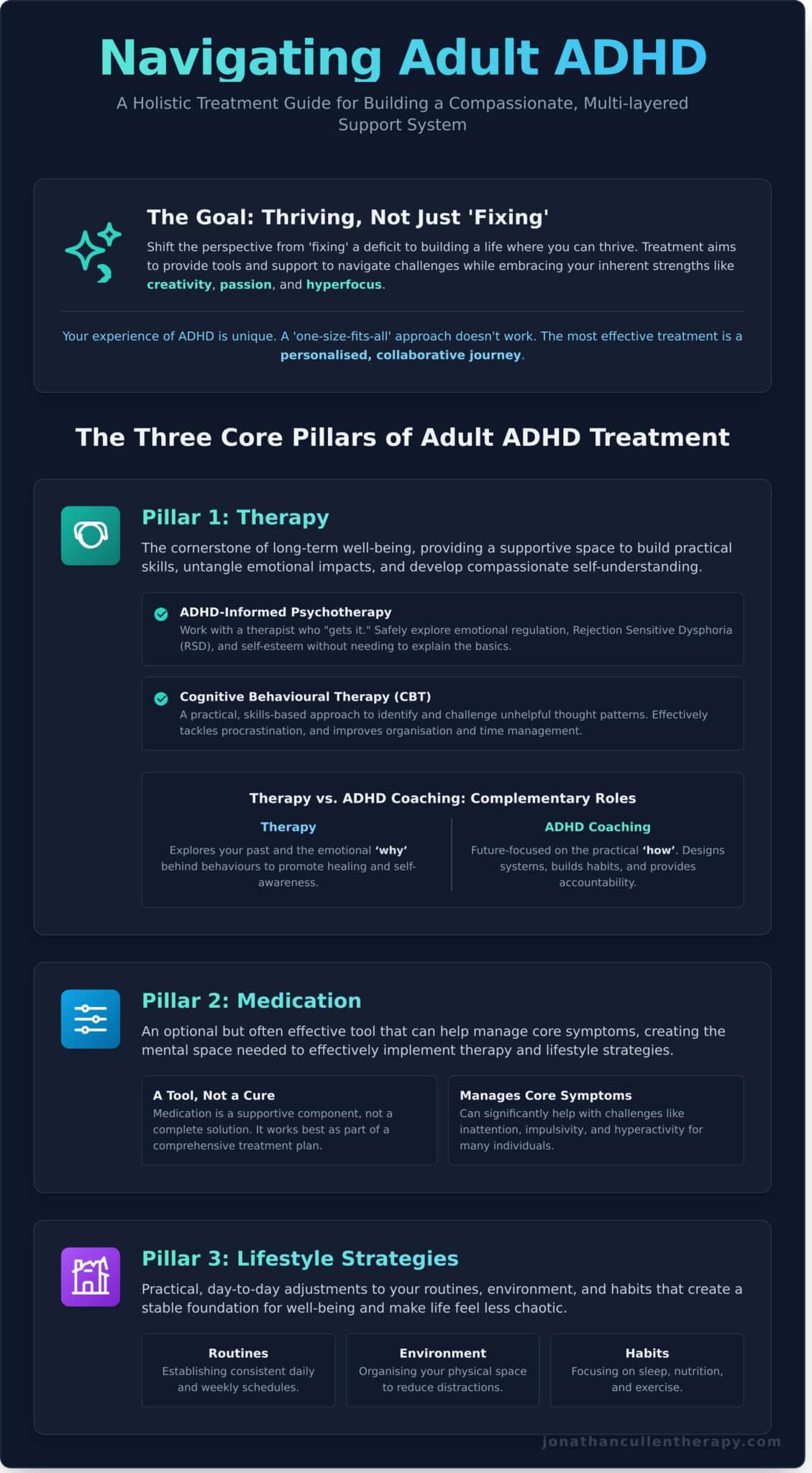
Effective adhd treatment for adults is a collaborative journey. It typically rests on three core pillars that work together to help you manage challenges and harness your strengths:
- Therapy: Creating a supportive space to understand your ADHD, develop coping skills, and address emotional challenges.
- Medication: An option that can help manage core symptoms like inattention and impulsivity for many individuals.
- Lifestyle Strategies: Practical, day-to-day adjustments to your routines, environment, and habits that create a foundation for well-being.
Finding the right balance is a personal process, and the most successful plans are those we create together, tailored specifically to you.
Why a ‘One-Size-Fits-All’ Approach Doesn’t Work
Your experience of ADHD is entirely your own. The diverse presentation of Adult attention deficit hyperactivity disorder means a strategy that works for one person may not work for another. Furthermore, it often co-exists with conditions like anxiety or depression, which require a sensitive, integrated approach. The most compassionate and effective treatment aligns with your personal goals, values, and what you truly want for your life.
The Goal of Treatment: Thriving, Not Just ‘Fixing’
Let’s shift the perspective from ‘fixing’ a deficit to building a life where you can thrive. The goal of ADHD treatment isn’t to erase who you are; it’s to provide the tools and support needed to navigate challenges while embracing your inherent strengths, such as creativity, passion, and the ability to hyperfocus. With the right support system in place, it is entirely possible to lead a grounded, connected, and fulfilling life.
The Role of Therapy: Building Skills and Self-Understanding
While medication can be a vital tool for managing ADHD symptoms, therapy is often the cornerstone of long-term, sustainable well-being. It’s about so much more than just ‘talking about your feelings’. Effective therapy for ADHD provides a supportive, non-judgmental space to build practical skills, untangle the emotional impact of living with a neurodivergent brain, and develop a deeper, more compassionate self-understanding. It’s where you can build the toolkit you need to navigate life with greater confidence.
ADHD-Informed Psychotherapy: Working with Someone Who ‘Gets It’
Working with an ‘ADHD-informed’ or ‘neurodivergent-affirming’ therapist means you don’t have to spend your sessions explaining the basics. These therapists understand the ‘why’ behind common ADHD challenges. In this collaborative space, you can safely explore sensitive topics like emotional regulation, the intense sting of Rejection Sensitive Dysphoria (RSD), and the impact ADHD has had on your self-esteem. The goal isn’t to ‘fix’ you, but to honour your unique experience and help you reframe your story.
Cognitive Behavioural Therapy (CBT) for ADHD
Cognitive Behavioural Therapy (CBT) is a practical, skills-based approach that is highly effective in many plans for adhd treatment for adults. It focuses on the connection between your thoughts, feelings, and actions. A therapist trained in CBT for ADHD can help you identify and challenge unhelpful, automatic thought patterns-like thinking “I’m a complete failure” after making a small mistake. The effectiveness of non-pharmacological approaches is increasingly recognised, and as highlighted in recent ADHD treatment research, CBT provides a structured way to tackle procrastination, improve organisation, and develop better time management skills.
ADHD Coaching vs. Therapy
It’s helpful to understand the distinction between therapy and coaching, as they serve different but complementary purposes. Think of it this way:
- Therapy often explores your past and the emotional ‘why’ behind your behaviours to promote healing and self-awareness.
- ADHD Coaching is typically future-focused, concentrating on the practical ‘how’. A coach helps you design systems, build sustainable habits, and provides accountability to help you achieve specific personal or professional goals.
Many people find that combining the deep emotional work of therapy with the practical, forward-moving strategies of coaching creates the most powerful and comprehensive support system.
Understanding ADHD Medication: A Tool, Not a Cure
Considering medication for ADHD can feel like a significant step, and it’s completely normal to have questions or concerns. It’s helpful to think of medication not as a “cure,” but as a supportive tool. For many, it acts as a foundation, creating the mental clarity needed to make other strategies-like therapy and coaching-even more effective. The goal is never to change your personality; it’s to quiet the background noise, reduce impulsivity, and improve focus so that more of you can come through.
This journey is a collaborative one, undertaken with the compassionate guidance of a psychiatrist who specialises in adult ADHD. Research consistently shows that a blended approach combining pharmacological and psychosocial ADHD treatment offers the most comprehensive support, honouring both the neurological and emotional aspects of your experience.
Stimulant Medications: The First-Line Approach
Stimulants, such as methylphenidate and lisdexamfetamine, are typically the first type of medication prescribed in the UK. They work by increasing the availability of key brain chemicals like dopamine, which helps improve communication between different parts of the brain. For many adults, this leads to a noticeable improvement in focus, attention, and impulse control, often within a short time of taking them. Finding the right type and dose is a careful, personalised process guided by your specialist.
Non-Stimulant Medications: An Alternative Path
If stimulants aren’t suitable-perhaps due to side effects or co-occurring conditions like severe anxiety-non-stimulant medications provide another effective path. Medications like atomoxetine work differently, building up their effect more gradually over several weeks. They offer consistent, 24-hour symptom management, which can be particularly beneficial for emotional regulation and sleep. This makes them a valuable part of the toolkit for a holistic adhd treatment for adults.
What to Expect When Starting Medication
Beginning medication involves a process called ‘titration,’ where you start on a very low dose that is slowly increased under your psychiatrist’s supervision. This allows your body to adjust and helps find the optimal dose that gives you the most benefit with the fewest side effects. Common side effects can include:
- Decreased appetite
- Difficulty falling asleep
- Dry mouth
These are often mild and temporary, and your doctor will work closely with you to manage them. Remember, this is a supportive and non-judgmental process. You are always in control, and you don’t have to navigate it alone.
Practical Strategies: Building an ADHD-Friendly Life
While therapy and medication are cornerstones of ADHD treatment for adults, empowering yourself with daily strategies is where you can truly begin to thrive. The goal isn’t to force your brain to work like a neurotypical one, but to compassionately create a life that honours its unique wiring. Small, consistent changes in your routines and environment can have a profound impact, reducing daily friction and building a sense of calm and control.
Mastering Your Environment
The ADHD brain often struggles with working memory, so we can support it by “externalising” important information. This means getting things out of your head and into your line of sight. You can start by:
- Using Visual Reminders: A large wall calendar or a whiteboard for appointments and deadlines can be a game-changer.
- Creating Dedicated Zones: Have a “launch pad” by your front door for keys, your wallet, and phone so you never have to hunt for them again.
- Minimising Distractions: Consider noise-cancelling headphones to block out sound, or use apps to limit distracting websites while you work.
Executive Function Supports
Executive functions like starting tasks and staying focused can feel like a constant battle. Instead of fighting, we can build supportive scaffolding. Techniques like “body doubling”-working quietly alongside a friend or colleague, even on a video call-can dramatically reduce procrastination. You can also break down large, overwhelming projects into tiny, manageable steps to make them feel less daunting. Similarly, using a timer, such as the Pomodoro Technique (25 minutes on, 5 minutes off), can help sustain focus without burning out.
The Foundational Four: Sleep, Nutrition, Exercise, and Mindfulness
These four pillars are non-negotiable supports for a well-regulated ADHD brain. Prioritising quality sleep is critical, as fatigue worsens nearly every ADHD symptom. A protein-rich diet can help stabilise blood sugar and improve focus, while regular exercise is a powerful, natural way to boost dopamine and improve executive function. Finally, simple mindfulness practices, like a one-minute breathing exercise, can create a vital pause, helping you manage emotional intensity and feel more grounded throughout your day.
Integrating these tools is a compassionate process of self-discovery. These strategies form a powerful part of a holistic approach to adhd treatment for adults, and exploring them within a supportive therapeutic relationship can make all the difference. If you’d like to learn more about building a life that works for you, feel free to explore my down-to-earth approach.
How to Create Your Personalised Treatment Plan
Understanding your options is the first step; now it’s time to bring them together into a plan that feels right for you. Creating a personalised approach to adhd treatment for adults is a collaborative journey, not a one-size-fits-all prescription. It’s about taking an active, empowered role in your own wellbeing. Remember, this plan is a starting point-a living document that will evolve and adapt as you learn more about yourself and what works for you.
Step 1: The Importance of a Professional Diagnosis
While online tests and self-realisation are often a powerful and validating first step, a formal diagnosis from a qualified professional is key. It provides the clarity needed to access the right support, from medication to workplace accommodations. An adult ADHD assessment typically involves in-depth conversations about your life experiences, from childhood to today, and the completion of specialised questionnaires. It’s a comprehensive process designed to understand your unique story. For more information, please see our guide on getting diagnosed with ADHD in the UK.
Step 2: Finding the Right Professional(s) for You
You don’t have to navigate this alone; building a supportive team can make all the difference. Your team might include:
- Your GP: Often the first point of contact for getting a referral to a specialist.
- A Psychiatrist: A specialist who can formally diagnose ADHD and manage medication if you choose that path.
- A Therapist or Coach: A professional who provides a supportive space to develop coping strategies, build skills, and work through the emotional impact of ADHD.
When looking for a therapist, seek out someone who is “neurodivergent-affirming.” It’s essential that you feel genuinely comfortable and understood by the professionals you work with.
Step 3: Combining Treatments for the Best Outcome
The most effective adhd treatment for adults often involves a combination of approaches. Think of it as a supportive ecosystem. For many, medication helps create the focus and calm needed to engage with and implement the practical strategies learned in therapy. At the same time, lifestyle adjustments like improving sleep or incorporating movement can amplify the benefits of both. This holistic approach ensures you are supported from all angles.
Putting these pieces together can feel daunting, but you don’t have to figure this out alone. Let’s explore how therapy can help create the supportive framework for your journey forward.
Your Journey Starts Here: Creating a Life That Honours Your Brain
Navigating your path with ADHD is a deeply personal journey. As we’ve explored, effective adhd treatment for adults isn’t about finding a single cure, but about compassionately building a personalised toolkit. This involves understanding the role of therapy in building skills, viewing medication as a supportive tool, and integrating practical strategies to create a life that truly works for you.
Taking that first step can feel overwhelming, but you don’t have to face it alone. As a neurodivergent therapist with lived experience of ADHD, I offer a down-to-earth, non-judgmental space to help you find your way. From my practice in Hendon, I support clients across North West London and online.
Ready to feel more grounded and connected? Reach out to book a warm, supportive consultation today.
Frequently Asked Questions About ADHD Treatment for Adults
Can adult ADHD be treated without medication?
Absolutely. While medication can be a very effective tool for many, it is not the only path forward. A compassionate and comprehensive approach to ADHD treatment often includes therapy, coaching, and lifestyle adjustments. Together, we can explore practical strategies, behavioural therapies like CBT, and supportive routines that honour your unique brain wiring. For many, this non-medical support is enough to create meaningful, lasting change and help them feel more grounded and in control.
How is therapy for ADHD different from therapy for anxiety or depression?
While there is often overlap, as many people with ADHD also experience anxiety or low mood, ADHD-focused therapy has a distinct practical element. It goes beyond exploring feelings to help you build tangible skills for executive function challenges. We work on developing personalised systems for organisation, time management, and emotional regulation. It’s a down-to-earth approach that aims to build a supportive structure for your daily life, reducing overwhelm and building confidence in your own abilities.
How long does ADHD treatment for adults usually take?
This is a personal journey, and there is no one-size-fits-all timeline. Some individuals find that a focused block of therapy over a few months is enough to build the skills they need. For others, ongoing support is more beneficial as they navigate different life stages. The goal isn’t to “fix” you, but to empower you with a toolkit of strategies. Our work together is collaborative, and the length of your ADHD treatment for adults will be guided by your unique needs and goals.
Will I have to be on ADHD medication for the rest of my life?
Not necessarily. Deciding to use medication is a personal choice made with your medical provider, and it doesn’t have to be a lifelong commitment. Some people find it helpful long-term, while others use it for a specific period to create the stability needed to effectively engage in therapy and build new habits. As you develop stronger coping skills and routines, you may find your need for medication changes. It is a supportive tool, not a life sentence.
What is the difference between an ADHD coach and an ADHD therapist?
Think of it as the difference between “why” and “how.” A therapist is a qualified mental health professional who can help you explore the emotional impact of ADHD, address past experiences, and treat co-occurring conditions like anxiety. A coach is a forward-looking partner who helps you implement practical, day-to-day strategies and systems to achieve specific goals. Both roles are incredibly valuable and can work in a complementary way to offer you comprehensive, non-judgmental support.
Is it possible to develop coping skills that reduce the need for treatment over time?
Yes, this is one of the most empowering outcomes of effective treatment. The entire purpose of therapy and coaching is to help you build a personalised set of sustainable coping skills. As you learn to work with your ADHD brain-rather than against it-by implementing new strategies for focus, organisation, and emotional balance, these skills can become second nature. This often leads to a greater sense of self-reliance and may naturally reduce your need for formal, ongoing support.