
Does it feel like you and your partner are speaking different languages, stuck in a cycle of arguments that never seem to resolve? The distance between you can feel vast, and the thought of trying to fix things can be overwhelming. If you’re wondering whether it’s possible to find your way back to each other, you don’t have to face that question alone. For many, the idea of couples therapy brings up a mix of hope and anxiety. It’s a step into the unknown, often taken when you feel you’ve tried everything else and worry it might be too late.
This gentle guide is here to offer clarity and reassurance. We will explore what couples therapy is, how it can help your relationship, and what to expect on your journey towards healing. Together, we’ll demystify the process, address common worries-like the fear a therapist will take sides-and show you how to find the right support. By the end, you’ll have a compassionate understanding of how you can stop having the same fights and start building a stronger, more connected, and fulfilling partnership.
Key Takeaways
- Learn that therapy isn’t about assigning blame, but about creating a safe, neutral space to understand your relationship dynamics together.
- Recognise common relationship challenges not as signs of failure, but as valuable opportunities to grow stronger and more connected as a couple.
- Understand the typical journey of couples therapy, from the first call to ongoing sessions, so you know what to expect and can feel more at ease.
- Discover clear, actionable steps you can take to find the right therapist and begin your journey towards a more fulfilling relationship.
What is Couples Therapy, Really? A Space for Connection, Not Conflict
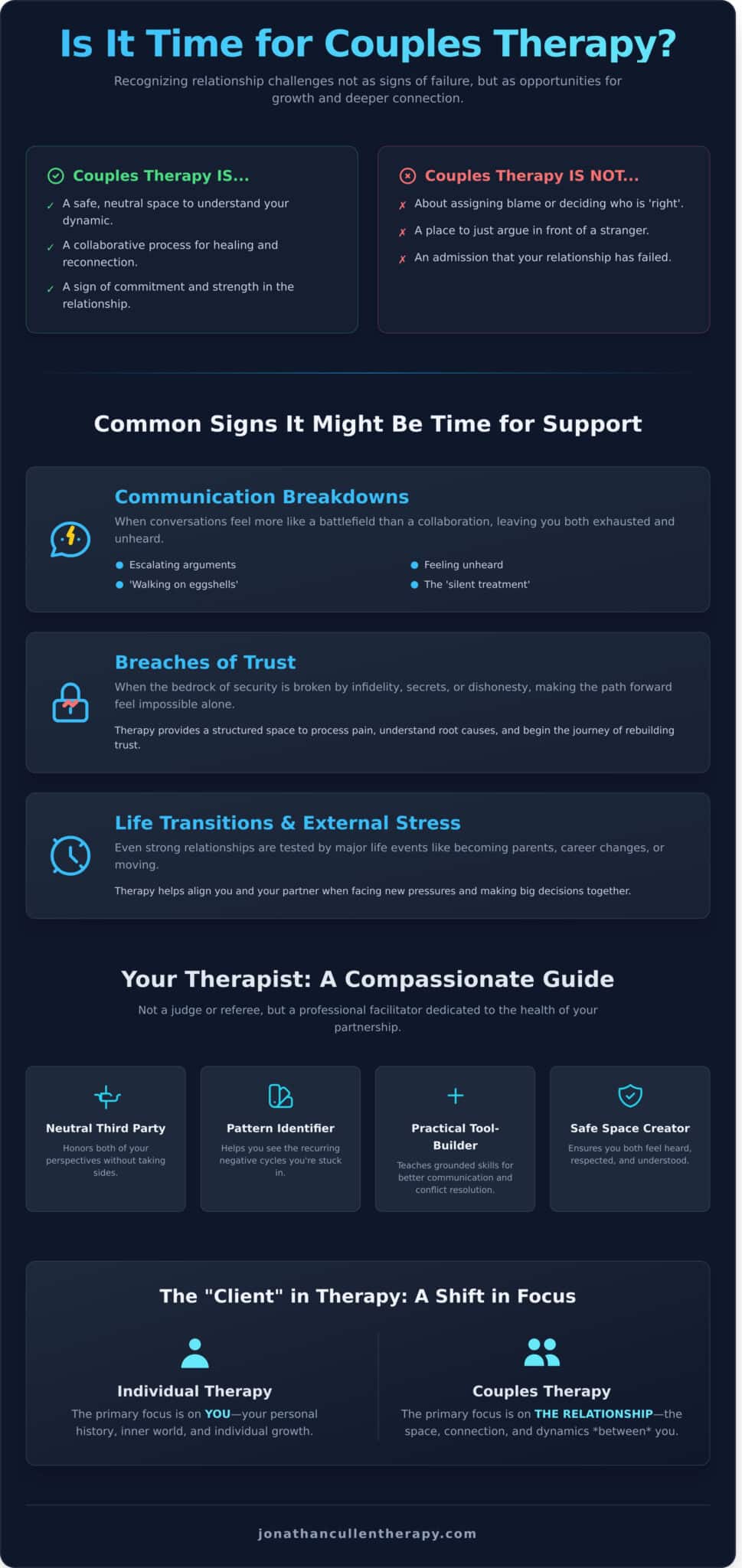
If you and your partner feel stuck in a cycle of misunderstanding or distance, the thought of therapy can feel daunting. It’s easy to picture the dramatic, confrontational scenes we see on television. But the reality is far more gentle and constructive. At its heart, Couples therapy is a collaborative process designed to help you and your partner understand the dynamics of your relationship in a safe, non-judgmental space. It’s not about finding fault or deciding who is ‘right’ or ‘wrong’.
Instead, the primary goal is to foster understanding, healing, and reconnection. Guided by a neutral professional, you are given the space to explore your patterns and learn new ways of relating to one another. It’s a courageous step that offers hope and a clear path forward when you feel lost. You don’t have to navigate this alone.
The Role of the Couples Therapist
Think of a couples therapist not as a judge or referee, but as a compassionate facilitator and guide. Their role is to:
- Act as a neutral third party who honours both of your perspectives.
- Help you identify recurring negative patterns that you may be too close to see.
- Teach you practical, grounded tools for better communication and conflict resolution.
- Ensure the therapy room is a safe space where you both feel heard, respected, and understood.
Dispelling Common Fears About Starting Therapy
It’s completely normal to feel anxious about starting couples therapy. Many people share the same worries, but they are often based on misconceptions. Let’s address a few:
- ‘The therapist will take my partner’s side.’ A professional therapist is committed to the health of the relationship. Their loyalty is to the partnership, not to one individual.
- ‘It means our relationship has failed.’ Quite the opposite. Seeking support is a sign of profound commitment and strength. It shows you both believe the relationship is worth fighting for.
- ‘We’ll just argue in front of a stranger.’ While difficult emotions may arise, the therapist’s job is to de-escalate conflict and help you turn arguments into productive, healing conversations.
Couples Therapy vs. Individual Therapy
While individual therapy focuses on your personal history and inner world, couples therapy views the ‘relationship’ itself as the client. The primary focus is on the space between you-how you communicate, connect, and interact. While your individual experiences, such as anxiety or past trauma, are important and will be explored, they are always considered in the context of how they impact the partnership and your shared life together.
Common Signs It Might Be Time for Couples Therapy
Deciding to seek help is a sign of profound strength and commitment to your relationship, not a sign of failure. Every partnership faces challenges, and viewing these moments as opportunities for growth can be transformative. Recognising the signs early allows you to address them proactively before they become deeply rooted. If you’re new to the idea, understanding what is couples therapy can demystify the process and make it feel far less daunting. You don’t have to face these challenges alone.
Communication Breakdowns
Do your conversations feel more like a battlefield than a collaboration? This is one of the most common reasons couples seek support. When communication falters, the entire foundation of your relationship can feel shaky. You might notice patterns like:
- Conversations that consistently escalate into arguments, leaving you both exhausted.
- A feeling of ‘walking on eggshells’ or actively avoiding certain topics to prevent a fight.
- One or both of you feeling persistently unheard, dismissed, or misunderstood.
- The ‘silent treatment’ becoming a regular tool for managing conflict.
Breaches of Trust and Infidelity
Trust is the bedrock of a secure relationship, and when it’s broken-whether through a physical or emotional affair, secrets, or financial infidelity-the path forward can feel impossible to navigate. The aftermath is often filled with pain, anger, and confusion. A compassionate therapist provides a structured, non-judgmental space to process these complex emotions, understand the root causes, and begin the delicate journey of rebuilding trust and exploring forgiveness.
Navigating Life Transitions and External Stress
Even the strongest relationships can be tested by major life events. Becoming parents, changing careers, moving house, or caring for elderly relatives can introduce new and unexpected pressures. When you and your partner are not aligned on big decisions about parenting, finances, or future goals, it creates friction. Effective couples therapy can help you build a united front, improve your joint problem-solving skills, and protect your bond from external strains.
Loss of Intimacy and Connection
If you feel more like roommates than romantic partners, you are not alone. Over time, it’s common for the spark of emotional and physical intimacy to fade amidst the demands of daily life. You might long for the connection you once shared but feel completely lost on how to find your way back. Therapy offers a supportive environment to explore what’s created this distance and learn new, intentional ways to reconnect, communicate desire, and rediscover each other.
The Couples Therapy Journey: What to Expect in Your Sessions
Taking the first step into therapy can feel like stepping into the unknown, which is often a source of anxiety. We want to demystify the process for you. While every couple’s journey is unique, understanding the general structure can help you feel more grounded and prepared. Remember, this is a collaborative process, and you are always in a supportive, non-judgmental space where you don’t have to face your challenges alone.
Your First Session: Setting the Foundation
Your initial session is all about building a safe foundation. It’s an opportunity for you, your partner, and your therapist to get to know one another. We will gently explore your relationship’s history, what brought you to therapy, and what you both hope to achieve. Each of you will have the space to share your perspective without interruption. A key part of this first meeting is establishing ground rules for communication, ensuring the therapy room feels like a secure place to be vulnerable and honest.
The Structure of a Typical Session
Once you’re established, sessions typically last 50-60 minutes. Rather than a free-form chat, each meeting is a focused space to work on a specific issue or a recurring pattern. Your therapist acts as a guide, helping to de-escalate conflict and ensure the conversation remains productive. You’ll learn and practise new communication skills in real-time. The specific methods used will depend on your needs; there are many Different Approaches to Couples Therapy, from Emotionally Focused Therapy (EFT) to the Gottman Method, and your therapist will tailor their approach to what best supports you.
Growth Between Sessions: ‘Homework’ and Practice
The most important work in couples therapy often happens outside of the session. Lasting change comes from integrating new skills and insights into your daily life together. Your therapist may suggest ‘homework’ to help bridge the gap between sessions. This isn’t about getting a grade; it’s about building positive momentum. This might include:
- Practising a specific communication technique you learned, like using “I feel” statements.
- Setting aside dedicated time for a shared, positive activity, free from distractions.
- Reflecting on a specific question individually to bring your thoughts to the next session.
These tasks are designed to help you reconnect and turn therapeutic breakthroughs into lasting, positive habits.
Different Approaches to Couples Therapy: Finding Your Fit
When you first start looking into support for your relationship, you might come across different names and acronyms for therapies that can feel a bit academic or overwhelming. The good news is, you don’t need to become an expert on these models. The most important factor in successful couples therapy is finding a therapist you both feel comfortable and connected with, and whose approach resonates with your needs as a couple.
Think of these as different toolkits a therapist might use to help you build a stronger, more fulfilling partnership. Here are a few common and effective approaches, explained in simple terms.
Emotionally Focused Therapy (EFT)
At its heart, EFT is about strengthening the emotional connection and secure bond between you and your partner. It helps you look beneath the surface of recurring arguments to understand the deeper feelings driving them. Instead of just focusing on a specific disagreement, you explore the cycle you’re stuck in and the vulnerable emotions underneath. The goal is to create new, positive patterns of emotional responsiveness, helping you turn towards each other with empathy and understanding.
The Gottman Method
Developed from decades of research into what makes relationships succeed, the Gottman Method is a structured and practical approach. It’s like a roadmap for relationship health, focusing on three key areas: deepening your friendship and intimacy, managing conflict constructively (rather than avoiding it), and creating a life of shared meaning. This method often uses specific exercises and tools to help you improve communication, show appreciation, and navigate disagreements more effectively.
An Integrative Psychotherapy Approach
Rather than sticking rigidly to one method, an integrative therapist draws on techniques from various models to create a flexible approach tailored specifically to you. This isn’t a “one-size-fits-all” solution; it’s a compassionate process that honours your unique story and challenges. It allows the work to adapt as your needs change, ensuring you get the most effective support. This down-to-earth, personalised way is how I work with couples in my practice. Learn more about my integrative approach to therapy.
How to Begin: Taking the First Step Towards a Healthier Relationship
Deciding to explore professional support is often the most challenging step on the journey back to connection. It’s a moment that requires courage and vulnerability, but it’s also a powerful sign of your commitment to your relationship. Remember, you don’t have to face this alone. Taking this step puts you in control, allowing you to mindfully choose the right path forward for both of you.
Talking to Your Partner About Therapy
Approaching your partner about therapy can feel daunting. The key is to frame it as a positive, collaborative step for ‘us,’ not a criticism of ‘you.’ Choose a calm, private moment and speak from your own experience, expressing your hopes for a more connected future. Try starting with phrases like, “I feel like we’re struggling to connect, and I’d love for us to find a way back to each other,” or “I’ve been thinking about how we can strengthen our relationship, and I wonder if we could explore this together.”
Finding and Choosing the Right Therapist
The success of couples therapy often comes down to finding the right fit. This is about more than just qualifications; it’s about finding a professional whose approach feels right for you. When searching, look for therapists who are registered with a professional body like the BACP or UKCP in the UK. Read their website and see if their voice resonates. Most importantly, use the initial consultation to see how you feel. It’s a chance to ask questions and gauge whether you both feel comfortable, heard, and understood in their presence.
Preparing for Your First Session
It’s completely normal to feel nervous before your first appointment; your therapist will expect this and will create a supportive, non-judgmental space. To get the most from it, you might find it helpful to think about a few things beforehand:
- What are your individual hopes for therapy?
- What is one thing you hope to change or improve as a couple?
- What questions do you have for the therapist about their process or experience with issues like yours?
This first step is an investment in the future of your relationship. By seeking the right support, you are creating an opportunity to heal, grow, and build a more fulfilling connection. If you feel ready to explore how a down-to-earth approach to couples therapy could support you and your partner, I invite you to learn more.
Your Journey to Reconnection Begins Here
Embarking on the path of couples therapy is a powerful act of hope and commitment to your relationship. As we’ve explored, it’s not about assigning blame, but about creating a safe, neutral space to understand one another more deeply and find new ways to communicate. Recognising that your partnership needs support is the first, most courageous step toward healing and building a stronger future together.
If you and your partner are in North West London and feel ready to explore what’s next, you don’t have to face it alone. I provide a warm, non-judgmental, and supportive space for couples to reconnect and heal. My down-to-earth, integrative approach is always tailored to honour your unique story and guide you toward a more connected, fulfilling relationship.
Ready to take the first step? Contact me for a confidential consultation.
Frequently Asked Questions About Couples Therapy
What if my partner refuses to go to therapy?
This is a common and understandable challenge. It doesn’t mean your relationship is stuck. You can begin therapy on your own to explore your feelings and your part in the relationship dynamic. Taking this step can create positive change and, in time, may even encourage your partner to see the benefits and decide to join you on the journey. You don’t have to face this alone.
How long does couples therapy typically take to see results?
Every couple’s journey is unique, so there is no fixed timeline. Many couples begin to notice positive shifts in communication and understanding within 6 to 12 sessions. For more deep-rooted issues, a longer-term commitment may be more beneficial. The focus is always on making steady progress towards building a more connected and fulfilling relationship, rather than on a quick fix. We will work together at a pace that feels right for you.
Will a couples therapist tell us if we should break up?
A therapist’s role is never to make decisions for you. My approach is to provide a compassionate, non-judgmental space where you can both explore your feelings and needs safely. I will help facilitate clearer, more honest communication so that you can gain the clarity needed to make your own informed decision about the future of your relationship. The power to choose your path always remains with you.
Is couples therapy confidential?
Yes, absolutely. Confidentiality is a cornerstone of effective couples therapy and is essential for building a safe, trusting environment. Everything discussed in our sessions remains private, with the only legal exceptions being situations where there is a serious risk of harm to yourself or others. This secure foundation allows you both to be vulnerable and open, which is vital for healing and reconnection.
What is the difference between couples counselling and marriage counselling?
The terms are often used interchangeably, and the core process is the same. “Marriage counselling” is a more traditional term that historically focused on married partners. “Couples counselling” is a more modern, inclusive term that welcomes all committed partners, whether you are married, cohabiting, or dating. Both provide a supportive space to improve communication, navigate conflict, and deepen your emotional bond.
How much does couples therapy cost in the UK?
The cost of couples therapy in the UK can vary based on the therapist’s experience and location, particularly between major cities and other areas. You can generally expect to pay between £70 and £150 per session. Some therapists may offer a sliding scale based on income to make support more accessible. It is always best to discuss fees directly with a therapist during an initial consultation.