
Do you carry a persistent feeling of being different, or perhaps even ‘broken’, without fully understanding why? If you find yourself struggling with intense, overwhelming emotions, navigating turbulent relationships, and feeling that your experiences don’t quite fit a standard PTSD diagnosis, please know you are not alone. What you may be experiencing has a name: Complex PTSD, or cptsd. It often arises from prolonged or repeated trauma, and its effects can weave themselves deeply into the fabric of your daily life, leaving you feeling stuck and disconnected from yourself and others.
This gentle guide was created to offer clarity and compassion. You don’t have to face this journey alone. Here, we will explore what CPTSD is in a down-to-earth way, understand how it can shape your thoughts and feelings, and most importantly, illuminate the hopeful and supportive path toward healing. Your story is valid, and reclaiming a sense of safety and connection is possible. This is a supportive space to begin.
Key Takeaways
- Learn why Complex PTSD develops from prolonged, repeated trauma, not just a single event, and how this shapes your experience.
- Recognise the core ways cptsd can show up in your daily life, affecting your relationships, emotional responses, and sense of self.
- Discover a compassionate path to healing that isn’t about erasing the past, but about gently reducing its power over your present.
- Understand that reaching out is a courageous first step, and get gentle guidance on how to find the right therapeutic support for your journey.
What is Complex PTSD? More Than a Single Event
If you’re exploring the topic of trauma, you may have come across the term Complex PTSD. At its heart, Complex Post-Traumatic Stress Disorder (CPTSD) is a deeply human response to prolonged, repeated traumatic experiences, particularly where there was no sense of escape. It’s crucial to understand that this is not a sign of weakness or a personal failing; it is a normal and adaptive reaction to an overwhelmingly abnormal and unsafe situation. It is a testament to what you have endured.
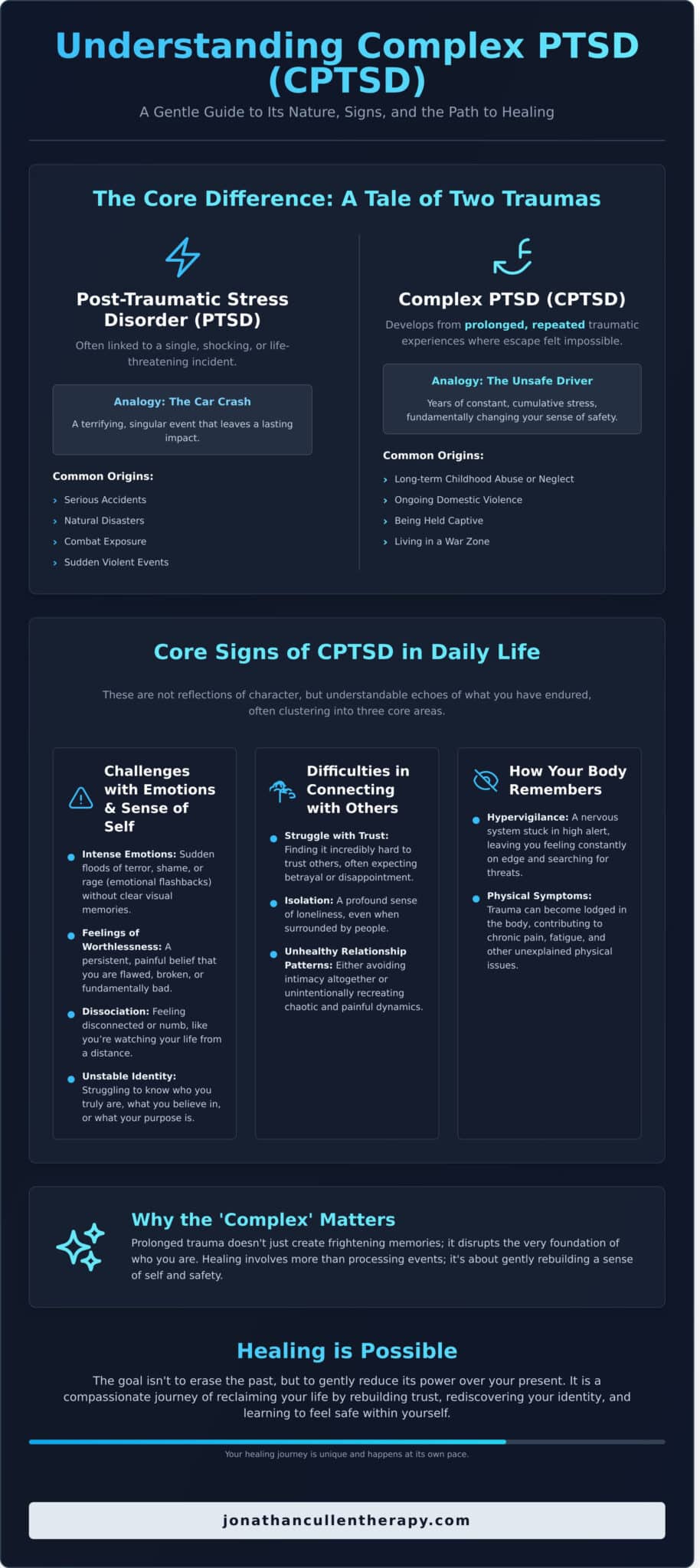
To draw a simple analogy, Post-Traumatic Stress Disorder (PTSD) is often compared to the aftermath of a single, shocking car crash. The event is terrifying and leaves a lasting impact. By contrast, you can think of CPTSD as the result of spending years as a passenger in a car with an unpredictable and unsafe driver. The threat is constant, the stress is cumulative, and it fundamentally changes your relationship with safety, trust, and control. To understand what is Complex PTSD on a deeper level is to recognise it as a response to a traumatic environment, not just a single event.
Distinguishing CPTSD from PTSD
While both conditions share some symptoms, their origins are quite different. PTSD is often linked to a specific, life-threatening incident like a serious accident, a natural disaster, or combat. CPTSD, however, typically develops from ongoing situations where escape felt impossible. This often involves relational or developmental trauma, such as long-term childhood abuse or neglect, domestic violence, or being held captive. The trauma is woven into the fabric of daily life and key relationships.
Why the ‘Complex’ Matters: The Impact of Ongoing Trauma
The ‘complex’ part of cptsd highlights how this prolonged exposure to harm can profoundly shape a person’s identity and worldview. When trauma is ongoing, it doesn’t just create frightening memories; it can disrupt the development of a stable sense of self, the ability to trust others, and the capacity to feel safe in the world. Because of this, healing is a compassionate journey that involves more than just processing memories. It’s about gently rebuilding trust, rediscovering your identity, and learning to feel safe within yourself and your relationships.
The Core Signs of CPTSD in Your Daily Life
Understanding Complex PTSD (CPTSD) goes far beyond a simple checklist. It’s about recognising the quiet, persistent ways that past trauma can shape your present reality. If you find yourself struggling in ways that feel confusing or overwhelming, please know that you are not alone, and these experiences are not a reflection of your character. They are the understandable echoes of what you have endured.
These challenges often cluster into three core areas of daily life. Recognising these patterns is a compassionate first step toward understanding your own story and beginning the journey of healing.
Challenges with Emotions and Your Sense of Self
Living with the effects of prolonged trauma often means your inner world can feel turbulent and difficult to navigate. You might feel at the mercy of intense emotions that seem to come from nowhere, or you may feel profoundly disconnected from yourself. These internal struggles are a central feature of cptsd and are increasingly reflected in resources that explore the official diagnostic criteria for CPTSD, distinguishing it from single-event trauma.
- Difficulty managing intense emotions: You might experience emotional flashbacks, where you are suddenly flooded with feelings like terror, shame, or rage from the past, without the visual memory.
- Persistent feelings of worthlessness: A deep, painful belief that you are flawed, broken, or fundamentally bad can colour your every experience.
- Feeling disconnected or unreal: Dissociation can feel like you’re watching your life from a distance, or that you or the world around you isn’t quite real. It’s a coping mechanism that can leave you feeling numb and empty.
- Struggling with a stable identity: You may find it hard to know who you truly are, what you believe in, or what your purpose is.
Difficulties in Connecting with Others
When your earliest experiences taught you that people and relationships weren’t safe, it’s natural to struggle with connection as an adult. This can create a profound sense of isolation, even when you are surrounded by people. You might find it incredibly hard to trust others, waiting for the moment they will let you down. For some, this leads to a pattern of avoiding intimacy, while for others, it can mean unintentionally recreating unhealthy or chaotic relationship dynamics that feel painfully familiar.
How Your Body Remembers
Trauma is not just an event that happens to the mind; it’s an experience that becomes lodged in the body. Your nervous system may be stuck in a state of high alert, a condition known as hypervigilance, leaving you feeling constantly on edge, jumpy, or unable to relax. This chronic stress can manifest in very real physical symptoms, such as unexplained chronic pain, digestive issues, migraines, and persistent fatigue. These are not “all in your head”-they are your body’s way of holding onto and communicating unresolved trauma.
Understanding the Roots of Complex Trauma
Exploring the origins of complex trauma can be a deeply validating part of the healing journey. It helps us understand the ‘why’ behind the symptoms we experience today. Before we explore these causes, it is essential to hold one truth firmly: what you went through was never your fault. The responsibility for trauma always lies with the person or circumstances that caused the harm, not the survivor. Unlike single-event trauma, CPTSD develops from prolonged, repeated experiences where there was no viable option for escape.
When Home Isn’t a Safe Place
For many, the roots of cptsd are found in childhood. A home that should be a sanctuary can instead become a source of chronic fear and instability. This can involve ongoing emotional, verbal, or physical abuse, or profound neglect where a child’s fundamental needs for safety, love, and connection are not met. This early-life experience can deeply impact our core beliefs about ourselves, our relationships, and the world, making it feel like an inherently unsafe place.
Long-Term Traumatic Situations
Complex trauma is not limited to childhood. It can also stem from any long-term situation in adulthood where a person is subjected to ongoing threat and control. These overwhelming circumstances can include:
- Prolonged domestic violence
- Being a prisoner of war or living in a conflict zone
- Involvement in cults or high-control groups
- Experiences of human trafficking or organised exploitation
In these situations, the constant state of high alert and powerlessness wears down a person’s psychological defences over time, leading to profound and lasting impacts.
The Core Element: Lack of Escape
The single most defining element of experiences that lead to complex trauma is the feeling of being trapped. This entrapment can be physical, such as being held captive, or it can be emotional and psychological. A child, for example, is entirely dependent on their caregivers and cannot simply leave an abusive home. This prolonged powerlessness is central to why the symptoms and treatment of CPTSD are distinct. The nervous system adapts to a state of constant threat, creating deep-seated changes that shape a survivor’s life long after the traumatic situation has ended.
Healing is Possible: A Gentle Path to Reclaiming Your Life
Living with the weight of the past can feel exhausting, but it’s important to know that healing is not just a concept-it is a tangible possibility. The goal of recovery from cptsd is not to erase your history, but to gently reduce its power over your present life. This allows you to feel more grounded, connected, and in control.
It’s a journey that is rarely a straight line; there will be moments of progress and times when you feel stuck. This is a normal and expected part of the process. The path forward is about building resilience and self-compassion, one step at a time, within a supportive environment.
What Does ‘Healing’ from CPTSD Truly Mean?
Healing is a deeply personal process of integration and reconnection. It’s less about a final destination and more about cultivating a new way of being in the world. For many, this transformative journey involves:
- Learning to feel safe and at home in your own body and your surroundings.
- Developing a stronger, more compassionate, and stable sense of self.
- Building healthier, more trusting, and fulfilling relationships with others.
- Finding a sense of meaning and purpose that extends beyond your trauma story.
How Therapy Creates a Foundation for Healing
Therapy offers a unique, confidential space where this gentle journey can unfold. The first and most crucial step is always establishing a sense of safety and stability. A compassionate, trauma-informed therapist understands the intricate ways trauma impacts the nervous system and works collaboratively with you, honouring your pace and your unique story. The therapeutic relationship itself-one built on trust, respect, and non-judgment-becomes a powerful agent for healing, providing a secure base from which to explore difficult feelings and experiences. You don’t have to face it alone. Learn more about trauma therapy.
Therapeutic Approaches That Gently Support Healing
Because the effects of cptsd are held in the mind, body, and emotions, effective therapy often goes beyond just talking. Somatic (body-based) approaches help you reconnect with your body’s sensations and release stored tension in a safe way. Modalities like Eye Movement Desensitisation and Reprocessing (EMDR) can help the brain process and integrate traumatic memories so they no longer feel so immediate and overwhelming. A skilled therapist will often use an integrative approach, thoughtfully tailoring different methods to fit your specific needs and support your whole self on the path to recovery.
Taking the First Step: How to Find the Right Support
If you are reading this, you have already taken a profoundly courageous step on your healing journey. Acknowledging the need for help when navigating the complexities of Complex PTSD (CPTSD) can feel overwhelming, but it is a sign of incredible strength. Finding the right therapist is a deeply personal process, and it is essential to find someone who feels like a safe, supportive partner. Remember, you don’t have to face this alone.
Empowering yourself to find the right fit is a crucial part of the healing process. It’s perfectly okay to ‘shop around’ and speak with a few different professionals until you find someone you connect with. Trust your instincts; the therapeutic relationship is the foundation upon which your recovery will be built.
What to Look For in a Trauma-Informed Therapist
When searching for a therapist, the right qualifications and approach make all the difference. A trauma-informed therapist understands the deep impact of trauma on the mind and body and prioritises your sense of safety above all else. Here are a few things to look for:
- Specialised Language: Look for terms like “trauma-informed,” “integrative,” or “attachment-focused” on their website. This often indicates specialised training beyond general counselling.
- A Collaborative Approach: A good therapist will work with you, not on you. The focus should be on collaboration, respecting your pace, and empowering you to be an active participant in your healing.
- Relevant Experience: They should have clear experience working with the core challenges of cptsd, including dissociation, emotional regulation, and relational difficulties.
- The Right Feeling: Most importantly, how do they make you feel? During an initial call or consultation, you should feel heard, respected, and never rushed or judged.
Preparing for Your First Session
The first session is not an interrogation. You do not need to share everything at once. The goal is simply to see if you feel comfortable and safe in their presence. Think of it as a two-way conversation to determine if you are a good fit for one another.
It can be helpful to prepare a few questions, such as, “How do you approach working with trauma?” or “What can I expect in our sessions?” This is your space to gather the information you need to make a grounded, informed decision. This process honours your unique story and your need for safety. If you’re ready to take the next step, I offer a warm, supportive space to begin that journey.
Embracing Your Journey to Healing
Understanding that Complex PTSD is a response to prolonged trauma, not a personal failing, is the first step. The journey involves gently untangling its impact on your daily life-from your relationships to your sense of self. Most importantly, remember that healing from cptsd is not just a possibility; it’s a reality you deserve.
You don’t have to walk this path alone. With a warm, compassionate, and down-to-earth approach, I provide a non-judgmental space that honours your unique experience. My specialised training in trauma-informed therapy is here to support you in finding your footing and feeling more grounded.
When you feel ready to take that next gentle step, I invite you to reach out. Your story is unique, and your healing journey can be too. Let’s explore how we can work together. A more connected and fulfilling life is waiting.
Frequently Asked Questions About CPTSD
Is Complex PTSD an official diagnosis in the UK?
Yes, it is. The World Health Organisation’s diagnostic manual (the ICD-11), which is used by the NHS, officially recognised Complex PTSD as a distinct diagnosis in 2018. While awareness is still growing, this means that healthcare professionals and therapists in the UK are increasingly able to identify and provide specific, supportive treatment for CPTSD, validating the unique experiences of those who have endured prolonged or repeated trauma.
How is CPTSD different from Borderline Personality Disorder (BPD)?
While some symptoms can overlap, like difficulties with relationships and emotional regulation, the core focus is different. CPTSD is fundamentally a trauma-related disorder, with symptoms like a persistent sense of threat and a deeply negative self-concept rooted in past events. BPD is primarily characterised by an unstable sense of self and an intense fear of abandonment. A trauma-informed therapist can help explore your unique story to reach a compassionate and accurate understanding.
Can you ever fully ‘cure’ Complex PTSD?
It can be more helpful to think in terms of healing and recovery rather than a ‘cure’. The goal of therapy isn’t to erase your past, but to significantly reduce the distressing symptoms so they no longer control your daily life. Healing means integrating your experiences, developing a stronger sense of self, and building a safe, fulfilling life. It’s a journey of learning to manage triggers and live with a sense of peace and connection.
How long does therapy for CPTSD usually take?
The healing journey is deeply personal, so there isn’t a fixed timeline. Because the challenges of cptsd are often rooted in long-term experiences, therapy is typically a longer-term process than for single-incident trauma. The most important thing is moving at a pace that feels safe and supportive for you. Together, we can find a rhythm that honours your unique needs and allows for deep, lasting change without feeling rushed or overwhelmed.
What if I can’t remember large parts of my childhood?
This is incredibly common and a normal protective response to trauma. Your mind did what it needed to do to help you survive. It’s important to know that therapy does not depend on having a complete or detailed memory of every event. We can work with the feelings, beliefs, and bodily sensations you experience today. The focus is on healing the impact of the past on your present life, not on forcing you to recall distressing memories.
Can medication help with the symptoms of CPTSD?
While there is no specific medication for Complex PTSD itself, it can be a valuable part of your support system. A GP or psychiatrist may prescribe medication, such as antidepressants, to help manage specific symptoms like severe depression, anxiety, or sleep problems. For many people, this can help create the stability needed to engage more deeply and effectively with therapeutic work. It’s often most helpful when used alongside compassionate, trauma-informed therapy.