
Do you ever feel like you’re caught in a loop of negative thoughts, running the same unhelpful scripts in your mind? The idea of therapy can feel overwhelming, perhaps like an endless conversation about the past with no clear way forward. If you’re looking for a practical, down-to-earth approach that empowers you in the here and now, you’re in the right place. Understanding CBT therapy is the first step towards feeling more in control of your own wellbeing.
This guide is designed to offer a warm and simple introduction to Cognitive Behavioural Therapy. We’ll gently explore the powerful connection between your thoughts, feelings, and actions, without the confusing jargon. You will learn how this collaborative approach provides supportive, practical tools to help you understand and change unhelpful patterns. You don’t have to stay stuck. Let’s discover how change is not only possible but within your reach, one step at a time.
Key Takeaways
- Understand the powerful connection between your thoughts, feelings, and actions, and how changing one can impact the others.
- Discover how CBT therapy offers a practical, supportive approach focused on helping you with the challenges you’re facing right now.
- Get a clear picture of what a therapy session actually involves, helping to ease any worries about starting your journey.
- Explore how this approach can help with common life struggles and gain clarity on whether it’s the right path for you.
Table of Contents
- What is Cognitive Behavioural Therapy (CBT) in Simple Terms?
- The Core of CBT: How Thoughts, Feelings, and Behaviours Connect
- What Does a CBT Session Actually Look Like?
- Common Challenges CBT Can Help With
- Is CBT Right For You? Finding the Best Path Forward
What is Cognitive Behavioural Therapy (CBT) in Simple Terms?
If you’re feeling stuck in a cycle of difficult thoughts and feelings, it’s easy to feel overwhelmed. You don’t have to face it alone. Cognitive Behavioural Therapy (CBT) is a grounded, practical, and collaborative form of talk therapy designed to help you understand and change these unhelpful patterns. It’s less about digging deep into your past and more about focusing on the challenges you’re facing in the here and now, honouring your unique story as we go.
Think of your mind as a kind of operating system. Over time, it can develop ‘bugs’-automatic negative thoughts or beliefs that affect how you feel and act. In our sessions, we work together to identify these bugs. The ultimate goal of CBT isn’t just to talk, but to equip you with lasting tools. It’s a compassionate process of learning to become your own therapist, so you can navigate life’s challenges with more confidence long after our work is done. This is a journey we take together, in a warm and supportive space.
Beyond ‘Just Thinking Positively’
A common myth is that CBT is about forcing yourself to ‘think positive’, which can feel invalidating when you’re struggling. This isn’t the case at all. It’s about gaining a more balanced and realistic perspective. We start by acknowledging that life is difficult and your feelings are completely valid. The work is about noticing negative thoughts without letting them take over, exploring them with curiosity, and allowing you to respond to situations with more clarity and self-compassion.
How CBT Differs From Other Talk Therapies
While some therapies, like psychodynamic therapy, focus heavily on exploring your past to find the ‘why’ behind your feelings, CBT is more focused on the ‘how’ of the present. How can we make meaningful changes now? This forward-looking approach makes cbt therapy a highly structured and goal-oriented process. Because it’s designed to give you practical skills for specific issues like anxiety or low mood, it is often a shorter-term therapy compared to more open-ended approaches.
The Core of CBT: How Thoughts, Feelings, and Behaviours Connect
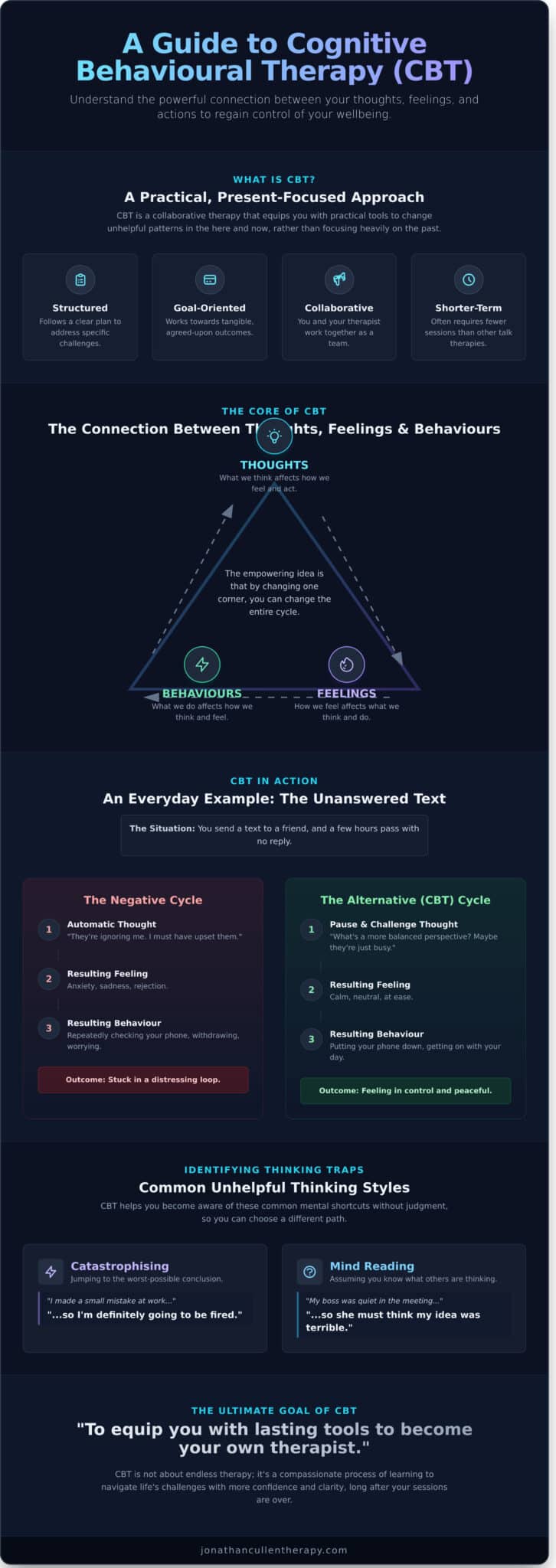
Have you ever noticed how two people can experience the same event but react in completely different ways? This simple observation is at the heart of Cognitive Behavioural Therapy. The central, empowering idea of CBT therapy is that it’s not external events that cause us distress, but rather the meaning we attach to them-the story we tell ourselves about what’s happening.
This powerful insight forms the basis of the core principles of CBT and is often visualised as a simple but profound model known as the CBT Triangle. Understanding this connection is often the first ‘aha!’ moment for people, as it shows us where we have the power to create change.
The CBT Triangle Explained
Imagine a triangle where each corner influences the others. When we get stuck in a difficult cycle, it’s often because these three elements are feeding into each other in an unhelpful way.
- Thought: The automatic thought or interpretation that pops into your head about a situation. It’s the story you tell yourself.
- Feeling: The emotion that arises directly from that thought, such as anxiety, sadness, or anger.
- Behaviour: The action you take based on that feeling, like avoiding a social event or withdrawing from a loved one.
The good news is that this cycle isn’t set in stone. By learning to change just one corner-for instance, by questioning an unhelpful thought-we can create a positive ripple effect across the entire system.
A Relatable, Everyday Example
Let’s make this more concrete. Consider this common situation: You send a text message to a friend, and a few hours pass with no reply.
The Negative Cycle: Your automatic thought might be, “They’re ignoring me; I must have upset them.” This thought leads to a feeling of anxiety and rejection. Your resulting behaviour might be to repeatedly check your phone or worry about what you did wrong.
An Alternative Cycle: By pausing, you could challenge that initial thought and consider a more balanced one: “They’re probably just busy at work.” This new thought leads to a feeling of calm. Your behaviour is then to put your phone down and get on with your day, feeling much more at ease.
Identifying Your Own Unhelpful Thinking Styles
We all fall into common thinking traps from time to time; it’s a normal part of being human. In CBT, the goal is to become aware of them without judgment. Here are a couple of examples:
- Catastrophising: Your mind jumps to the worst-possible conclusion. A small mistake at work leads to the thought, “I’m definitely going to be fired.”
- Mind Reading: Assuming you know what others are thinking, usually negatively. “My boss was quiet in the meeting, so she must think my idea was terrible.”
Recognising these patterns is the first, most compassionate step towards change. It allows us to gently question our automatic thoughts and choose a more helpful and realistic perspective.
What Does a CBT Session Actually Look Like?
Stepping into a therapist’s office for the first time can feel daunting. You might be wondering what to expect, what to say, or how it all works. The good news is that a CBT therapy session is designed to be a clear, collaborative, and supportive experience. Think of it less like a clinical appointment and more like a team meeting where you are the expert on your life, and I am here to offer guidance and practical tools. The environment is always warm, compassionate, and completely non-judgmental.
Each session is structured to make the most of our time together. We typically start with a brief check-in on your week before agreeing on an agenda. This ensures we focus on what feels most important to you right now, working together to explore challenges and build skills for a more fulfilling life.
Your First Few Sessions: Setting the Stage
The initial sessions are all about building a foundation of trust and understanding. This is a safe space for you to share your story and what brought you to therapy. We’ll gently explore the difficulties you’re facing, whether they relate to anxiety, depression, or other common challenges CBT can help with. Together, we will set clear, manageable goals for our journey, ensuring the process always honours your unique needs and moves at a pace that feels comfortable for you.
The Role of Practice Between Sessions
One of the most powerful parts of CBT happens outside our sessions. Rather than ‘homework’, we call it ‘practice’ or ‘real-world experiments’. This is your chance to try out the new skills and perspectives we discuss in your daily life. It’s a no-pressure activity designed to help you learn and see what works. This might involve:
- Keeping a simple thought diary to notice patterns.
- Trying a new, helpful behavioural response to a familiar trigger.
- Scheduling a small, enjoyable activity you’ve been avoiding.
Tools and Techniques You Might Learn
In our sessions, you’ll gain a toolkit of practical strategies to manage difficult thoughts and feelings. These are skills you can carry with you long after our work together is done. Some common techniques we might explore include:
- Thought Challenging: Learning to gently question automatic negative thoughts and find more balanced, helpful perspectives.
- Behavioural Activation: Taking small, meaningful steps to re-engage with activities that bring you joy and a sense of accomplishment.
- Exposure Therapy: A gentle and gradual process of facing fears in a safe, controlled way, helping to reduce their power over you.
Ready to see what a session feels like? Let’s connect.
Common Challenges CBT Can Help With
While often associated with specific diagnoses, the real strength of CBT therapy lies in its practical application to the common, human experiences we all face. It’s less about clinical labels and more about understanding the powerful connection between our thoughts, our feelings, and our actions. If you feel stuck in a pattern that is holding you back, this approach offers a supportive, structured way to find a new path forward.
Managing Overwhelming Anxiety and Worry
Does your mind often race with ‘what if’ scenarios, leaving you with a constant feeling of dread? Whether it’s the specific fear of social situations, the sudden rush of panic, or a general, persistent worry that clouds your day, anxiety can feel all-consuming. In our sessions, we can gently explore these anxious thoughts, learn to challenge their power, and develop grounded, calming techniques to help you feel more in control and at peace in your own body.
Lifting the Weight of Depression and Low Mood
Depression can feel like a heavy blanket, draining your energy, motivation, and interest in the things you once loved. It often comes with a harsh inner critic that reinforces feelings of hopelessness. CBT directly addresses this by helping you identify and reframe the negative self-talk that fuels depression. Together, we’ll focus on small, achievable actions that help you gradually rebuild momentum, rediscover joy, and reconnect with your life.
Changing Unhelpful Habits and Compulsions
Sometimes, we feel trapped by repetitive behaviours we can’t seem to control, from the cycles of OCD to patterns of procrastination or other unhealthy habits. These actions often provide temporary relief but create long-term distress. The framework of cbt therapy helps illuminate the entire cycle-the trigger, the thought, the feeling, and the compulsion-so you can understand it without judgment. From there, we work collaboratively to build new, healthier responses and break free from the loop.
If any of these challenges resonate with your own experience, please know you don’t have to face them alone. Exploring how therapy can support your unique journey is a powerful and compassionate step to take for yourself.
Is CBT Right For You? Finding the Best Path Forward
Choosing a therapeutic approach can feel like another overwhelming decision when you’re already struggling. It’s important to remember that therapy is not one-size-fits-all. The most effective path is one that resonates with your personality, your current challenges, and what you hope to achieve. The goal is to find a supportive space where you feel understood and empowered to move forward.
Who Benefits Most from CBT?
Cognitive Behavioural Therapy can be a wonderfully effective and grounding choice, particularly if you are someone who:
- Prefers a practical, hands-on approach. You want to leave sessions with clear strategies and tools you can apply in your daily life.
- Thrives with structure and clear goals. You appreciate a collaborative process focused on identifying specific problems and working towards measurable solutions.
- Wants to focus on the “here and now.” While your past is important, your primary goal is to manage current difficulties and change present-day patterns.
How CBT Fits into an Integrative Therapy Journey
While some people benefit from a purely structured course of CBT therapy, it’s often most powerful when its tools are integrated into a broader, more flexible approach. As an integrative therapist, I draw from different modalities to create a therapy that honours your unique story. Sometimes, understanding the roots of our present-day patterns requires us to compassionately explore past experiences. We might use CBT techniques to manage current anxiety while also gently looking at where that anxiety first began.
The aim is never to fit you into a rigid box, but to tailor the therapy to your individual needs. You don’t have to face this journey alone; together, we find what works for you.
Ultimately, you don’t need to have all the answers before you begin. A good therapeutic relationship starts with a conversation about your needs and goals. The right therapist will help you navigate these questions and co-create a path forward that feels right. If you’re ready to explore what a supportive, down-to-earth approach could look like, you can learn more about working with me.
Your Path Forward: Embracing Your Story
Understanding the connection between your thoughts, feelings, and behaviours is the first step towards meaningful change. As we’ve explored, cbt therapy offers a practical and collaborative framework for identifying and reshaping the patterns that may be holding you back, empowering you to navigate life’s challenges with greater clarity and confidence.
But real progress often begins when you feel truly seen and heard. My approach is warm, non-judgmental, and down-to-earth. As an integrative psychotherapist experienced in supporting clients with anxiety, ADHD, and life’s many challenges, I am here to create a compassionate space that honours your unique story and helps you find a path that feels right for you.
If you feel ready to explore your thoughts in a supportive space, I invite you to get in touch.
Remember, you don’t have to face this journey alone. Taking that first step can lead to a more grounded and fulfilling way of being.
Frequently Asked Questions About CBT Therapy
How many sessions of CBT will I need?
The number of sessions is a personal part of your journey and something we decide together. CBT is often a short-term therapy, with many people finding between 6 and 20 sessions helpful. However, your unique story and goals guide the process. We’ll work at a pace that feels comfortable and supportive for you, regularly checking in to ensure the therapy is meeting your needs and helping you move forward in a meaningful way.
What is the main difference between CBT and general counselling?
Think of it as two different paths to feeling better. General counselling often provides a supportive space to explore your feelings and past experiences more broadly. In contrast, cbt therapy is more structured and present-focused. It concentrates on identifying and changing specific unhelpful patterns of thinking and behaviour that are causing you difficulty right now. Both approaches are valuable, and the best one depends on what feels right for you and what you hope to achieve.
Can CBT help with trauma or PTSD?
Yes, a specific form called Trauma-Focused CBT (TF-CBT) is one of the most effective and recommended treatments for trauma and PTSD. This approach provides a safe, compassionate space to help you process traumatic memories and change the unhelpful thoughts connected to them. It’s a gentle, structured process that helps reduce the overwhelming feelings associated with trauma, allowing you to feel more grounded and in control of your life again. You don’t have to face it alone.
Is CBT an effective therapy for adults with ADHD?
Absolutely. While CBT doesn’t ‘cure’ ADHD, it offers incredibly practical tools to manage the daily challenges that often come with it. Together, we can work on strategies for procrastination, organisation, and managing overwhelming emotions. It’s about building a toolkit that works with your unique brain, not against it. This approach can help you build confidence and develop a more compassionate understanding of yourself, honouring the way you think and experience the world.
What are some simple CBT techniques I can try myself?
A simple yet powerful technique is ‘thought challenging’. When you notice a negative thought, gently ask yourself: “Is this 100% true? What’s a more balanced or compassionate way to see this?” Another is ‘behavioural activation’. If you’re feeling low, schedule one small, positive activity, like a short walk or listening to a favourite song. These small steps can be a gentle starting point for shifting your mood and perspective.
Do I need a formal diagnosis to benefit from CBT?
Not at all. You don’t need a formal diagnosis to benefit from CBT. If you’re feeling stuck, overwhelmed, or simply want to understand yourself better, that’s more than enough reason to seek support. Therapy honours your unique story and personal experience, not a label. The goal is to provide you with a supportive space and practical tools to navigate whatever challenges you’re facing, helping you feel more connected and grounded in your life.