
If you’re feeling overwhelmed, stuck, or simply wondering if there’s a better way to navigate life’s challenges, the idea of starting therapy may have crossed your mind. But that thought can often be followed by a wave of questions. You might be asking yourself if your problems are ‘bad enough’, feeling confused by all the different approaches, or feeling anxious about the process of finding someone to talk to. It’s a completely normal place to start, and you are not alone in feeling this way.
This guide was created to offer a warm, supportive hand and gently answer those questions. We will walk you through what therapy is in a simple, down-to-earth way, explore how this compassionate space can help you, and outline the first steps of your journey. Our hope is to replace any uncertainty with a sense of clarity and confidence, so you can feel empowered to find the support you deserve.
Key Takeaways
- Recognise the signs it might be time for support, even if you feel your problems aren’t “bad enough.”
- Understand what therapy truly is: a confidential, collaborative space for self-exploration and growth.
- Discover a few common therapeutic approaches to see which style might be the best fit for your unique needs.
- Get a clear, step-by-step plan to help you find a therapist in the UK and confidently book your first session.
What is Therapy, Really? More Than Just a Conversation
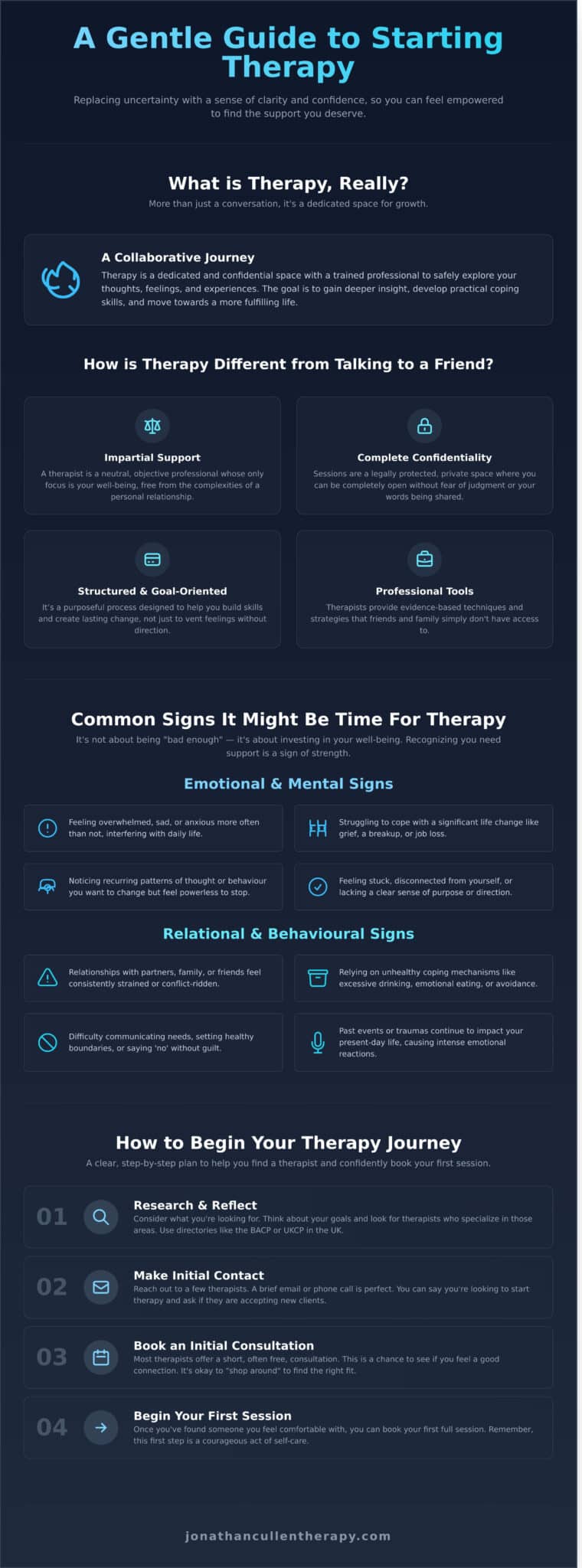
If you’re feeling overwhelmed or stuck, the idea of starting therapy can seem daunting. At its heart, Psychotherapy, often simply called therapy, is a dedicated and confidential space set aside just for you. It’s a collaborative journey with a trained professional, where you can safely explore your thoughts, feelings, and experiences. The goal isn’t just to talk, but to gain deeper insight, develop practical coping skills, and move towards a more connected and fulfilling life. It’s a powerful reminder that whatever you are going through, you don’t have to face it alone.
How is Therapy Different from Talking to a Friend?
While the support of friends and family is invaluable, professional therapy offers something fundamentally different. A friend listens, but a therapist is trained to listen in a way that helps you uncover patterns and see things from new perspectives. Key differences include:
- Impartial Support: A therapist is a neutral, objective professional whose only focus is your well-being, free from the complexities of a personal relationship.
- Complete Confidentiality: Sessions are a legally protected, private space where you can be completely open without fear of judgment or your words being shared.
- Structured and Goal-Oriented: It’s a purposeful process designed to help you build skills and create lasting change, not just vent.
- Professional Tools: Therapists provide evidence-based techniques and strategies that friends and family simply don’t have.
Creating a Safe and Non-Judgmental Space
The single most important part of successful therapy is the relationship you build with your therapist. Feeling safe, truly heard, and understood without judgment is the foundation of all healing. This is a space where all parts of you are welcome-the confident, the anxious, the messy, and the uncertain. Our work together honours your unique story and experiences, creating a grounded and compassionate environment where you can explore, grow, and reconnect with yourself.
Common Signs It Might Be Time to Consider Therapy
One of the most common barriers to seeking support is the feeling that our problems aren’t ‘bad enough’ for professional help. Many of us wait for a crisis point, believing we should be able to handle things on our own. But therapy isn’t just for moments of breakdown; it’s a powerful, proactive space for growth, self-understanding, and building a more fulfilling life. Recognising that you could use some support is not a sign of weakness-it’s a sign of profound strength and self-awareness. It’s about honouring your unique story and deciding you are ready to explore your next chapter in a more grounded, connected way.
Emotional and Mental Signs
Often, the first signs are internal. They can feel like a persistent, low-level hum of discomfort that affects your daily life and dulls your sense of joy. It’s not always a loud alarm bell, but rather a quiet, consistent feeling that something isn’t right. These feelings are valid and deserve a compassionate, non-judgmental space to be explored and understood.
- You feel overwhelmed, sad, or anxious more often than not, and it’s starting to interfere with your work, sleep, or relationships.
- You’re struggling to cope with a significant life change, such as grief, a breakup, or job loss, and feel you’re not moving forward.
- You notice recurring patterns of thought or behaviour you want to change but feel powerless to stop on your own.
- You feel stuck, disconnected from yourself, or lack a clear sense of purpose and direction in your life.
Relational and Behavioural Signs
Sometimes, the signs are more visible in how we interact with the world and the people around us. Our behaviours and relationships often act as a mirror, reflecting our internal state back to us. Exploring the ‘why’ behind these patterns is a key part of the collaborative process, and learning more about Understanding psychotherapy can help demystify how that journey of discovery works.
- Your relationships with partners, family, or friends feel consistently strained, conflict-ridden, or distant.
- You find yourself relying on unhealthy coping mechanisms-like excessive drinking, emotional eating, or avoidance-to manage stress.
- You have difficulty communicating your needs clearly, setting healthy boundaries, or saying ‘no’ without feeling guilty.
- Past events or traumas continue to impact your present-day life, showing up as flashbacks, avoidance, or intense emotional reactions.
If any of these signs resonate with you, please know that you don’t have to face them alone. Taking the first step is a courageous and positive decision to invest in your own well-being and create lasting change.
What Can Therapy Help With? Common Areas of Focus
People often seek support during a crisis, but the true value of therapy lies in its ability to support us through a wide range of life’s challenges. It provides a confidential, non-judgmental space to explore what’s on your mind, whether you’re feeling stuck, overwhelmed, or simply want to understand yourself better. The goal is not just to cope, but to grow. As The Jed Foundation explains in its helpful guide, What is Therapy and Will It Work?, the process is about gaining insight and developing new skills, no matter the specific issue.
While every person’s journey is unique, some common areas of focus include:
Managing Difficult Emotions and Experiences
If you’re finding it hard to manage intense feelings, you don’t have to face it alone. A compassionate therapeutic relationship can help you understand and process these experiences. Together, we can explore:
- Anxiety, stress, and panic attacks: Learning to understand triggers and develop grounded coping mechanisms to find calm.
- Depression and low mood: Gently challenging feelings of hopelessness and finding a path towards reconnection and meaning.
- Grief and loss: Honouring your unique grieving process in a supportive space, without a timeline or expectation.
- Trauma: Working safely to heal from past events so they no longer define your present.
Improving Relationships and Self-Esteem
Our connection with ourselves profoundly impacts our relationships with others. Therapy offers a space to strengthen both. This can involve:
- Relationship dynamics: Navigating challenges with partners, family, or friends to foster healthier connections.
- Self-worth and self-criticism: Building self-compassion and moving beyond negative self-talk.
- Identity and life transitions: Exploring who you are through career changes, parenthood, or other significant life shifts.
- Neurodivergence: Coping with the unique challenges of living with conditions like ADHD in a neurotypical world.
Personal Growth and Fulfilment
You don’t need to be at a low point to benefit from talking to a professional. Therapy is also a powerful tool for proactive personal development, helping you to live a more conscious and fulfilling life by:
- Developing healthier habits and coping strategies.
- Clarifying your personal values and life goals.
- Learning to live more authentically and mindfully.
Explore how individual therapy could support you.
Different Types of Therapy: Finding an Approach That Fits You
The world of mental health support can sometimes feel confusing, with many different names and acronyms. When you first start looking for help, you might wonder which type of therapy is right for you. The most important thing to remember is that you don’t need to be an expert. The goal is to find a supportive relationship and a way of working that feels comfortable and makes sense for your unique situation.
While there are many different models, most are designed to help you gain insight and develop new skills. To help demystify the process, here are a few common approaches explained in simple terms.
Common Therapeutic Approaches
- Cognitive Behavioural Therapy (CBT): This practical approach focuses on the here and now. It helps you explore the powerful connections between your thoughts, your feelings, and your actions. In CBT, you work to identify and challenge unhelpful thinking patterns or behaviours that may be keeping you stuck, allowing you to develop more balanced ways of coping.
- Psychodynamic Therapy: This approach involves a deeper exploration of your past to understand your present. It operates on the idea that our early life experiences and relationships shape our current feelings and behaviours, often in ways we aren’t fully aware of. It’s a journey to uncover and understand these unconscious patterns.
- Humanistic/Person-Centred Therapy: Rooted in empathy and acceptance, this approach sees you as the expert on your own life. The therapist provides a warm, non-judgmental, and supportive space for you to explore your feelings freely. The focus is on self-acceptance, personal growth, and helping you connect with your true self.
What is an Integrative Approach?
You are not a puzzle to be solved with a single key. An integrative therapist understands this and doesn’t stick rigidly to one single method. Instead, they thoughtfully blend elements from different therapeutic models to create a process that is tailored specifically to you and your needs.
This is not a ‘one-size-fits-all’ approach; it’s a flexible, holistic, and collaborative partnership that truly honours your unique story. It allows our work together to be grounded and down-to-earth, meeting you exactly where you are on your journey.
As an integrative psychotherapist, this is the compassionate and personalised approach I use in my practice. If you feel that this flexible way of working could be right for you, I invite you to learn more about how we can work together.
Your First Steps: How to Begin Your Therapy Journey
Deciding to start therapy is a significant and courageous step. It’s completely normal to feel a mix of hope and nervousness about what comes next, but this feeling is often a sign that you’re ready for meaningful change. To make the process feel less daunting, here is a simple guide to help you begin your journey with confidence and find the support that’s right for you.
Finding the Right Therapist
The connection you have with your therapist is the foundation of your work together. Finding a ‘good fit’-someone you feel comfortable and safe with-is the most important factor. As you search for a professional, it helps to:
- Check their credentials: Look for a therapist who is registered with a recognised professional body, such as the BACP or UKCP in the UK.
- Get a sense of their approach: Take time to read their website and professional profile. Does their way of working resonate with you?
- Consider the practicalities: Think about what works for your life. Do you prefer in-person sessions in a specific area, like North West London, or would the flexibility of online therapy be a better fit?
The Initial Consultation
Most therapists offer a free initial consultation, which is a brief, no-obligation call or meeting. This isn’t a full session, but rather a chance for you to ask questions and get a feel for the person. You can briefly explain what brings you to therapy and hear how they might work with you. Remember, this is a two-way street. You are interviewing them just as much as they are getting to know you, ensuring you feel it’s the right partnership for you.
What Happens in the First Session?
Your first full session is about building a foundation. It’s a dedicated space to start exploring your story, your history, and what you hope to achieve. Your therapist will guide the conversation, but there is never any pressure to share more than you feel ready to. The primary goal is to establish a safe, non-judgmental space where you can begin to feel understood and lay the groundwork for a supportive and trusting relationship.
Taking that first step can feel like the hardest part, but you don’t have to do it alone. Ready to take the first step? Book a free initial consultation.
Your Path Forward: Taking the First Step
Beginning this journey is a courageous decision to honour your own story. As we’ve explored, therapy is a collaborative, non-judgmental space designed for growth, not just a conversation. Understanding that there are many different approaches and that finding the right fit for you is the most important part of the process can empower you to move forward with confidence.
Remember, you don’t have to face this alone. As a Registered Member of the BACP, I offer a down-to-earth, integrative approach that honours your unique experience. With a special focus on anxiety, relationships, and ADHD-informed therapy, I provide a compassionate, supportive space for you to explore what’s on your mind.
If you feel ready to talk, I offer a warm, supportive space. Contact me to book a free consultation.
Taking that first step is a sign of strength, and a more connected, fulfilling life is possible.
Frequently Asked Questions
How much does therapy cost and can I afford it?
Understanding the cost is an important first step. In the UK, private therapy sessions typically range from £50 to £150, depending on the therapist’s experience and location. While this can feel like a significant investment in your wellbeing, there are also more affordable options. You can explore low-cost services offered by mental health charities or sessions with trainee therapists. It’s always worth discussing fees with a potential therapist, as some may offer a sliding scale.
Is everything I say in therapy confidential?
Yes, confidentiality is the foundation of a safe and trusting therapeutic relationship. Everything you share is kept private. The only exception is if there is a serious risk of harm to yourself or someone else, or in rare legal situations involving child protection or terrorism. In these circumstances, a therapist has a professional and ethical duty to break confidentiality, but they would almost always aim to discuss this with you first in a supportive way.
How long does therapy take to work?
The therapeutic journey is unique to each person, so there is no fixed timeline. Some people find that short-term therapy of 6-12 sessions is enough to work through a specific challenge. Others benefit from longer-term, open-ended work to explore deeper patterns and experiences. The goal isn’t to meet a deadline but to move at a pace that feels right for you. Together, we can regularly check in on your progress and goals along the way.
What’s the difference between counselling, psychotherapy, and psychology?
These terms can be confusing as they often overlap. Generally, counselling focuses on a specific current issue, like bereavement or stress, over a shorter period. Psychotherapy tends to be a longer-term process, exploring deeper, recurring patterns of feeling and behaviour. A psychologist has a degree in psychology and may offer therapy, but their title is legally protected. The most important factor is finding a qualified professional with whom you feel a genuine, supportive connection.
What if I don’t know what to talk about in a session?
This is a very common feeling, and it’s completely okay. There is no pressure to have everything figured out before you arrive. Sometimes the most powerful sessions begin with “I’m not sure what to say today.” A therapist is skilled at helping guide the conversation with gentle questions, and even silence can be a useful and reflective part of the process. Simply showing up is the most important step; the conversation will unfold from there.
Can I do therapy online, and is it as effective?
Yes, you absolutely can. Online therapy has become a popular and effective way to access support. Research shows that for many people, it is just as effective as in-person sessions. It offers great flexibility and convenience, allowing you to have sessions from the comfort of your own space. The most important thing is to choose the format that feels most comfortable and safe for you, whether that’s online or meeting face-to-face in a therapy room.