
Have you ever questioned if your struggles are ‘real’ ADHD simply because you don’t fit the classic image of someone who is constantly hyperactive? Perhaps you feel overwhelmed by a mind that never seems to switch off, but your challenges are more internal than external. This feeling is incredibly common, and it often stems from a misunderstanding of the different types of adhd. The world of neurodiversity can feel complex, and outdated terms only add to the confusion, leaving many adults feeling invalidated or unsure of where they belong.
This article offers a calm, down-to-earth guide. Together, we will gently explore the three official presentations of ADHD-Inattentive, Hyperactive-Impulsive, and Combined. Our goal is to move beyond complex medical definitions and towards clarity and validation. Recognising your own type can be the first, most compassionate step towards understanding your needs, finding effective support, and finally having the language to explain your unique story to others. You don’t have to face this journey alone.
Key Takeaways
- Discover why the common stereotype of hyperactivity doesn’t capture the full, nuanced picture of ADHD in adulthood.
- Understanding the three official types of adhd-Inattentive, Hyperactive-Impulsive, and Combined-can help you make sense of your unique experiences.
- Recognise the signs of ‘quiet’ ADHD, a presentation often characterised by internal distraction and frequently overlooked in adults.
- Learn how identifying your presentation is an act of self-care that can help you reframe past struggles with compassion and understanding.
Beyond the Stereotype: Understanding ADHD ‘Presentations’ in Adults
When you hear ‘ADHD’, what comes to mind? For many, it’s a picture of a young boy bouncing off the walls, unable to sit still in class. While that can be one experience of ADHD, it’s a very small part of a much larger, more compassionate, and nuanced picture, especially when it comes to adults. Understanding the main types of adhd is the first step toward clarity and self-compassion.
To better reflect this complexity, clinicians and diagnostic manuals now use the term ‘presentations’. These aren’t separate, rigid disorders, but rather different ways the core challenges of ADHD can manifest. It’s a more helpful and down-to-earth approach because it acknowledges that your experience is unique and can even shift and change throughout your life journey.
Why ‘Presentations’ is a More Helpful Term Than ‘Types’
Thinking in terms of ‘presentations’ rather than fixed ‘types’ is a profoundly validating shift. This language honours your unique story by recognising that your symptoms are not static. They can evolve with age, new responsibilities, or different support systems. This approach avoids the feeling of being put into a rigid, unchangeable box and instead reflects the true, fluid nature of the ADHD experience.
The Core Challenges: Inattention, Hyperactivity, and Impulsivity
All presentations of Attention deficit hyperactivity disorder are built on a unique combination of three core areas of difficulty. Recognising how they show up for you is key to understanding your personal experience.
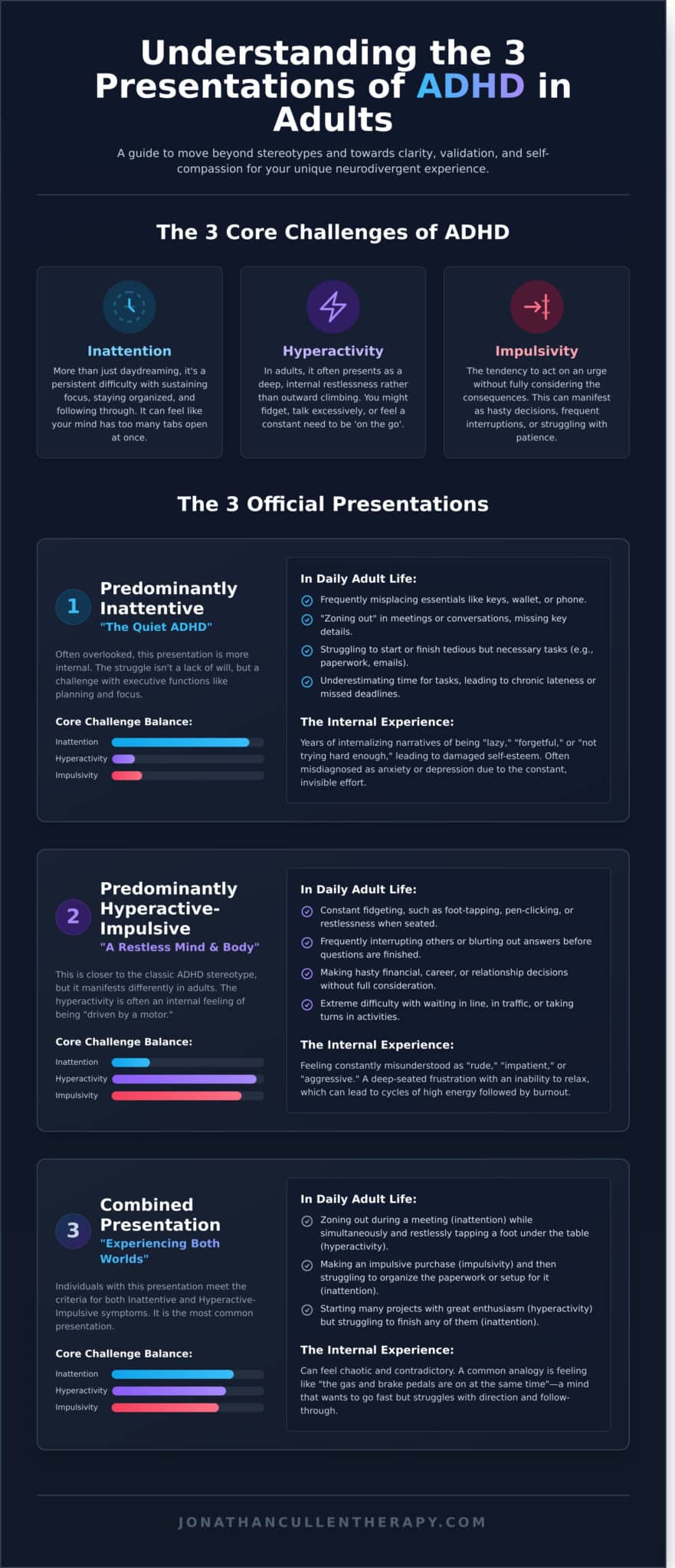
- Inattention: This goes far beyond simple daydreaming. It’s a persistent difficulty with sustaining focus, staying organised, remembering appointments, and following through on tasks. It can feel like your mind has too many tabs open at once, making even simple projects feel overwhelming.
- Hyperactivity: In adults, this rarely looks like the childhood stereotype. Instead of running and climbing, it often presents as a deep, internal feeling of restlessness. You might find yourself fidgeting constantly, talking excessively, or feeling an unshakable need to be busy or ‘on the go’.
- Impulsivity: This is the tendency to act on an urge without fully considering the potential consequences. It can manifest as making hasty financial decisions, frequently interrupting others in conversation, or struggling with patience in everyday situations.
Predominantly Inattentive Presentation: The Quiet ADHD
When many people think of ADHD, they picture constant motion and outward disruption. However, one of the main types of adhd is far more internal and often goes unnoticed for years. This is the Predominantly Inattentive presentation, sometimes remembered by the older, now outdated term ‘ADD’. Because its symptoms are less disruptive to others, it’s frequently missed during childhood and is diagnosed much later in life, particularly in women.
Instead of struggling with hyperactivity, adults with this presentation face a persistent internal battle with distraction, focus, and follow-through. It’s a quiet, often invisible challenge rooted in difficulties with executive functions-the mental skills we use for planning, organising, and managing our time and attention.
What Inattentive ADHD Looks Like in Daily Adult Life
The day-to-day experience can feel like you’re constantly fighting to keep your head above water. While this looks different for everyone, some common patterns include:
- Frequently misplacing essential items like your keys, wallet, or phone, often finding them in strange places.
- “Zoning out” during conversations, long work meetings, or even while reading, only to realise you’ve missed important details.
- Struggling to start or finish tedious but necessary tasks, such as filling out paperwork, responding to emails, or completing household chores.
- Consistently underestimating how long a project will take, leading to rushed work, chronic lateness, and missed deadlines.
The Internal Experience and Common Misunderstandings
Perhaps the most challenging part of inattentive ADHD is the internal toll it takes. For years, you may have believed you were simply lazy, forgetful, or not trying hard enough. This internalised narrative can be incredibly damaging to your self-esteem. Because the struggle is so quiet, it’s often misdiagnosed as anxiety or depression, as the constant effort and perceived failures can lead to these conditions. Getting the right diagnosis is crucial, and you can find authoritative information on ADHD from sources like the National Institute of Mental Health to better understand the symptoms.
It’s the profound frustration of knowing exactly what you need to do but feeling a mental block that makes it impossible to start. This isn’t a lack of willpower; it’s a very real neurodevelopmental difference. Recognising the various types of adhd, including this inattentive presentation, is the first, compassionate step towards finding strategies that truly work for you.
Predominantly Hyperactive-Impulsive Presentation: A Restless Mind and Body
When most people think of ADHD, this is often the presentation that comes to mind-the classic image of someone who is always on the move and acts on impulse. While this is one of the main types of adhd, the way it appears in adults can be quite different from how it shows up in childhood. The boundless, overt physical energy of a child often evolves into a persistent feeling of internal restlessness in adulthood.
For adults, hyperactivity isn’t always about running and climbing. It’s more like an engine that’s always running, a mind that won’t quieten down. Impulsivity remains a core challenge, affecting everything from conversations to major life choices. Of all the three types of ADHD, the hyperactive-impulsive presentation is perhaps the most outwardly visible, yet it is still deeply misunderstood in adults, who may be seen as simply “energetic” or “impatient” rather than experiencing a neurodevelopmental condition.
How Hyperactivity and Impulsivity Show Up in Adults
If you experience this presentation of ADHD, you might feel a constant need to be doing something. This isn’t just a preference for being busy; it can feel like a genuine inability to switch off. This internal and external restlessness can show up in many ways:
- An intense feeling of being “on the go” or an inability to relax, even during quiet moments.
- Constant fidgeting, such as tapping your feet, clicking a pen, or doodling during meetings.
- A tendency to interrupt others, finish their sentences, or speak out of turn without meaning to be rude.
- Making hasty decisions, from impulsive online purchases to sudden changes in career, relationships, or travel plans.
Navigating Social and Professional Challenges
Living with this constant inner motor can create significant hurdles in daily life. In social situations, you may worry about being perceived as impatient, rude, or overly talkative. At work, jobs that require long periods of sedentary, focused attention can feel almost impossible to endure, leading to frustration and underperformance.
The impact of impulsivity can also be profound, leading to financial strain from unplanned spending or instability in relationships due to sudden decisions. It can be exhausting to feel like you’re constantly fighting your own brain’s need for stimulation. However, understanding these patterns is the first step toward managing them. Therapy can help you develop strategies to manage these challenges.
Combined Presentation: Experiencing Both Worlds
When exploring the different types of adhd, many people find they don’t fit neatly into one box. The Combined Presentation is diagnosed when you meet the symptom criteria for both the Inattentive and Hyperactive-Impulsive presentations. This is, in fact, the most common way ADHD shows up in the general population.
Living with this presentation can feel like having a brain that is simultaneously ‘revved up’ with boundless energy and ideas, yet also ‘zoned out’ and struggling to hold onto a single thought. The intensity of these symptoms often fluctuates. Some days might feel overwhelmingly inattentive and slow, while others are driven by a restless, hyperactive energy that is difficult to contain.
A Day in the Life with Combined ADHD
Imagine starting your morning with a brilliant idea for a new project, diving in with intense focus and excitement. An hour later, a notification pulls your attention away. You feel a sudden restlessness and a need to get up and move. After a break, you return to your desk, but the thread is lost. The original task now feels overwhelming, joining a growing collection of unfinished projects and sparking a familiar cycle of frustration.
The Unique Complexity of the Combined Experience
Navigating Combined ADHD means managing two distinct sets of challenges that can often feel contradictory. This internal push-and-pull can be confusing not only for you but also for those around you, leading to feelings of being misunderstood. Finding peace requires compassionate strategies that honour both sides of your experience-the vibrant innovator and the quiet dreamer. It’s about learning to work with your unique brain, not against it.
Understanding this complexity is the first step on a journey towards compassionate self-management. If this experience resonates with you, know that you don’t have to face it alone.
Why Understanding Your ADHD Presentation Is a Form of Self-Care
Learning about the different types of adhd is more than just collecting information; it’s a profound act of self-care. For many adults, a diagnosis is the first time they receive a framework that explains a lifetime of experiences. The persistent feeling of being “lazy,” “disorganised,” or “too much” can finally be replaced with understanding and self-compassion. This knowledge isn’t an excuse, but an explanation-a compassionate guide to how your unique brain operates.
With this understanding, you can look back at past struggles not as personal failures, but as the symptoms of a neurotype that wasn’t being supported. It empowers you to stop fighting against your brain and start working with it. This is the foundation for advocating for your needs, whether that means asking for instructions in writing at work, explaining your need for quiet time to a partner, or setting up your home environment to support your focus.
Finding the Right Support for Your Brain
Once you understand your specific presentation, you can seek out strategies that are genuinely effective for you. Generic advice often falls short because the challenges faced by each of the main types of ADHD can be quite different. Therapy can be tailored to honour your unique story and needs:
- Predominantly Inattentive Presentation: Support may focus on building robust routines, developing organisational systems that stick, and learning techniques to manage distractions and sustain focus.
- Predominantly Hyperactive-Impulsive Presentation: We might work together on strategies for emotional regulation, managing impulsivity through mindfulness, and finding healthy outlets for excess energy.
You Are More Than Your Diagnosis
It’s crucial to remember that these labels are descriptions of challenges, not a definition of who you are. Your ADHD is just one part of your identity. Many people with ADHD also possess incredible strengths, such as boundless creativity, the ability to think outside the box, and a contagious passion for their interests.
Living a connected and fulfilling life with ADHD is entirely possible. It is a journey of understanding, acceptance, and finding the right tools to help you thrive. You don’t have to navigate this path alone. If you’re ready to explore how to work with your brain in a more compassionate way, you can learn more about a supportive, down-to-earth approach to therapy at jonathancullentherapy.com.
Understanding Your ADHD: Your Path to Clarity and Support
Navigating the world of ADHD begins with understanding that it’s not a one-size-fits-all experience. As we’ve explored, the condition manifests differently across its three main presentations. Recognising which of these types of adhd resonates most with your own life is more than just applying a label; it’s a profound act of self-care. This clarity allows you to move past stereotypes and begin developing compassionate, effective strategies tailored to how your brain truly works.
If this has felt like a moment of recognition, you don’t have to figure out the next steps by yourself. As a down-to-earth, neurodivergent therapist, I offer a warm, non-judgmental space to explore your unique mind. Together, we can find ADHD-informed support that is tailored to your specific challenges and celebrates your strengths.
Frequently Asked Questions About Adult ADHD
What is the difference between ADD and ADHD?
This is a common point of confusion, and it’s understandable why. ‘ADD’ (Attention Deficit Disorder) is an outdated term that was once used for what we now call ADHD, Predominantly Inattentive Presentation. The medical community now recognises that all presentations are forms of ADHD. So, whether you experience hyperactivity or not, the correct clinical term is ADHD, which encompasses a wider understanding of the condition and its various expressions.
Can my ADHD presentation change as I get older?
Yes, it’s very common for your experience of ADHD to evolve throughout your life. For many adults, the visible, external hyperactivity seen in childhood can lessen or change into a feeling of internal restlessness or mental busyness. Life changes, new responsibilities, and developing coping strategies can all influence which symptoms feel most prominent. Your journey with ADHD is unique, and it’s okay for it to shift over time.
How are the different types of ADHD diagnosed in adults?
In the UK, the diagnostic journey usually begins with a conversation with your GP. They can refer you to a specialist NHS service for a comprehensive assessment. Alternatively, you can seek a private assessment from a qualified psychiatrist or clinical psychologist. The assessment involves detailed interviews, questionnaires, and a review of your personal history to understand how your symptoms affect you. This helps determine which of the main types of ADHD best describes your experience.
Does ADHD present differently in women and men?
ADHD can indeed look very different depending on your gender, often due to societal expectations. Women are more frequently diagnosed with the inattentive presentation and may become skilled at ‘masking’ their symptoms to fit in. This can lead to their struggles being overlooked or misdiagnosed as anxiety. Men are more often diagnosed with the hyperactive-impulsive type, as these behaviours tend to be more externally visible and align with traditional stereotypes.
Is one type of ADHD considered more ‘severe’ than the others?
No single type is inherently more ‘severe’. The level of challenge an individual faces depends on their unique circumstances, support systems, and the demands of their environment. Someone with inattentive ADHD might struggle intensely in an academic setting, while someone with hyperactive-impulsive ADHD may find a structured office job difficult. Severity is personal, and finding compassionate, non-judgmental support is key, regardless of the type.
Can you have symptoms of all three ADHD types?
Yes, absolutely. In fact, experiencing a significant number of both inattentive and hyperactive-impulsive symptoms is very common. This is officially known as ADHD, Combined Presentation, and it is one of the three main types of ADHD. If you feel you don’t fit neatly into just one box, you are not alone. Many adults find their experience is a blend of symptoms from across the spectrum.